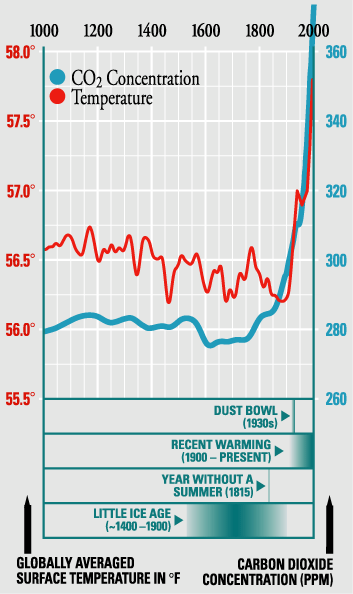
"From 1650 to 1710, temperatures across much of the Northern Hemisphere plunged when the Sun entered a quiet phase now called the Maunder Minimum."...
...
If energy from the Sun decreased only slightly, why did temperatures drop so severely in the Northern Hemisphere? Climate scientist Drew Shindell and colleagues at the NASA Goddard Institute for Space Studies tackled that question by combining temperature records gleaned from tree rings, ice cores, corals, and the few measurements recorded in the historical record, with an advanced computer model of the Earth’s climate. The group first calculated the amount of energy coming from the Sun during the Maunder Minimum and entered the information into a general circulation model. The model is a mathematical representation of the way various Earth systems—ocean surface temperatures, different layers of the atmosphere, energy reflected and absorbed from land, and so forth—interact to produce the climate.
When the model started with the decreased solar energy and returned temperatures that matched the paleoclimate record, Shindell and his colleagues knew that the model was showing how the Maunder Minimum could have caused the extreme drop in temperatures. The model showed that the drop in temperature was related to ozone in the stratosphere, the layer of the atmosphere that is between 10 and 50 kilometers from the Earth’s surface. Ozone is created when high-energy ultraviolet light from the Sun interacts with oxygen. During the Maunder Minimum, the Sun emitted less strong ultraviolet light, and so less ozone formed. The decrease in ozone affected planetary waves, the giant wiggles in the jet stream that we are used to seeing on television weather reports....
http://earthobservatory.nasa.gov/IOTD/view.php?id=7122
...
If energy from the Sun decreased only slightly, why did temperatures drop so severely in the Northern Hemisphere? Climate scientist Drew Shindell and colleagues at the NASA Goddard Institute for Space Studies tackled that question by combining temperature records gleaned from tree rings, ice cores, corals, and the few measurements recorded in the historical record, with an advanced computer model of the Earth’s climate. The group first calculated the amount of energy coming from the Sun during the Maunder Minimum and entered the information into a general circulation model. The model is a mathematical representation of the way various Earth systems—ocean surface temperatures, different layers of the atmosphere, energy reflected and absorbed from land, and so forth—interact to produce the climate.
When the model started with the decreased solar energy and returned temperatures that matched the paleoclimate record, Shindell and his colleagues knew that the model was showing how the Maunder Minimum could have caused the extreme drop in temperatures. The model showed that the drop in temperature was related to ozone in the stratosphere, the layer of the atmosphere that is between 10 and 50 kilometers from the Earth’s surface. Ozone is created when high-energy ultraviolet light from the Sun interacts with oxygen. During the Maunder Minimum, the Sun emitted less strong ultraviolet light, and so less ozone formed. The decrease in ozone affected planetary waves, the giant wiggles in the jet stream that we are used to seeing on television weather reports....
http://earthobservatory.nasa.gov/IOTD/view.php?id=7122