Making JH' SCT and all his material alive

Forgive me if you already told me that it's not a thing to do. Did you mention it already ? I am not sure of it. I did not know there was a fixed start for the 81 bars. I thought the start was when volume is providing suficient liquidity.

Apparently, yes you already mentionned it. I don't know where nor when, but I trust you.

View attachment 188203


As I said previously, I do not understand the concept of degapping.

The threads that you have posted in the beginning of your thread all contain the concept of degapping. This is what Jack says about it.


Do you mean here to just identify the price case formed by the last bar (closing RTH of the previous day) and the first one (opening RTH of the next day) ? In other way, do you mean we're to "stick" the last bar of the previous day to the first one of the next day, and act like of all the bars between those two did not exist, or also like if they formed just one ?Is this what degap mean?

Yes. The close of the previous bar and all geometrical relationships are moved so when the close of the prior bar is equal to the open of the current bar with the previous day's ending context is intact. This also means if the prior day's last bar was within a lateral, the lateral context gets carried over. Same with TL's, BM's and channels.


View attachment 188205

Anyway I could not answer that question.

Even with your explanation, I don't understand what is WCB.

You are not using your glossary. WCB has been defined before and can easily be found by searching.


As your question begins by "When", I'd say "when a non dominant trend ends".

If true, then that implies the ending of one trend is the beginning of another. We can annotate a trend as a sequence of events that repeat alternatively.

Dominance and non-Dominance cycling through failure to continue at a point also simultaneously successful at change.

Trends are composed of three moves. The 1st and 3rd move are in the same direction. Moves are in alternate directions.


M1 originates in the prior trend with price moving from pt1 to pt2. As pt2 is always outside the prior trend, then price must have XO'd the established RTL.

M2 sees price migrate from pt2 to pt3 of (with pt3 occurring) the newly defined channel.

M3 is within the channel from pt3 to ve/ftt.


The ftt is the failure of trend to traverse. Since failure is another view of a new beginning, it's also pt1 of the new trend. This price move from pt1 to pt2 of price is a reversal move from the prior trend.


The first RTL is the horizontal BM placed at P1. This is the assigned P1 of volume. This comes into existence with one bar. This RTL then increases in slope as a pt3 of price is established above the BM with successive bars. The BM establishes the long and short context from this assigned horizontal line.


One is assigned at the start of a trend segment. If a trend doesn't end earlier by an EE, it will ultimately end by price XO of the RTL which itself is an EE.


In one type of trend, as a measurable bar2 price is continuing - volume forms a T1.

The T1 is the non-Dom move of the prior trend. This is the end of trend overlap. This is seen primarily at the tape/traverse level.

Now with increasing volume, price continues to XO the RTL to form a pt2 of a new trend.


With an increasing peak from T1, the volume element is P2.


Let's continue with the distillation of the 10x10 cases. As you examine all the cases that three bars can go through, the piles can be distinguished by those with waits for bar2 and those without. In this example Bar1 is P1. P1 sets a BM.

Bar2 is a SYM. As a SYM it's a wait. The bar is not measurable. It is still informative by not being measurable. It can assist in temporary TL's. The bar prior sets the boundaries of the forming lateral currently at the formation SYM. It's not a lateral yet, it's an internal. Internals are not measurable. The only exception is to use larger volume. There is a column on the log - UL.


Only if this bar had closed XB or XR it would there be permission to measure volume.


StR and StB are a special case of internal. It depends on the close if it's measurable or not.

OB's have their own set.

When coming across an OB in the VTP, one simply divides the row into two rows and starts at the top row with the SOP. Then next is triggered automatically and goes to the subrow to advance the OOE. If there was no failsafe in the top subrow of the OB then P1 is assigned on the next bar. Otherwise, P1 assigned on the OB.

Comments within quoted text.
 
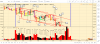
Here is the beginning of the Log of the window appearing on the first chart I joined in my prior message.
I have not my camera with me now, so I can't post my log sheet, therefore I post the screenshot with volume points and turns appearing only.

View attachment 188207

At bar 4, issues begin.

Here follows what I say in my mind, maybe this will help you to help me, by locating where I start failing.

bar 1 -> it's an OB. I still don't get it as for loging OB.

When coming across on OB, make that row two rows. Do the VTP as usual for the top row, and then advance to next on the subsequent row. Jack on OB.


bar 2 -> XB, I assign P1 on that bar cause it crosses the thin red RTL I arbitrary drew just before the beginning of RTH.

Ok, this thin arbitrary line should be the ending trend of the previous day. One copies and pastes previous day's endings to current day's beginnings to understand this relationship clearer.
The P1 assignment is correct in that it's a BO bar extending and closing past the high of the previous bar. But not from the arbitrary red line. The P1 assignment gets a BM.


bar 3 -> Stitch Red (SR). No trendline on that price case crosses the previous one (or better said, no COUNTER trendline appear), so I advance to the next cell on my log : the volume bar is under the prior one : T1.

BM,Rev because of the above. This gets an assigned P1. BM at it's high.


bar 4 -> XR. This time the TL established by the XR price case, does cross the prior RTL. Is it a new P1 assigned because of a BO,T1 ? Is it at least BO,T1 ? Cause I see volume under the prior bar, so as I labelled it I'd see a T1.

If there's a T1 in the trend there is, when there's not, there's not. This is a pt3 short from the previous BO bar pt1.


bar 5 -> SYM with a UL. Another problem here, how to log a SYM ? There's also (like on any OB for example) two opposite trendlines.So OF COURSE, one of them is breaking through the prior one established by the XR. So another BO,T1 cause now volume is higher ?

A SYM is a wait unless it's a UL or a failsafe. Then it's measurable. This is a T1. The next bar, XO the rtl established by this bar.


That is the problem I have, I don't know on the Log, what is to be watched FIRST to decide of the Event. The volume bar or the price bar ?

All volume starts as a trough. The price bar is what gives permission. One must get permission to measure. If there is no permission to measure all that there is to do is wait and get permission to measure.

This permission to measure operates independently from Failsafes. Failsafes are always operational in the background.


I see it now like if when a BO,T1 appears on price, then it's a P1 assigned, nothing more nothing less. When there's no BO,T1, then we can only focus on the volume bars.

I wish I could by what I say, expose in a clearer way what I miss so you could see it more easily, and you could help me to see what I do not.

Comments within quoted text.
 
Last edited:
Here's a flowchart that'll help,...

Start at Reset.

Along the bottom is the time axis.

Permit to Measure is a state of being influence by both price cases and volume elements. It's fluctuates intrabar during now (n) until lock-in prior to eob.


VTP page1.jpg


Then through the Hypothesis Set of the Parametric Measure, a check for repeat, rev chron is performed to assign the bar using the volume elements definitions with a logic circuit.

Let's use P1.
P1 is the first point of an extreme. The extreme is a starting point, a beginning of trend. It's the start of a window that creates a context independent of past up to this bar. Since it is the start of a window, it’s also at the ending of the prior window. We start by assigning the P1 where there is BO of the previous trend's RTL.

Then the VTP continues until an EE occurs.

What supports the effort is having a visual catalog of bar formations that consist of the various bands and failsafe EE's.

You just have to sit and think through the various sheets that Jack gave out and repeat the information to yourself and form your preliminary understanding of each EE. This gets refined in practice and debriefing the day. You'll end up with two charts, the live one and the debriefed one.
You’ll notice how ID’s that change cause a cascading effect. This lessens in frequency as the the more accurate EE is identified in iterative refinement.

One of the standards you can use is the idea of receiving the full offer of the market. Look from this space. It will inform

This works like clockwork, it's precise and provides a lot of clarity but it's only through your own thinking through the various concepts and assimilating them.


VTP page2.jpg
 
@Sprout, your last 3 messages are helping me. I post my last attempt on doing the VTP. I still have problems with my camera that makes me unable to take pics of my VTP done on a paper sheet. So I do what I can for the now, in other words label each volume point according to my comprehension of the stuff i'm on currently, on the chart.

Jack's message on OB did not help me in any way, unfortunately.

Putting all the pieces together on that stuff reveals itself to me as the most insane thing I've ever put myself in. On days like today, I feel madness is very close.

BUT

As I have no choice but accomplishing what is to be done in that stuff to get what I want, I'm still in.
 

Attachments

  • new VTP attempt.png
    new VTP attempt.png
    105.7 KB · Views: 47
I hope you guys are experiencing nice moments and profitability.

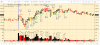
Here is my most recent attempt on labeling volume bars according to the VTP.
 

Attachments

  • VTP on chart.png
    VTP on chart.png
    87.3 KB · Views: 51
I hope you guys are experiencing nice moments and profitability.

Here is my most recent attempt on labeling volume bars according to the VTP.


Ok, you are successfully making the shift from annotating tapes/traverses/channels and simplifying to use a single rtl for trend segments.
You also have a developed a baseline reference for turns.

Some next steps:
1) use the templates in tradingview to create a library of annotations. Start with the text tool and the goal is to make a template for each of the 56 elements of rdbms. Not all at once, just as you need them. The first is for the two failsafes - a text box like you have turns currently.
Start adding the failsafes when you see them. Also have a blank text box to identify turns that you see in the chart but where you do not know what the EE would be.
EE’s are ends of trend segments. Three trend segments define a normative trend - Dom to non-Dom to Dom.

Volume annotations are to be placed in your volume pane.
The templates expand to include PP!’s, A band, C-K bands.


2) Create a tool for yourself to identify all the PP!’s as a one pager. I’ve posted what I’ve used in the past, this will continually be refined as your understanding of them grows. Put this in the appropriate tab of your RDBMS 1/2” binder. The binder that contains the ‘11 sheets’ mentioned in previous posts. This binder has the Modrian table on the front outside cover and the move reversal table on the back outside cover. You’ll make one pagers for the other subsets of the EE’s. In other words draw each EE as a pattern. Put as a set by bands in a one-pager makes ID simpler during RTH. Additionally, doing them individually on index cards will support understanding the Modrian table.


3) How you are currently annotating the turns has built a baseline reference of the market’s basic granularity. You succeeded at this. Put this on hold for now.
Ultimately, the turns get associated with EE’s but first the thing to do is get comfortable in identifying all the EE’s.
Having done the intermediate step that you did will make this next part easier.


3) Draw “the pattern”. Do it from memory. Draw a cycle. A cycle is composed of two failed trends. Start with the price pane.
Label the points, label zones, label as much as you can where you can of what you know. Add a volume pane.
Do it the other way. Start with a volume pane. If volume made these bars what must price do?

Keep up the good work!
 
Last edited:
@WchPl : As you are working on this material, are you actively referencing and have you purposefully worked through every post on this thread: https://www.elitetrader.com/et/threads/sctlearning-from-scratch.282221/
Sprout has generously provided alot of material and explanations in his last posts as well, both here and elsewhere on ET. As a suggestion, I think it'll be helpful to actively work through the mentioned resources above together with your initiative here.
Sometimes a revisit to something read long ago is also helpful to shed new light and stringing the concepts to work together. As I'm working through the same material, I see all the different parts has to fit together, and thought I'd mention it.
 
Back
Top