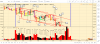
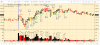
Forgive me if you already told me that it's not a thing to do. Did you mention it already ? I am not sure of it. I did not know there was a fixed start for the 81 bars. I thought the start was when volume is providing suficient liquidity.
Apparently, yes you already mentionned it. I don't know where nor when, but I trust you.
View attachment 188203
As I said previously, I do not understand the concept of degapping.
The threads that you have posted in the beginning of your thread all contain the concept of degapping. This is what Jack says about it.
Do you mean here to just identify the price case formed by the last bar (closing RTH of the previous day) and the first one (opening RTH of the next day) ? In other way, do you mean we're to "stick" the last bar of the previous day to the first one of the next day, and act like of all the bars between those two did not exist, or also like if they formed just one ?Is this what degap mean?
Yes. The close of the previous bar and all geometrical relationships are moved so when the close of the prior bar is equal to the open of the current bar with the previous day's ending context is intact. This also means if the prior day's last bar was within a lateral, the lateral context gets carried over. Same with TL's, BM's and channels.
View attachment 188205
Anyway I could not answer that question.
Even with your explanation, I don't understand what is WCB.
You are not using your glossary. WCB has been defined before and can easily be found by searching.
As your question begins by "When", I'd say "when a non dominant trend ends".
If true, then that implies the ending of one trend is the beginning of another. We can annotate a trend as a sequence of events that repeat alternatively.
Dominance and non-Dominance cycling through failure to continue at a point also simultaneously successful at change.
Trends are composed of three moves. The 1st and 3rd move are in the same direction. Moves are in alternate directions.
M1 originates in the prior trend with price moving from pt1 to pt2. As pt2 is always outside the prior trend, then price must have XO'd the established RTL.
M2 sees price migrate from pt2 to pt3 of (with pt3 occurring) the newly defined channel.
M3 is within the channel from pt3 to ve/ftt.
The ftt is the failure of trend to traverse. Since failure is another view of a new beginning, it's also pt1 of the new trend. This price move from pt1 to pt2 of price is a reversal move from the prior trend.
The first RTL is the horizontal BM placed at P1. This is the assigned P1 of volume. This comes into existence with one bar. This RTL then increases in slope as a pt3 of price is established above the BM with successive bars. The BM establishes the long and short context from this assigned horizontal line.
One is assigned at the start of a trend segment. If a trend doesn't end earlier by an EE, it will ultimately end by price XO of the RTL which itself is an EE.
In one type of trend, as a measurable bar2 price is continuing - volume forms a T1.
The T1 is the non-Dom move of the prior trend. This is the end of trend overlap. This is seen primarily at the tape/traverse level.
Now with increasing volume, price continues to XO the RTL to form a pt2 of a new trend.
With an increasing peak from T1, the volume element is P2.
Let's continue with the distillation of the 10x10 cases. As you examine all the cases that three bars can go through, the piles can be distinguished by those with waits for bar2 and those without. In this example Bar1 is P1. P1 sets a BM.
Bar2 is a SYM. As a SYM it's a wait. The bar is not measurable. It is still informative by not being measurable. It can assist in temporary TL's. The bar prior sets the boundaries of the forming lateral currently at the formation SYM. It's not a lateral yet, it's an internal. Internals are not measurable. The only exception is to use larger volume. There is a column on the log - UL.
Only if this bar had closed XB or XR it would there be permission to measure volume.
StR and StB are a special case of internal. It depends on the close if it's measurable or not.
OB's have their own set.
When coming across an OB in the VTP, one simply divides the row into two rows and starts at the top row with the SOP. Then next is triggered automatically and goes to the subrow to advance the OOE. If there was no failsafe in the top subrow of the OB then P1 is assigned on the next bar. Otherwise, P1 assigned on the OB.
Comments within quoted text.