The Limits of 'Made in America' Economics

How would the US manufacturers handle packaging materials in the future if MIA will be proceeded well???

imo, just packaging materials alone would produce serious supply-chain problems in the US.


July 27 2017

http://www.theage.com.au/business/m...s-industry-hits-dead-end-20170725-gxi8af.html

Grant Musgrove, chief executive of the Australian Council of Recycling, said China was now making new plastic at a much cheaper price than recyclers could offer.

"There is an oversupply of materials in the world globally, principally driven by China. China has massive excess capacity in material streams and massive stockpiles of their own," Mr Musgrove said.

"Just take plastics: prices have gone from $200 a tonne down to between $10 and $20 a tonne. Paper is similar, it's also collapsed."
 
please explain.
See what JackRab said and then look at this https://www.tradingview.com/chart/BUND/ctRW1IQo-Correlation-between-Bunds-Dax-and-Euro/
This is because there are a lot of exporters in the DAX30 who can export more crap when currency is cheaper.
The euro is the greatest trade heist of the century, in favor of germany. if the DM was still around fundamental trade balance situation would have it way stronger than the EUR but by bolting themselves to a bunch of much weaker (trade wise) countries they get to use a much weaker currency than they would otherwise. The issue is these dipshits don't share the wealth so they just screw everyone else. the sole best argument of euro exits is the benefit of having your own central bank. and of course it only applies to weaker (again in trade) countries. as Varoufakis said, just how many oranges does it take to compensate one mercedes ?
 
Some countries are already advocating paying people NOT to work.
Artists and drop outs can do their own thing ?
 
Some countries are already advocating paying people NOT to work.
Artists and drop outs can do their own thing ?

males from the millennials generation have already figured it out. they live with their parents rent free plus even with a favorable outcome, playing video games for hours is more enjoyable than listening to a woman for hours at end.
 
If Dump goes ahead with tariffs on foreign goods the prices of home made fridges, TVs, computers, autos etc will double for lack of competition.
 
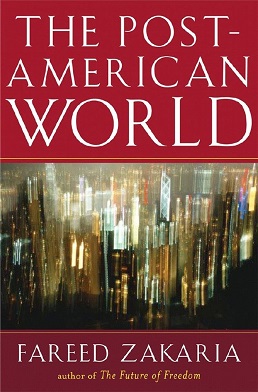
ZakariaFareed-PostAmericanWorld.jpg


https://en.wikipedia.org/wiki/The_Post-American_World

Synopsis
The content is divided into seven chapters. The first chapter introduces the thesis of the book: that a 'post-American' world order is emerging in which the United States will continue to be the most powerful nation but its relative power will be diminished. He believes that there have been three power shifts in the last 500 years: a shift of power to the West during the Renaissance, a shift of power to the US making it a superpower, and now a shift to several surging countries, especially China and India, and to non-governmental organizations. Zakaria believes that international organizations are not adapting well to emerging challenges and that there is too much focus on problems arising from potential market failures or general crises (e.g. terrorism) at the expense of focus on problems stemming from success (e.g. development causing environmental degradation, or rising demand creating high commodity prices).

The second and third chapters examine factors that led to the current power balance. Power shifted to the West because it fostered trade with foreign peoples and developed superior labour productivity per capita. Power shifted to the US because of its strong democracy and capitalist market. Zakaria argues that the success of the US in promoting free market capitalism and globalization has led to power being dispersed to several other countries. Economies have been surging for decades, in part due to large new players entering the global market place. He compares this era's economic growth to the economic surges of the 1890s and the 1950s which also saw new players become global powers. At the same time, Zakaria sees attitudes in the US becoming insular and distrustful of foreigners.

The fourth chapter focuses on China. Its strategy of small, gradual reforms have allowed it to quietly modernize. It has become the second most powerful nation, but still unlikely to match the US for decades to come. China's strengths include a philosophy that reflects Confucian ideals of practicality, ethics and rationalism. Its non-combative foreign policy is more appealing, most notably in Africa, over interventionist Western-style policy that demands reforms in other countries. China's weakness, though, is a fear of social unrest.

The fifth chapter focuses on India. Contrasted to China, India has a bottom-up democratic political system constantly subject to social unrest with only a few politicians losing elections. Its political system is characterized by strong regionalism — often placing high priority on regional interests rather than national. Zakaria lists India's advantages: independent courts that enforce contracts, private property rights, rule of law, an established private sector, and many business savvy English-speaking people.

The sixth chapter compares the American rise to superpower status and its use of power. He draws parallels between the British Empire in the 1890s and starting the Boer War, with the US in the 2000s and starting the Iraq War. The difference between them is that the British had unsurpassed political power but lost its economic dominance, whereas the US, in the 2000s, had huge economic power but faltering political influence. Zakaria defends the US from indicators that suggest American decline but warns that internal partisan politics, domestic ideological attack groups, special interest power, and a sensationalistic media are weakening the federal government's ability to adapt to new global realities.

The final chapter outlines how the US has used its power and provides six guidelines for the US to follow in the 'post-American world' envisioned by Zakaria.
 

Ironically, the American economy did best when protectionist policies were in place.
But now, I'd be afraid. You've got Asian workers willing to manufacture for a fraction of the price, and robotics to deal with. The newer advanced machines can manufacture at 10x the rate of a human and a tenth of the price over time barring Asians/Indians. That's scary for mom and pop sitting on a healthy salary in the states,
especially if your job is not essential for you to be there.

We may have reached a new normal.
 
Ironically, the American economy did best when protectionist policies were in place.
But now, I'd be afraid. You've got Asian workers willing to manufacture for a fraction of the price, and robotics to deal with. The newer advanced machines can manufacture at 10x the rate of a human and a tenth of the price over time barring Asians/Indians. That's scary for mom and pop sitting on a healthy salary in the states,
especially if your job is not essential for you to be there.

We may have reached a new normal.

imo, the only way that the US could try is innovation in order to come up with new products that would suit the China/India markets, or compete against their products through technology or patent or branding or trade-secret.

Very heavy investments would be needed.
 
Back
Top