
You are using an out of date browser. It may not display this or other websites correctly.
You should upgrade or use an alternative browser.
You should upgrade or use an alternative browser.
Neanderthals vs. "Science"
- Thread starter Tsing Tao
- Start date

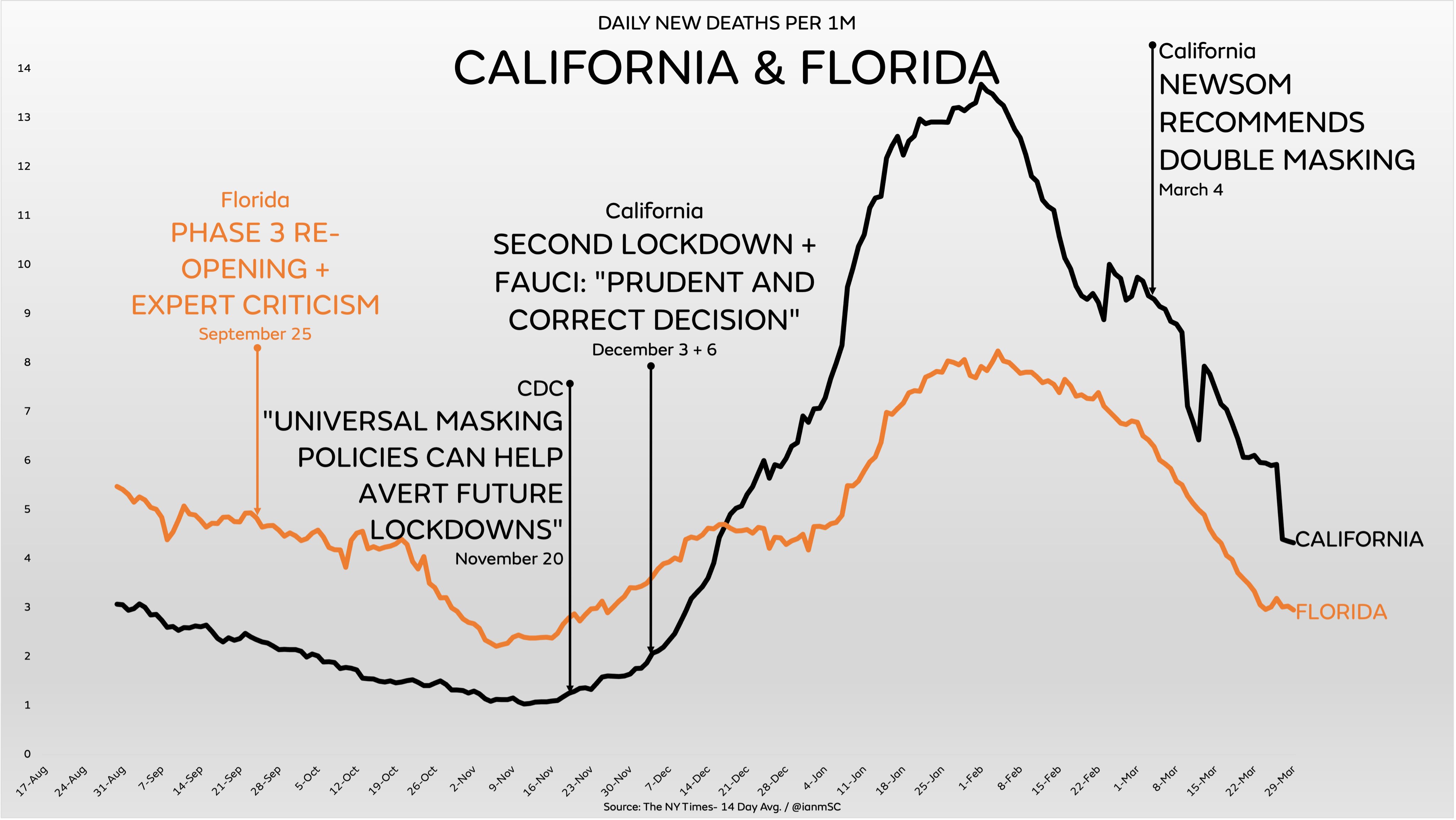
NY times 14 day average deaths per 1M.
Quotes easily found in google from government and news sources. Let me know if you need me to pull sources.
Masks are not equal in protection and effectivity. Most cloth masks do nothing for you, maybe, 50% protection tops. Most of those sold, also, do not have any filters in them. Still, till now, not the extreme liberal darling Doctor Anthony Fauci has not noted the difference. I guess he does not know. So much for the science. Now, an engineer actually tested the filtration rates of masks and he found the N95 and KN95 masks to provide the best protection. I started out with cloth masks with filters, even bought the aluminum with adhesive to make the masks adhere closer to the nose and prevent gaps. Still, I felt, I was taking a huge risk when I went to the grocery store or post office. Of course, I take zinc gluconate, vitamin C and Vitamin D3 to boost my immunity, take hot showers when I get back from the grocery store or other errands as a precaution. Now, if we were to just really, stick to the science without the BS, less people will die.
And how many of them were children? And how many died from a second infection?
Because that's the main point of the guy's post. People who had the vaccine and children don't need it.
The guy is listed at the CDC. He's an anti-vaxxer? LOL
I take it you don't understand how vaccinated herd immunity works.... nor do you seem to understand that in 40% of the people who get naturally infected their COVID antibody levels wane within six months below a threshold which allows them to be easily re-infected.
I take it you don't understand how vaccinated herd immunity works.... nor do you seem to understand that in 40% of the people who get naturally infected their COVID antibody levels wane within six months below a threshold which allows them to be easily re-infected.
I asked you simple questions about people who had been infected needing the vaccine, and children needing the vaccine. You ignored both and went on to herd immunity. You also ignored that the guy you called an "Anti-vaxxer" is recognized by the CDC for...wait for it...vaccines.
You're a sham.
Masks are not equal in protection and effectivity. Most cloth masks do nothing for you, maybe, 50% protection tops. Most of those sold, also, do not have any filters in them. Still, till now, not the extreme liberal darling Doctor Anthony Fauci has not noted the difference. I guess he does not know. So much for the science. Now, an engineer actually tested the filtration rates of masks and he found the N95 and KN95 masks to provide the best protection. I started out with cloth masks with filters, even bought the aluminum with adhesive to make the masks adhere closer to the nose and prevent gaps. Still, I felt, I was taking a huge risk when I went to the grocery store or post office. Of course, I take zinc gluconate, vitamin C and Vitamin D3 to boost my immunity, take hot showers when I get back from the grocery store or other errands as a precaution. Now, if we were to just really, stick to the science without the BS, less people will die.
For the record, I believe masks provide protection. I don't believe mask mandates work, because not everyone follows them. And that's what you need if you want to make an impact.
Liberals should be yelling at the symptomatic... not those who don't wear masks..
How many symptomatic people have you been around who were not wearing a a mask outside your home? I bet for the most the answer is zero.
How many people who have been symptomatic when out with their mask on thinking they were good little govt drones and you did not realize they were touching their dirty masks and you were getting their gobs of crap on you after they touched a door or a counter or something else?
For record... the CDC and Danish studies showed that masks did not protect the wearer.
what could be the reasons? mother nature... the human need for air flow.
1. the better the mask is at filtering in a lab... almost always the harder it is to breathe through. So people breathe around them. Anybody who wears glasses has experienced that.
Well fitted n-95s... could be the exception... but its also why I hear medical staff takes them off in break rooms and then gets in trouble. You can't fight mother nature for very long. like the invisible hand of economics.
2. studies have shown that covid and other viruses collect on the outsides of masks because of the way the air flow happens.
3. multiple studies have found dirty masks are dangerous.
4. masks likely help people make poor decisions.
So in theory some masks could work.
In reality that allow symptomatic people to think they can go out and not be dangerous... and they those around them to think they are protected.
Liberals should be yelling at the symptomatic... not those who don't wear mask..
How many symptomatic people have you been around for few minutes who were not wearing a a mask...
How many people who have been symptomatic when out with their mask on thinking they were good little liberals.
How many symptomatic people have you been around who were not wearing a a mask outside your home? I bet for the most the answer is zero.
How many people who have been symptomatic when out with their mask on thinking they were good little govt drones and you did not realize they were touching their dirty masks and you were getting their gobs of crap on you after they touched a door or a counter or something else?
For record... the CDC and Danish studies showed that masks did not protect the wearer.
what could be the reasons? mother nature... the human need for air flow.
1. the better the mask is at filtering in a lab... almost always the harder it is to breathe through. So people breathe around them. Anybody who wears glasses has experienced that.
Well fitted n-95s... could be the exception... but its also why I hear medical staff takes them off in break rooms and then gets in trouble. You can't fight mother nature for very long. like the invisible hand of economics.
2. studies have shown that covid and other viruses collect on the outsides of masks because of the way the air flow happens.
3. multiple studies have found dirty masks are dangerous.
4. masks likely help people make poor decisions.
So in theory some masks could work.
In reality that allow symptomatic people to think they can go out and not be dangerous... and they those around them to think they are protected.
Liberals should be yelling at the symptomatic... not those who don't wear mask..
How many symptomatic people have you been around for few minutes who were not wearing a a mask...
How many people who have been symptomatic when out with their mask on thinking they were good little liberals.
Liberals should be yelling at the symptomatic... not those who don't wear masks..
How many symptomatic people have you been around who were not wearing a a mask outside your home? I bet for the most the answer is zero.
How many people who have been symptomatic when out with their mask on thinking they were good little govt drones and you did not realize they were touching their dirty masks and you were getting their gobs of crap on you after they touched a door or a counter or something else?
For record... the CDC and Danish studies showed that masks did not protect the wearer.
what could be the reasons? mother nature... the human need for air flow.
1. the better the mask is at filtering in a lab... almost always the harder it is to breathe through. So people breathe around them. Anybody who wears glasses has experienced that.
Well fitted n-95s... could be the exception... but its also why I hear medical staff takes them off in break rooms and then gets in trouble. You can't fight mother nature for very long. like the invisible hand of economics.
2. studies have shown that covid and other viruses collect on the outsides of masks because of the way the air flow happens.
3. multiple studies have found dirty masks are dangerous.
4. masks likely help people make poor decisions.
So in theory some masks could work.
In reality that allow symptomatic people to think they can go out and not be dangerous... and they those around them to think they are protected.
Liberals should be yelling at the symptomatic... not those who don't wear mask..
How many symptomatic people have you been around for few minutes who were not wearing a a mask...
How many people who have been symptomatic when out with their mask on thinking they were good little liberals.
It appears you do not support adding 1 Trillion dollars to the U.S. GDP. Anti-maskers are also anti-business.
An evidence review of face masks against COVID-19
https://www.pnas.org/content/118/4/e2014564118
January 26, 2021
Conclusion
Our review of the literature offers evidence in favor of widespread mask use as source control to reduce community transmission: Nonmedical masks use materials that obstruct particles of the necessary size; people are most infectious in the initial period postinfection, where it is common to have few or no symptoms (45, 46, 141); nonmedical masks have been effective in reducing transmission of respiratory viruses; and places and time periods where mask usage is required or widespread have shown substantially lower community transmission.
The available evidence suggests that near-universal adoption of nonmedical masks when out in public, in combination with complementary public health measures, could successfully reduce Re" to below 1, thereby reducing community spread if such measures are sustained. Economic analysis suggests that mask wearing mandates could add 1 trillion dollars to the US GDP (32, 34).
Models suggest that public mask wearing is most effective at reducing spread of the virus when compliance is high (39). We recommend that mask use requirements are implemented by governments, or, when governments do not, by organizations that provide public-facing services. Such mandates must be accompanied by measures to ensure access to masks, possibly including distribution and rationing mechanisms so that they do not become discriminatory. Given the value of the source control principle, especially for presymptomatic people, it is not sufficient for only employees to wear masks; customers must wear masks as well.
It is also important for health authorities to provide clear guidelines for the production, use, and sanitization or reuse of face masks, and consider their distribution as shortages allow. Clear and implementable guidelines can help increase compliance, and bring communities closer to the goal of reducing and ultimately stopping the spread of COVID-19.
When used in conjunction with widespread testing, contact tracing, quarantining of anyone that may be infected, hand washing, and physical distancing, face masks are a valuable tool to reduce community transmission. All of these measures, through their effect on Re, have the potential to reduce the number of infections. As governments exit lockdowns, keeping transmissions low enough to preserve health care capacity will be critical until a vaccine can be developed.
It appears you do not support adding 1 Trillion dollars to the U.S. GDP. Anti-maskers are also anti-business.
An evidence review of face masks against COVID-19
https://www.pnas.org/content/118/4/e2014564118
January 26, 2021
Conclusion
Our review of the literature offers evidence in favor of widespread mask use as source control to reduce community transmission: Nonmedical masks use materials that obstruct particles of the necessary size; people are most infectious in the initial period postinfection, where it is common to have few or no symptoms (45, 46, 141); nonmedical masks have been effective in reducing transmission of respiratory viruses; and places and time periods where mask usage is required or widespread have shown substantially lower community transmission.
The available evidence suggests that near-universal adoption of nonmedical masks when out in public, in combination with complementary public health measures, could successfully reduce Re" to below 1, thereby reducing community spread if such measures are sustained. Economic analysis suggests that mask wearing mandates could add 1 trillion dollars to the US GDP (32, 34).
Models suggest that public mask wearing is most effective at reducing spread of the virus when compliance is high (39). We recommend that mask use requirements are implemented by governments, or, when governments do not, by organizations that provide public-facing services. Such mandates must be accompanied by measures to ensure access to masks, possibly including distribution and rationing mechanisms so that they do not become discriminatory. Given the value of the source control principle, especially for presymptomatic people, it is not sufficient for only employees to wear masks; customers must wear masks as well.
It is also important for health authorities to provide clear guidelines for the production, use, and sanitization or reuse of face masks, and consider their distribution as shortages allow. Clear and implementable guidelines can help increase compliance, and bring communities closer to the goal of reducing and ultimately stopping the spread of COVID-19.
When used in conjunction with widespread testing, contact tracing, quarantining of anyone that may be infected, hand washing, and physical distancing, face masks are a valuable tool to reduce community transmission. All of these measures, through their effect on Re, have the potential to reduce the number of infections. As governments exit lockdowns, keeping transmissions low enough to preserve health care capacity will be critical until a vaccine can be developed.
What sorcery is this? Are you trying to suggest that adding regulation from government is just fine as long as it adds spending to the economy?
Because we could go down a rabbit hole on the climate that would be great for the economy, and horrible for the world.
What sorcery is this? Are you trying to suggest that adding regulation from government is just fine as long as it adds spending to the economy?
Because we could go down a rabbit hole on the climate that would be great for the economy, and horrible for the world.
Having everyone home sick with COVID because there is no mandate to wear masks certainly will have a detrimental impact on the economy. If you want a robust economy that quickly rebounds then follow the best public health practices when facing a pandemic.
Liberals should be yelling at the symptomatic... not those who don't wear masks..
How many symptomatic people have you been around who were not wearing a a mask outside your home? I bet for the most the answer is zero.
How many people who have been symptomatic when out with their mask on thinking they were good little govt drones and you did not realize they were touching their dirty masks and you were getting their gobs of crap on you after they touched a door or a counter or something else?
For record... the CDC and Danish studies showed that masks did not protect the wearer.
what could be the reasons? mother nature... the human need for air flow.
1. the better the mask is at filtering in a lab... almost always the harder it is to breathe through. So people breathe around them. Anybody who wears glasses has experienced that.
Well fitted n-95s... could be the exception... but its also why I hear medical staff takes them off in break rooms and then gets in trouble. You can't fight mother nature for very long. like the invisible hand of economics.
2. studies have shown that covid and other viruses collect on the outsides of masks because of the way the air flow happens.
3. multiple studies have found dirty masks are dangerous.
4. masks likely help people make poor decisions.
So in theory some masks could work.
In reality that allow symptomatic people to think they can go out and not be dangerous... and they those around them to think they are protected.
Liberals should be yelling at the symptomatic... not those who don't wear mask..
How many symptomatic people have you been around for few minutes who were not wearing a a mask...
How many people who have been symptomatic when out with their mask on thinking they were good little liberals.
Let's fact check the nonsense you constantly peddle...
Fact check: CDC study links mask mandates to slowing COVID-19 infections and deaths
https://www.usatoday.com/story/news...-mandates-slowed-covid-infections/6938262002/
The claim: CDC study found that face masks have a negligible effect on the spread of COVID-19
A new study from the Centers for Disease Control and Prevention found a link between face mask mandates and a reduction in COVID-19 cases and deaths, but at least one widely shared report wrongly interprets that data.
One America News Network on March 7 published an article under the headline “CDC: Face masks don’t prevent COVID-19, study finds masks have negligible impact on coronavirus numbers.” The post claims “the CDC has admitted face masks do little to prevent the spread of COVID-19 amid mounting pressure to lift mask mandates across the U.S.”
But the CDC’s study doesn’t say that. In fact, it doesn't study mask efficacy at all. Instead, it links mask mandates to “statistically significant decreases in county-level daily COVID-19 case and death growth rates within 20 days of implementation.”
“Over the course of the pandemic, the scientific evidence and our understanding of masks have grown. The data we now have conclusively show that widespread use of masks is a very effective way to reduce the spread of COVID-19,” CDC spokeswoman Jasmine Reed wrote in an email to USA TODAY.
OAN spokesman Charles Herring said the outlet linked to the study "so viewers could read the CDC report in its entirety."
What exactly was the CDC studying?
Reed said the CDC's report “did not examine the effectiveness of masks.”
Instead, it analyzed the connection between mask mandate policies and the rate of new county-level coronavirus cases and deaths. It also examined the link between allowing on-site restaurant dining and the number of coronavirus cases and deaths.
The study used county-level data from March 1 through Dec. 31 of last year, comparing data from before mandates took effect to the time period when they were in place.
While it controlled for other policies that have been used to try to mitigate new infections from the coronavirus – including bar closures, stay-at-home orders and bans on gatherings of 10 or more people – it did not account for some others, such as physical distancing recommendations and other types of business closures.
The study also did not measure compliance with and enforcement of mask mandates and prohibitions on dining at restaurants.
“What they’re looking at here is efficacy of mask mandates. They’re not looking at masks in and of themselves," Josh Petrie, research professor in the University of Michigan's School of Public Health, told USA TODAY. "They don’t know how well people complied with these mandates or what proportion of the population was actually wearing masks.”
"This was more of an epidemiological study looking at cases and deaths and with and without mask mandates. That’s what this study was pursuing to try to answer," said Michael Bisesi, vice dean and interim chair of environmental health sciences in Ohio State University's College of Public Health.
What did the study find?
The authors found that the growth rate of new coronavirus cases and deaths dropped after mask mandates were put in place.
In the first 20 days after implementing mask mandates, new cases slowed by 0.5 percentage points. They continued to fall over the 100 days analyzed in the study. COVID-19 death rates dropped by 0.7 percentage points in the first 20 days after masks were required.
Decreases in the rate of new infections and deaths from the virus were statistically significant, the study’s authors found.
“Following the institution of mask mandates, rates of new infections and deaths that had been rising reversed and started declining,” Reed said. “Immediately after these mandates were instituted, these declines were statistically significant.”
The study also found a statistically significant increase in the rate of COVID-19 infections and deaths starting 40 days after indoor or outdoor dining at restaurants was allowed.
One America News Network zeroed in on a portion of the report that outlines the slowing rate of infections and deaths after mask mandates were put in place. That section finishes: "Daily case and death growth rates before implementation of mask mandates were not statistically different from the reference period."
But the "reference period" is defined by the report as the 20 days before mask mandates started. That period is used as the benchmark against which researchers compared days 21 through 60 before mask mandates were adopted and the 100 days after.
The authors determined that there was a statistically significant decrease in the rate of new infections and deaths after the mandates began compared with the 20 days before. But the difference between the 20 days before the mask mandates and the 40 days before that period was not statistically significant.
Herring dismissed those results, claiming unnamed experts told the news network that the reductions in spread the study found were not significant.
Experts interviewed by USA TODAY said the One America News Network had "misinterpreted" or "mischaracterized" the findings of the CDC study.
"Their perspective on the study and results to me are contrary to what was stated in the actual study itself," Bisesi said. “I just don’t know based on reading the OAN summary how they came to the same conclusions because the CDC conclusions were favorable.”
Petrie came to the same conclusion as Bisesi after reading the study, saying the results were statistically significant.
What do other studies say about mask mandates?
The CDC's report is the latest in a growing body of evidence establishing mask mandates as an effective strategy in curbing the virus.
Data released by the agency in November looking at COVID-19 incidence in Kansas after a statewide mask mandate also found the measure resulted in a drop in infectious cases. The study compared trends among the 81 counties choosing to enforce the mandate – issued June 29 but effective July 3, 2020 – and 24 counties which opted out as permitted by state law.
Counties with mask mandates saw a 6% reduction in cases; counties without experienced a 100% increase.
While the downtrend could also have been a result of other countermeasures like social distancing, Kansas' findings mirror observations from other states and countries.
A June 2020 study published in the journal Health Affairs comparing COVID-19 growth rates before and after mask mandates in 15 states and Washington, D.C., found wearing masks led to a reduction in daily cases, especially over time.
Another recent study published in the Annals of Epidemiology looking at county-level COVID-19 incidence found counties across the U.S. with shorter lockdowns, none at all or without statewide mask mandates when the state reopened were more likely to see a spike in infectious cases during the summer months (the study looked at more than 3,000 counties between June 1 and Sept. 30).
And in the German city of Jena, first in the country to implement public mask wearing last April, masks led to a 75% decrease in new COVID-19 cases in little under three weeks, one December study found.
Fact check: Masks and vaccines are effective at combating COVID-19 spread
Our rating: False
The claim that a CDC study found face masks to have a negligible effect on the spread of COVID-19 is FALSE. The study referenced in the One America News Network report says the opposite, noting that mask mandates were linked to “statistically significant decreases” in COVID-19 case within 20 days of implementation.
Our fact-check sources:
- U.S. Centers for Disease Control and Prevention, March 5, "Association of State-Issued Mask Mandates and Allowing On-Premises Restaurant Dining with County-Level COVID-19 Case and Death Growth Rates — United States, March 1–December 31, 2020"
- U.S. Centers for Disease Control and Prevention, Nov. 27, 2020, "Trends in County-Level COVID-19 Incidence in Counties With and Without a Mask Mandate — Kansas, June 1–August 23, 2020"
- Kansas.gov, June 29, 2020, "Governor Laura Kelly Announces Masks Must be Worn Statewide"
- Annals of Epidemiology, Feb. 14, "Differences in rapid increases in county-level COVID-19 incidence by implementation of statewide closures and mask mandates — United States, June 1–September 30, 2020"
- Health Affairs, June 16 2020, "Community Use Of Face Masks And COVID-19: Evidence From A Natural Experiment Of State Mandates In The US"
- France24, April 24, 2020, "Germany to oblige mandatory face masks from Monday"
- Proceedings of the National Academy of Science of the United States of America, Dec. 3, 2020, "Face masks considerably reduce COVID-19 cases in Germany"
- U.S. Centers for Disease Control and Prevention, Feb. 12, "Decline in COVID-19 Hospitalization Growth Rates Associated with Statewide Mask Mandates — 10 States, March–October 2020"