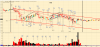
Your annotations on the extension of the price case drill to three bars are confusing. Jack uses bands designations such as Aa, Ab, Ac, etc. Your duplication of them in a different context other than volume will just add to confusion.
I had not anticipated that. Thank you, I'll label them differently to get clarity. If I choose U for Up, D for Down, E for equal, and then get for a volume peak a "UD" label, is it ok ?
Then, it would be :
AA -> UU
AB -> UD
AC -> UE
BA -> DU
BB -> DD
BC -> DE
CA -> EU
CB -> ED
CC -> EE
How is it ?
In your matrix, draw 3 TL's when possible. The first to encapsulate the first two bars, the second to encapsulate the 2nd and 3rd bar. The third to encapsulate all three bars as per OOE of price. What this third bar does in it's variation of price form, price sentiment, price geometry and volume profile will make it unique or part of a larger set of similars. It will also either include it in the first two bars or not.
Clear ! I want to begin again from scratch the 900's cases matrix.
ie. An XB, then an XR.
The XR could close inside the TL established by the XB,
penetrate it and still close within the TL,
penetrate it and close outside the TL,
or penetrate it and penetrate the close outside the BM established at the Low of Bar1 of the XB
or penetrate the BM and close above it in between the BM and the TL.
Clear
I understand what you say here, except the T1 concept. I understand it in your sentence, but do not see it embodying itself on charts.When volume comes into the market, it's pace accelerates until it ebbs and flows. As it ebbs and flows, the 1st de-acceleration establishes a T1 in volume. An increasing in volume from this point is price going toward pt2. Therefore r2r and b2b , include a T1 of volume in-between two peaks of volume as price moves from pt1,pt2,pt3 in the first traverse. This Dominant traverse is always a r2r or b2b.
Some times this is easily seen in the gaussian formations. Othertimes, this dynamic is occurring intrabar and one would have to go to a faster timescale to discern it. When people describe 'fractal jumping' it's referring to the phenomenon that gaussians couple to price action aperiodically as the previous example points out.
I understand this
You've not numbered your questions nor coupled them to the pics.
I thought I had explained the pairing of my questions with each *, **, *3, etc... they appear on my sheets of the 900's cases, and each of them is related to the labeled *, **, *3 questions.
Am I still not clear ? If I'm still doing bad, I apologize and beg you to explain me what you're waiting from me. I'd really feel better if I could put you in a better comfort to answer me.
In general, an FTP followed by an FTP could be one of two cases.
1)The second FTP is within the bounds of the first, thereby forming a Lat3 with a faster fractal within forming a RTL.
2) The second FTP is not within the bounds of the first, in such a case the 2nd price case is not an FTP.
I don't get your 2). How can an FTP not be in the bounds of the first in a FTP+FTP case ? I see it geometrically impossible. In other words, how can an FTP not be an FTP ?
Check again. An FTP/FBP 3 bar combo can and frequently form within laterals. Depending on the volatility of the form and where the bar closed determines if there was a BO of the FTP rtl or fanning the FTP rtl is more appropriate.
I do not understand in what the close and the volatility of the form of the 3d bar can either lead to consider a BO or a fan. Anyway, you're right, FTP + FBP form a Lateral. But you say "it can and frequently form a Lat". I would understand this if you showed me an example where FTP + FBP do not create a Lat. Cause currently, I do not see any other possibility.
You're using AB labeling in a completely different context than ID'ing EE's. In general, there is no "non-tape" case. All price cases are mathematically derived. When a bar forms it is one of the 10 price cases without exception. In a series of bars, trends interlock, and in so doing there is bar or series of bars where trends also overlap.
Got it