Fun at the ZLB, and below!?

Who cares about "directly", when its indirect actions are so broadly influential? The gun doesn't directly kill, the bullet does.

Directly is important, even if you do not wish to admit it. The gun does directly kill with the bullet. Monetary policy affects inflation through the change in interest rate. Changing interest rate does not affect unemployment without a host of other things first happening. This is why the unemployment rate - the real U6 rate, is still so horrid, and why the unemployment rate continued to rise well after the Fed began QE.

The Fed can never directly affect unemployment because they do not make it easier to hire people or change the conditions to make companies to want to hire people. It's pretty simple. Oh sure, the Fed can create business conditions that result in companies wanting to increase headcount over time, but companies base the decision to hire on a broad range of conditions, with many outside the Federal Reserve's control. Which is where we are today and why the Fed's policy towards unemployment is commonly referred to as "pushing on a string".

We've been through this before. But I'll start again here at home:

Not if you and I is the "we". Please show me a link where we've been through this before.

Bank of Canada Act

R.S.C., 1985, c. B-2

An Act respecting the Bank of Canada

Preamble
WHEREAS it is desirable to establish a central bank in Canada to regulate credit and currency in the best interests of the economic life of the nation, to control and protect the external value of the national monetary unit and to mitigate by its influence fluctuations in the general level of production, trade, prices and employment, so far as may be possible within the scope of monetary action, and generally to promote the economic and financial welfare of Canada;

Oh BS. As usual you're trying to skate around the issue with semantics. The Bank of Canada has one mandate - to control inflation. Sure, every central bank in the world has language out there to include overall economic health in their founding charter but their stated mandate is "inflation control or price stability, etc." This is because that is the only thing a central bank can directly be responsible for. Interest rates, and the changing of them, only directly affects the flow and access of money.

Even the text above revolves around the currency and credit (price stability) and talks about mitigating that influence on other metrics (like unemployment).

If Canadian inflation were 4% and the unemployment rate were 12%, you can be sure they would target 4% inflation.
 
Last edited:
In the 70's, when money was a tad, but not completely more real, the financial sector made about 15% of total corp profits. Then, when money went full fiat and completely disengaged from gold, the financial sector profits as a percentage of total corporate profits began rising until it hit around 40% in the last decade.
When there's a whole lot more money available to be lent out, it becomes easier to make big bucks for banks.
Nice work if you can get it. Or if your buddies work at the federal reserve.
 
Bernanke: I Didn’t Throw Seniors Under The Bus (MarketWatch)

" His blog is built around the concept of an “equilibrium real interest rate” which is the ideal level of rates minus inflation that would allow the economy to use all of its labor and capital resources.

So critics who argue that the he kept interest rates “artificially low” are also confused, Bernanke said. There is “absolutely nothing artificial” about setting the Fed rate at the equilibrium rate, he said."
-------

Theautomaticearth's take on what Ben said: The stupidest thing in a long while: “There is “absolutely nothing artificial” about setting the Fed rate at the equilibrium rate.”
 
"The Fed can never directly affect unemployment because they do not make it easier to hire people or change the conditions to make companies to want to hire people."

Lol.
 
"The Fed can never directly affect unemployment because they do not make it easier to hire people or change the conditions to make companies to want to hire people."

Lol.

That must be news to the Fed.
 
"The Fed can never directly affect unemployment because they do not make it easier to hire people or change the conditions to make companies to want to hire people."

Lol.

Key word here is directly. You can hide behind semantics (your M.O.) all you want, but the Fed making borrowing cheaper does not incentivize a company to go out and hire more people. There are a host of other things that have to happen between A and Z in order for it to affect hiring.

I see you dodged everything else, including the link where "we've been through this before." Ole'!

I'll post something below you should read that might help you understand the Fed's dual mandate horseshit below. Perhaps you might even choose to educate yourself.
 
Last edited:
You would do well to read this, Ricter, though I won't hold my breath in hopes you will. Judy probably won't give it a second glance, preferring to remain "ignant" for the rest of his isolated life.

April 4, 2011


Will the Real Phillips Curve Please Stand Up? John P. Hussman, Ph.D.

Much of the intellectual basis for the Federal Reserve's dual mandate - "to promote effectively the goals of maximum employment, stable prices, and moderate long-term interest rates" - is based on the belief in what economists call the Phillips Curve. The Phillips curve, named after economist A.W. Phillips, is widely understood as a "tradeoff" between inflation and unemployment. The idea is so engrained in the minds of economists and financial analysts that it is taken as obvious, incontrovertible fact. High unemployment, the argument goes, is associated with low inflation risk, and in that environment, policy makers can safely pursue measures targeted at increasing employment, without undesirable consequences for inflation.

You can see this blind acceptance of Phillips Curve thinking in Ben Bernanke's go-out-and-speculate Op-Ed in defense of quantitative easing, which appeared in the Washington Post late last year:

"The Federal Reserve's objectives - its dual mandate, set by Congress - are to promote a high level of employment and low, stable inflation... low and falling inflation indicate that the economy has considerable spare capacity, implying that there is scope for monetary policy to support further gains in employment without risking economic overheating. The FOMC decided this week that, with unemployment high and inflation very low, further support to the economy is needed."

In prior weekly comments, we've reviewed the weakness in Bernanke's argument that stock market fluctuations influence GDP, noting that every 1% change in market value is associated with a short-lived change of only 0.03-0.05% in real GDP. That result is strongly rooted in economic theory, since consumption and wealth effects are based on assets that are viewed to be "permanent," not on fluctuations in assets that are known to be volatile.

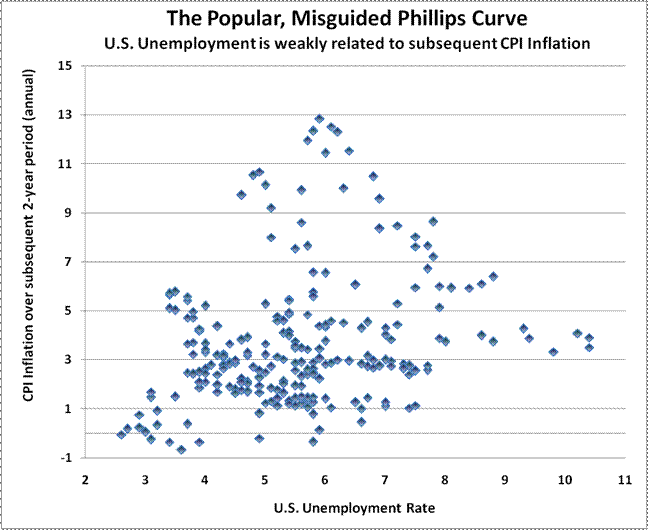
Similarly, Bernanke's belief in the Phillips Curve is equally devoid of factual substance, despite its broad acceptance and simplistic appeal. The chart below shows the historical record, since 1947, plotting the U.S. unemployment rate against the subsequent rate of CPI inflation over the following 2-year period. The correlation is essentially zero (techically, it's slightly positive, implying no "tradeoff" at all in historical data). I should also note that the same lack of correlation holds between unemployment and inflation measured over the previous 1-2 year period.

wmc110404a.gif


As it happens, economists have been well aware of this lack of correlation for decades, but because of the simple intellectual appeal of an inflation-unemployment tradeoff, they have gone to great lengths to try to make the relationship work. The most prominent version of this is the "expectations augmented" Phillips Curve, which looks at the graph above as a whole set of "nested" Phillips Curves (like indifference curves in consumer theory), where each curve is set at a different level based on the level of expected inflation. In this view, unexpected inflation moves you along a given Phillips Curve, while expected inflation shifts you to a different curve. While this version of the theory is popular among economists because it gives them a modeling "environment" in which to teach the importance of expectations and so forth, the fact remains even the expectations-augmented version has only a weak relationship to actual economic data.

In effect, the most basic intellectual underpinning of the Fed's "dual mandate" is Grade-A horse manure.

How can that be? Didn't A.W. Phillips demonstrate the inflation-unemployment tradeoff in historical data, giving rise to the famous curve that bears his name?

Well, actually, no.

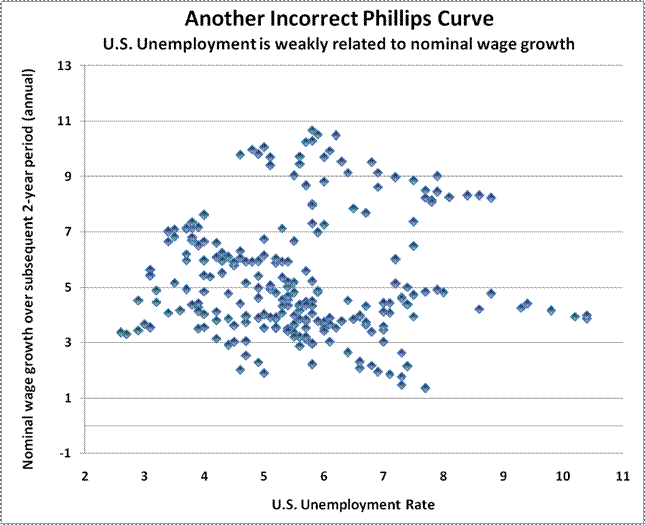
See, the Phillips Curve takes its name from a 1958 Economica paper by A.W. Phillips, which studied the relationship between unemployment and wage inflation in Britain, using a century of historical data through the 1950's. What Phillips found was this: when unemployment was low, wage inflation tended to be above-average, and when unemployment was high, wage inflation tended to be subdued.

Yet even this relationship, when viewed in U.S. data since 1947, doesn't seem to hold up very well. In fact, U.S. unemployment is just as weakly related to nominal wages as it is with overall price inflation.

wmc110404b.gif


We can get to the heart of the Phillips Curve by asking one crucial question: What is the difference between Britain in the period from 1861-1957, and the United States in the post-war period?

The answer is simple. During most of the period that Phillips studied, Britain was on the gold standard. As a result, the general price level was actually very stable, with very little general price inflation at all. In fact, Phillips excluded data "in or immediately after those years in which there was a very rapid rise in import prices." So when Phillips observed wage inflation, he was actually observing real wage inflation as well. When unemployment was low and available labor was scarce, workers were able to command a greater amount of real goods and services in return for their work. In contrast, when unemployment was high and available labor was plentiful, workers found that their standard of living typically did not rise quickly because their services were not in sufficient demand.

Phillips demonstrated a principle that is well-known to every economist: very simply, when a useful resource becomes scarce, its price tends to increase relative to the prices of other goods and services. That finding doesn't need all sorts of intellectual contortions or modeling tricks to make it "work," because it is one of the most basic laws of economics.

(cont'd below)

 
Last edited:
(cont'd from above)

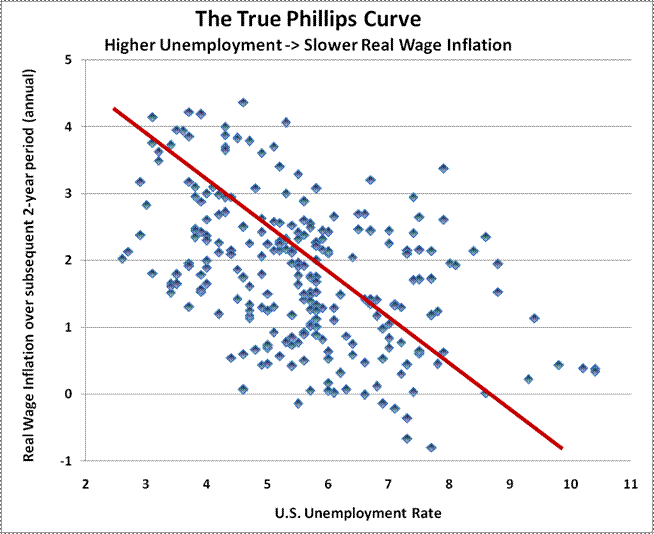
The true Phillips Curve, then, is a relationship between unemployment and real wages. When workers are scarce, wages tend to rise faster than the general price level. When workers are plentiful, wages tend to rise slower than the general price level. If we look at U.S. data in this way, we find precisely what A.W. Phillips found in British data. The following chart plots the U.S. unemployment rate versus the annual inflation in real wages (average hourly earnings deflated by the GDP price deflator) over the subsequent 2-year period.

wmc110404c.gif


The importance of the true Phillips Curve should not be underestimated. First, there is in fact no strong "tradeoff" between unemployment and general price inflation, and almost certainly not an exploitable one. The Phillips Curve is essentially a statement that lower unemployment is associated with higher inflation in real wages. The strategy of accepting higher inflation in hopes of achieving lower unemployment (which is the basis of Bernanke's policy efforts) not only drops the phrase "real wages" but reverses the direction of cause and effect.

The other important implication of this analysis is that real wages for U.S. workers are likely to stagnate for a prolonged period of time. As a side note, lest the prospect of further suffering among workers suggests that corporate profits and stock market returns will be correspondingly higher at their expense, I should note that there is virtually no correlation between real wage growth and total returns in the S&P 500. Weak employment conditions are a universal bad.

That said, however, the belief that the Federal Reserve can offset this by encouraging higher inflation is a dangerous and misguided dogma, which simply adds insult to injury to people at lower income levels who spend a large proportion of their income on food and energy. What the nation needs urgently is for the Fed to abandon its endless policy of distorting asset prices. This policy has the effect of reducing prospective future investment returns, damaging the incentive to save, and misallocating resources, all while increasing systemic risk and moral hazard - defending excessive risk-taking against losses over the short-run while leaving the nation vulnerable to the damaging consequences of that risk-taking over the long run.

I've long argued that the Fed has an essential function in providing liquidity during periods of banking crisis, but I have been dismayed by the extent to which the Fed has breached the restrictions of the Federal Reserve Act in recent years, as well as by the increasingly distortive policies it has pursued.

Market veteran Ned Davis puts it nicely "I think the Fed has punished savers and has put us between a rock and a hard place with QE2. It has kept the banking system liquid and helped goose stocks. But in that it has also provided juice for a commodity explosion that has hurt the world's poor, it has offset much, if not all, the good it did. In that real money (ex inflation) matters, the situation is not nearly as favorable as most Fed watchers believe."

Similarly, Vitaliy Katsenelson related a recent speech by the Fed's Thomas Hoenig at the Colorado CFA Society - "He said these policies encourage speculation and don't allow for price discovery, and consequently they lead to imbalances, unintended consequences, and misallocation of resources. He said it is important to judge QE2's success over the right time frame, one long enough to encompass not just its stimulative benefits but also its consequences." Hoenig argued that the Fed's intervention will have unintended consequences, and offered as an example the Fed's actions of 2003, the resulting asset bubble, and the subsequent financial crisis that resulted. Vitaliy observed "I too believe that the Fed's actions in 2003 played a very large role in the subsequent real estate bubble, financial crisis, and today's high unemployment, but this was the first time I've heard such an admission come directly from a Fed governor."

With respect to the Bernanke's actions, Vitaliy quoted the 19th century economist Frederic Bastiat:

"There is only one difference between a bad economist and a good one: the bad economist confines himself to the visible effect; the good economist takes into account both the effect that can be seen and those effects that must be foreseen... the bad economist pursues a small present good that will be followed by a great evil to come, while the good economist pursues a great good to come, at the risk of a small present evil."
 
Back
Top