Even the Pope sides with Futurecurrents

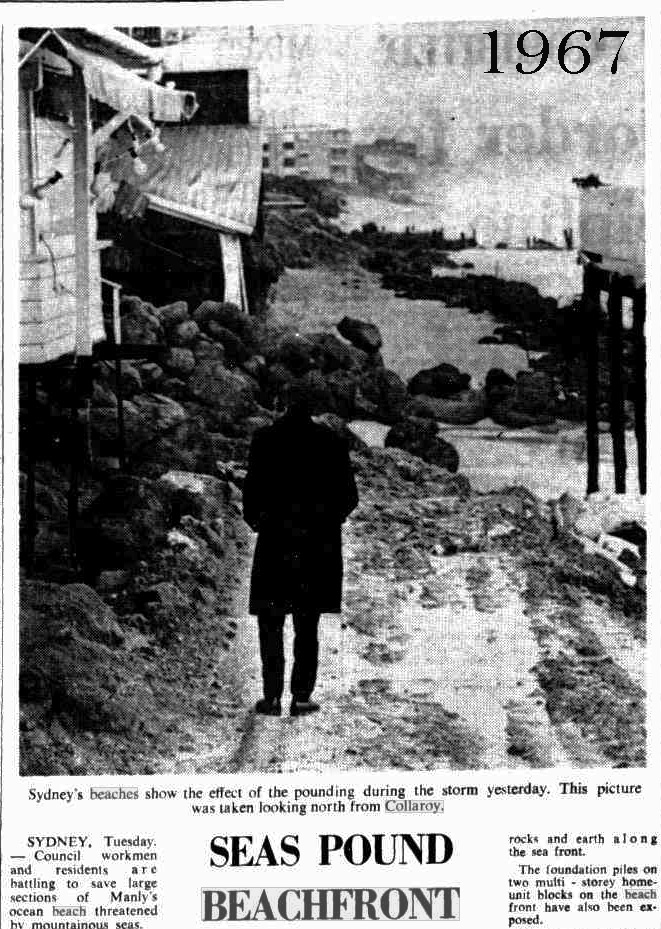
collaroy-beach-1967-bw.jpg

houses-washed-to-sea-crop.gif

62b0b735aa666e384685ff61ca214704

The protest against Collaroy/Narrabeen sea wall in 2002, published in a presentation from Warringah Council senior environment officer Daylan Cameron.

Bitter battle over Collaroy beachfront has raged for years
June 7, 2016
http://www.news.com.au/technology/e...s/news-story/31951320aaa2726c788acada52ede9ca

HOMEOWNERS LEFT AT THE SEA’S MERCY

Northern Beaches Council general manager Mark Ferguson said measures such as building sea walls were difficult to implement because of community opposition.

Warringah Council tried to extend a 1.1km sea wall along Collaroy/Narrabeen beach in 2002 but abandoned the plans when more than 3000 residents protested against it.

Thousands linked hands along the beachfront to oppose any upgrade or extension of the ad hoc wall that protects some homes.


The protest against Collaroy/Narrabeen sea wall in 2002, published in a presentation from Warringah Council senior environment officer Daylan Cameron.Source:Supplied

“There is a natural conflict between people with houses on the beach, and beach users,” coastal engineer Angus Gordon told news.com.au.

Seawalls can strip beaches of sand and change wave patterns, which is not popular with surfers and beach users.

Giving property owners permission to build sea walls to protect individual properties was also problematic.

“Sea walls have a flow on affect to other properties,” Mr Ferguson explained. “Water can be pushed onto neighbouring properties if they don’t have a sea wall. That’s why it’s better to build a wall covering a number of properties at the same time.”

One of the Collaroy residents whose home was damaged during the recent Sydney storms, told AAP of his frustration that he had not been allowed to protect his property.

“We moved in three years ago. We talked to council, but it’s a bit late now,” Garry Silk said.

“This is the only strip without sea protection.”

c3aa37b733e95a780903f484976d2bbf

There was extensive damage to Mr Silk’s property. John Grainger

There was extensive damage to Mr Silk’s property. John GraingerSource:News Corp Australia

Another neighbour Collaroy beachfront resident Thomas Falvo, 41, was allowed to build his own sea wall at great expense, but his house sustained minimal damage.

“That’s part of living on the beach,” Mr Falvo said. “Obviously government has not really helped on its part.”

A coastal zone management plan adopted by council last year now allows the construction of sea walls, but the issue of who pays for it, remains a barrier.
 
1st generation - No problem!

2nd generation - Not a problem!

3rd generation - Don't worry about the problem!

4th generation - Arguing whether it's a problem!

5th generation - Fighting how to deal with the problem!

6th generation - Still arguing the problem! Too expensive for treating the problem now.

7th genartion - The problem is too critical! But not enough money for the problem now! As we should have fixed the problem many many years ago when the costs involved were much much lower then!

8th generation - The problem seems already irreversible and unavoidable by now. It's just too late, no matter how much we want to spend! Sorry!

...

Nth generation - The problem is gone, and a history! Still arguing the True/Actual causes for the problem, still having huge disagreement! Some faithful ones still claim happily their effort and strength for huge money was luckily saved, otherwise wasting too much money for something not worth to worry about!

(Money perhaps should be spent only on finding another Habitable planet where the future generations live!)
I'm optimistic. After all, we did bring HFC emissions under control. Lead, too.
 
this is monumentally ridiculous. snowpack is cycles up and down an returned with this years rains.

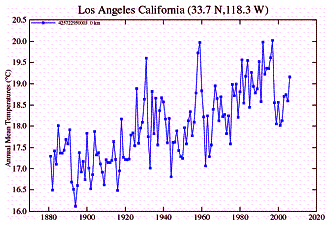
and we are not 3 degrees warmer... its bad data suffering from our urbanization.


http://appinsys.com/GlobalWarming/GW_Part3_GlobalTempMeasure.htm


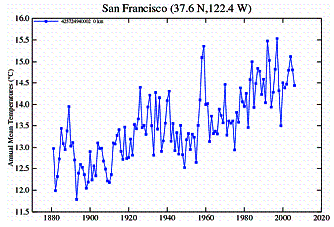
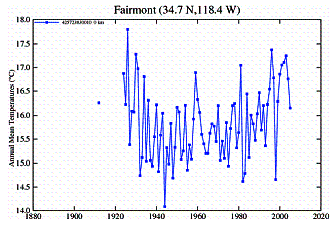
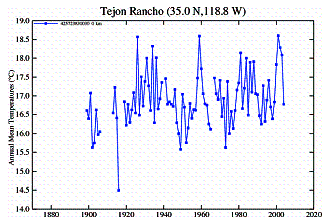
In California an examination of temperature stations within most of the state shows that most are highly urbanized - very few are land-based rural and of those many stopped reporting in the 1970’s – 1990’s. A comparison of urban and rural stations shows a very distinct difference in temperature trends. The urban stations exhibit distinct warming trends, while the rural stations either show no warming or cyclical warming that is not as warm as it was during the 1930’s.


Urban Stations:

image096.gif
image098.gif


Rural Stations:

image100.gif
image102.gif


California has had extended droughts in the past. But this time average temps in the state are three degrees warmer than one hundred years ago. Less snowpack and more evap makes it worse.

The combo of global warming and the drought cycle means that CA will be in big trouble.

The deniers will be able to stick their heads in dry hot sand. Hopefully a flash flood happens while they are down there.
 
what is the problem. Homeowners built on a beach. Storms have been causing problems to homes on beaches there for decades according to the article.

I knew people who had a 6,000 dollar beach cottage in one of the hamptons in the 60s. It was cheap because everyone knew every once in a while a big storm came through and wipes the cottages out. People forget those storms over time but they happened in the past.

Its been part of the weather cycle throughout history. Why is now different.. There is absolutely zero science showing man is doing it.


1st generation - No problem!

2nd generation - Not a problem!

3rd generation - Don't worry about the problem!

4th generation - Arguing whether it's a problem!

5th generation - Fighting how to deal with the problem!

6th generation - Still arguing the problem! Too expensive for treating the problem now.

7th genartion - The problem is too critical! But not enough money for the problem now! As we should have fixed the problem many many years ago when the costs involved were much much lower then!

8th generation - The problem seems already irreversible and unavoidable by now. It's just too late, no matter how much we want to spend! Sorry!

...

Nth generation - The problem is gone, and a history! Still arguing the True/Actual causes for the problem, still having huge disagreement! Some faithful ones still claim happily their effort and strength for huge money was luckily saved, otherwise wasting too much money for something not worth to worry about!

(Money perhaps should be spent only on finding another Habitable planet where the future generations live!)
 
Last edited:
I'm optimistic. After all, we did bring HFC emissions under control. Lead, too.


But CO2 hangs around for hundreds of years, so regardless of what we do now there is already a lot of warming built in unless we take it out again or engage in geoengineering.

And so far mankind is not doing nearly enough soon enough.

It will reach a point where the world will have to agree to start putting aerosols in the stratosphere.

Things will certainly get far worse before they get better.


But hey! Cheer up! We could get hit with an asteroid instead! :)
 
An Innovative Green Technology Funded by Bill Gates


The CE website notes that capturing CO2 directly from the air allows emissions originating from any source to be managed with standardized scalable industrial facilities.

CE’s full-scale design, could absorb the emissions created by 300,000 typical cars. Air capture can serve as a complement to climate strategies that reduce emissions at their source. It can remove far more CO2 per acre of land footprint than trees and plants and produce a stream of pure CO2 as its principal output for use in industrial applications or storage.

“Direct air capture gives us another option – to be used alongside others like wind power and energy efficiency – to help make deep cuts in our CO2 emissions and avoid dangerous climate change,” said Holmes.

Air capture plus fuel synthesis is potentially one of the few truly scalable ways to power transportation in a way that’s carbon-neutral.

CE’s air capture technology brings atmospheric air containing CO2 into contact with a chemical solution that naturally absorbs CO2, in a device called a contactor, which absorbs atmospheric CO2 to produce a liquid solution that is rich in CO2.

The regeneration process, involving several processing steps, produces a purified stream of CO2 and re-makes the original capture chemical. These two processes work together to enable continuous capture of CO2 from atmospheric air, with energy (and small amounts of make-up chemicals) as an input, and pure CO2 as an output. The stream of pure CO2 can be used in industrial applications and/or permanently sequestered underground.

“CE is currently in pilot demonstration phase, with a demo plant in Squamish BC under initial operations at current time,” Holmes added. “This plant will capture ~1 ton of CO2 per day to demonstrate and test CE’s design.”

Further information on CE’s Squamish demo plant, in British Columbia, can be found in the April update on the CE website, which also mentions the contributions of CE’s project partners. “CE has a number of industrial partners who provide equipment and expertise specific to various sub-systems within CE’s technology,” confirms Holmes.


Holmes explained to Hacked that CE’s business plan centers on using atmospheric CO2, and renewable energy, to synthesize liquid fuels like gasoline or diesel. “This is another way – in addition to electric cars – that renewable energy could be used to power transportation, one of the toughest sectors to de-carbonize.”

CE is predominantly funded by private investors including Bill Gates. In an interview with The Financial Times, Gates mentioned his investment in CE and stated that he plans to double his personal investment in innovative green technologies to $2bn over the next five years in an attempt to “bend the curve” in the fight against climate change.

Holmes added that CE uses government grant programs when possible to leverage private investment. In reply to a question on the ntended applications of CE’s technology, Holmes said that the near-term is fuel synthesis, as described. “Longer term, the technology could also be used to capture CO2 and sequester it underground, to provide a verifiable off-set to sources of emissions that are too difficult or costly to control at point of release,” he added.

Images from Carbon Engineering.


Tags: Carbon Engineering, CO2

https://hacked.com/carbon-engineering-technology-extract-co2-air-turn-fuel/
 
Fraud,

Here is your oil candidate. Bought and paid for by the biggest oil.

http://www.middleeasteye.net/news/d...llary-clinton-presidential-campaign-223282807

“Saudi Arabia always has sponsored both Republican and Democratic Party of America and in America current election also provide with full enthusiasm 20 percent of the cost of Hillary Clinton’s election even though some events in the country don’t have a positive look to support the king of a woman (sic) for presidency,” the report quoted Prince Mohammed as having said.
 
Following record-high temperatures and melting records in northwest Greenland in summer 2015, a new study provides the first evidence linking melting in Greenland to the anticipated effects of a phenomenon known as Arctic amplification.

Arctic amplification, in the simplest terms, is the faster warming of the Arctic compared to the rest of the Northern Hemisphere as sea ice disappears. It is fueled by a feedback loop: rising global temperatures are melting Arctic sea ice, leaving dark open water that absorbs more solar radiation, and that warms the Arctic even more. Arctic amplification is well documented, but its effects on the atmosphere are more widely debated. One hypothesis suggests that the shrinking temperature difference between the Arctic and the mid-latitudes will lead to a slowing of the jet stream, which circles the northern latitudes and normally keeps frigid polar air sharply separated from warmer air in the south. Slower winds could create wilder swings of the jet stream, allowing warm, moist air to penetrate farther north.

The new study, published this week in the journal Nature Communications, shows that those anticipated effects occurred over northern Greenland during the summer of 2015, including a northern swing of the jet stream that reached latitudes never before recorded in Greenland at that time of year.

https://www.ldeo.columbia.edu/news-...ent-‘arctic-amplification’?platform=hootsuite
 
Back
Top