Some excerpts below.
Global-Warming Alarmists, You're Doing It Wrong
http://www.bloomberg.com/view/articles/2016-06-01/global-warming-alarmists-you-re-doing-it-wrong
The arguments about global warming too often sound more like theology than science. Oh, the word “science” gets thrown around a great deal, but it's cited as a sacred authority, not a fallible process that staggers only awkwardly and unevenly toward the truth, with frequent lurches in the wrong direction. I cannot count the number of times someone has told me that they believe in “the science,” as if that were the name of some omniscient god who had delivered us final answers written in stone. For those people, there can be only two categories in the debate: believers and unbelievers. Apostles and heretics.
This is, of course, not how science works, and people who treat it this way are not showing their scientific bona fides; they are violating the very thing in which they profess such deep belief. One does not believe in “science” as an answer; science is a way of asking questions. At any given time, that method produces a lot of ideas, some of which are correct, and many of which are false, in part or in whole.
__________________________________________________
This meant that they were stuck guessing from observational data of a system that was constantly changing. They could make some pretty good guesses from that data, but when you built a model based on those guesses, it didn’t work. So economists tweaked the models, and they still didn’t work. More tweaking, more not working.
Eventually it became clear that there was no way to make them work given the current state of knowledge. In some sense the "data" being modeled was not pure economic data, but rather the opinions of the tweaking economists about what was going to happen in the future. It was more efficient just to ask them what they thought was going to happen. People still use models, of course, but only the unflappable true believers place great weight on their predictive ability.
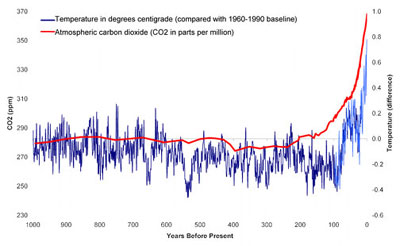
This lesson from economics is essentially what the "lukewarmists" bring to discussions about climate change. They concede that all else equal, more carbon dioxide will cause the climate to warm. But, they say that warming is likely to be mild unless you use a model which assumes large positive feedback effects. Because climate scientists, like the macroeconomists, can’t run experiments where they test one variable at a time, predictions of feedback effects involve a lot of theory and guesswork. I do not denigrate theory and guesswork; they are a vital part of advancing the sum of human knowledge. But when you’re relying on theory and guesswork, you always want to leave plenty of room for the possibility that your model's output is (how shall I put this?) … wrong.