
I have been saying this for years and years and years, I have made numerous posts on how QE has done nothing but help wall street, the big banks and the millionaires and billionaires, thats all it has done, it has created bubbles in housing, stocks, private equity, the art world, the car auctions, price of goods and services have skyrocketed even though the fed says inflation is running around 2% which is a complete LIE. It has created bubbles in the secondary IPO market valuing companies in the hundreds of millions and tens of billions when they are only worth 1/25th of what they claim they are valued at. I can go on and on but as you can see from this one fed official he says there is NO EVIDENCE QE BOOSTED ECONOMY...he also says "And he believes the "forward guidance"the Fed has used to communicate its intentions has instead been a muddle of broken vows that has served only to confuse investors." Which is 100 million % accurate, as I have been saying the entire time, its lies and broken promises the entire time as the fed BOWS to wall street. The only thing QE did since day one was inflate stock prices, thats all it has done, and thats what I have been saying the entire way up, without QE the markets would be 50% lower from where they are today, the s$p would have never crossed back over 1000 if it wasn't for QE, QE only helped wall street and once this all comes to an end and the next crisis is back you will finally notice the fed did absolutely nothing but literally print trillions of dollars for their wall street friends......Im wondering what their exit strategy is, because if you really want to know the fed doesn't have one, they never did have an exit plan and never will, that will all come to light when the next bottom falls out of the economy and the fed is scrambling to find a way print more money....however the next fix wont occur as easy as printing money because the next crisis that comes there will be no way to fix it as the fed will have lost every bit of credibility they once had.........
St. Louis Fed official: No evidence QE boosted economy
Jeff Cox | @JeffCoxCNBCcom
1 Hour Ago
The Federal Reserve is putting some of its post-crisis actions under a magnifying glass and not liking everything it sees.
In a white paper dissecting the U.S. central bank's actions to stem the financial crisis in 2008 and 2009, Stephen D. Williamson, vice president of the St. Louis Fed, finds fault with three key policy tenets.
Specifically, he believes the zero interest rates in place since 2008 that were designed to spark good inflation actually have resulted in just the opposite. And he believes the "forward guidance" the Fed has used to communicate its intentions has instead been a muddle of broken vows that has served only to confuse investors. Finally, he asserts that quantitative easing, or the monthly debt purchases that swelled the central bank's balance sheet past the $4.5 trillion mark, have at best a tenuous link to actual economic improvements.
Williamson is quick to acknowledge that then-Chairman Ben Bernanke's Fed, through liquidity programs like the Term Auction Facility that injected cash into banks, "helped to assure that the Fed's Great Depression errors were not repeated."
"There is no work, to my knowledge, that establishes a link from QE to the ultimate goals of the Fed—inflation and real economic activity"-Stephen D. Williamson, St. Louis Fed vice president
But as for spurring inflation, reducing employment or otherwise generating sustained economic activity, the results, particularly for QE, are "at best best mixed." In addition to muted inflation, gross domestic product has yet to eclipse 2.5 percent for any calendar year during the recovery, while wage gains, and consequently living standards, have been mired around 2 percent or less.
Read MoreThis is 'more damaging...than the Great Recession'
"There is no work, to my knowledge, that establishes a link from QE to the ultimate goals of the Fed—inflation and real economic activity. Indeed, casual evidence suggests that QE has been ineffective in increasing inflation," Williamson wrote.
"For example, in spite of massive central bank asset purchases in the U.S., the Fed is currently falling short of its 2 percent inflation target," he added. "Further, Switzerland and Japan, which have balance sheets that are much larger than that of the U.S., relative to GDP, have been experiencing very low inflation or deflation."
The primary place where QE seems to have worked is in the stock market, where the S&P 500 has soared by 215 percent since the recession lows in March 2009. Elsewhere, though, deflation fears have permeated and interest rates have remained low.
Interestingly, one of the biggest fears Fed critics have espoused about its activities has been that the bloated balance sheet would drive inflation by releasing that "high-powered" money into the economy and driving up prices.
However, the inflation rate for the U.S., and for much of the other developed world where central bank activism is high, has remain muted, at least by conventional measures.
Read MoreFed's trillions haven't helped worker paychecks
In Williamson's view, that's a product of policymakers wed to the Taylor rule, which dictates the level of interest rates in regard to economic conditions. The thinking essentially is that low rates beget low inflation, trapping central banks in zero interest rate policies (or ZIRP).
"With the nominal interest rate at zero for a long period of time, inflation is low, and the central banker reasons that maintaining ZIRP will eventually increase the inflation rate. But this never happens and, as long as the central banker adheres to a sufficiently aggressive Taylor rule, ZIRP will continue forever, and the central bank will fall short of its inflation target indefinitely," Williamson said. "This idea seems to fit nicely with the recent observed behavior of the world's central banks."
Source: Federal Reserve Bank of St. Louis
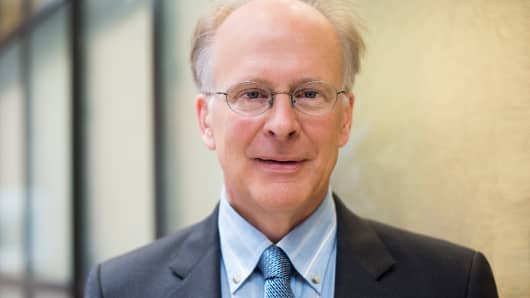
Steven Williamson
The trap then manifests itself in a failed communication strategy.
In the third stage of QE, the Fed sought to establish specific targets for when it would raise rates, such as 6.5 percent unemployment rate and a 2.5 percent inflation target. However, as unemployment fell and inflation lagged, the Fed began moving the goalposts, to the point where the headline unemployment rate is now 5.3 percent and the central bank has yet to move on interest rates.
Williamson argues that the Fed is perhaps overdoing it with transparency, and he uses a simple comparison of post-Open Market Committee meeting statements: After the Jan. 31, 2007, (precrisis) meeting, the Fed statement consisted of just 129 words; following the Jan. 28, 2015, meeting, the statement more than quadrupled, to 529 words.
Read MoreThe Fed's muddied message causing market mess
In that type of environment, the market becomes glued to certain phrases the Fed uses. In this case, the FOMC had been including the term "extended period" for how long it would remain accommodative. However, as the benchmarks fell and the Fed kept ZIRP in place, the impact of forward guidance became muted.
"'Extended period' is far too vague to have any meaning for market participants; monetary policy rules should be specified as contingent plans rather actions to take place at calendar dates; 'thresholds' are meaningless if nothing happens in response to crossing a threshold," Williamson wrote. "Thus, the Fed's forward guidance experiments after the Great Recession would seem to have done more to sow confusion than to clarify the Fed's policy rule."
Many Wall Street strategists have issued forecasts expecting the Fed finally to end zero interest rates in September. However, uncertainty lingers: The CME's FedWatch tool, which monitors futures contracts, indicates just a 36 percent chance of September tightening.
St. Louis Fed official: No evidence QE boosted economy
Jeff Cox | @JeffCoxCNBCcom
1 Hour Ago
The Federal Reserve is putting some of its post-crisis actions under a magnifying glass and not liking everything it sees.
In a white paper dissecting the U.S. central bank's actions to stem the financial crisis in 2008 and 2009, Stephen D. Williamson, vice president of the St. Louis Fed, finds fault with three key policy tenets.
Specifically, he believes the zero interest rates in place since 2008 that were designed to spark good inflation actually have resulted in just the opposite. And he believes the "forward guidance" the Fed has used to communicate its intentions has instead been a muddle of broken vows that has served only to confuse investors. Finally, he asserts that quantitative easing, or the monthly debt purchases that swelled the central bank's balance sheet past the $4.5 trillion mark, have at best a tenuous link to actual economic improvements.
Williamson is quick to acknowledge that then-Chairman Ben Bernanke's Fed, through liquidity programs like the Term Auction Facility that injected cash into banks, "helped to assure that the Fed's Great Depression errors were not repeated."
"There is no work, to my knowledge, that establishes a link from QE to the ultimate goals of the Fed—inflation and real economic activity"-Stephen D. Williamson, St. Louis Fed vice president
But as for spurring inflation, reducing employment or otherwise generating sustained economic activity, the results, particularly for QE, are "at best best mixed." In addition to muted inflation, gross domestic product has yet to eclipse 2.5 percent for any calendar year during the recovery, while wage gains, and consequently living standards, have been mired around 2 percent or less.
Read MoreThis is 'more damaging...than the Great Recession'
"There is no work, to my knowledge, that establishes a link from QE to the ultimate goals of the Fed—inflation and real economic activity. Indeed, casual evidence suggests that QE has been ineffective in increasing inflation," Williamson wrote.
"For example, in spite of massive central bank asset purchases in the U.S., the Fed is currently falling short of its 2 percent inflation target," he added. "Further, Switzerland and Japan, which have balance sheets that are much larger than that of the U.S., relative to GDP, have been experiencing very low inflation or deflation."
The primary place where QE seems to have worked is in the stock market, where the S&P 500 has soared by 215 percent since the recession lows in March 2009. Elsewhere, though, deflation fears have permeated and interest rates have remained low.
Interestingly, one of the biggest fears Fed critics have espoused about its activities has been that the bloated balance sheet would drive inflation by releasing that "high-powered" money into the economy and driving up prices.
However, the inflation rate for the U.S., and for much of the other developed world where central bank activism is high, has remain muted, at least by conventional measures.
Read MoreFed's trillions haven't helped worker paychecks
In Williamson's view, that's a product of policymakers wed to the Taylor rule, which dictates the level of interest rates in regard to economic conditions. The thinking essentially is that low rates beget low inflation, trapping central banks in zero interest rate policies (or ZIRP).
"With the nominal interest rate at zero for a long period of time, inflation is low, and the central banker reasons that maintaining ZIRP will eventually increase the inflation rate. But this never happens and, as long as the central banker adheres to a sufficiently aggressive Taylor rule, ZIRP will continue forever, and the central bank will fall short of its inflation target indefinitely," Williamson said. "This idea seems to fit nicely with the recent observed behavior of the world's central banks."
Source: Federal Reserve Bank of St. Louis
Steven Williamson
The trap then manifests itself in a failed communication strategy.
In the third stage of QE, the Fed sought to establish specific targets for when it would raise rates, such as 6.5 percent unemployment rate and a 2.5 percent inflation target. However, as unemployment fell and inflation lagged, the Fed began moving the goalposts, to the point where the headline unemployment rate is now 5.3 percent and the central bank has yet to move on interest rates.
Williamson argues that the Fed is perhaps overdoing it with transparency, and he uses a simple comparison of post-Open Market Committee meeting statements: After the Jan. 31, 2007, (precrisis) meeting, the Fed statement consisted of just 129 words; following the Jan. 28, 2015, meeting, the statement more than quadrupled, to 529 words.
Read MoreThe Fed's muddied message causing market mess
In that type of environment, the market becomes glued to certain phrases the Fed uses. In this case, the FOMC had been including the term "extended period" for how long it would remain accommodative. However, as the benchmarks fell and the Fed kept ZIRP in place, the impact of forward guidance became muted.
"'Extended period' is far too vague to have any meaning for market participants; monetary policy rules should be specified as contingent plans rather actions to take place at calendar dates; 'thresholds' are meaningless if nothing happens in response to crossing a threshold," Williamson wrote. "Thus, the Fed's forward guidance experiments after the Great Recession would seem to have done more to sow confusion than to clarify the Fed's policy rule."
Many Wall Street strategists have issued forecasts expecting the Fed finally to end zero interest rates in September. However, uncertainty lingers: The CME's FedWatch tool, which monitors futures contracts, indicates just a 36 percent chance of September tightening.

