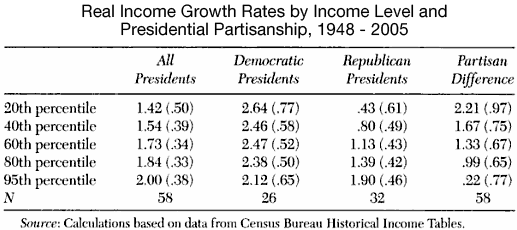
Liberal politicians and activists have long argued that the federal government caused the Great Divergence. And by "federal government," they generally mean Republicans, who have controlled the White House for 20 of the past 30 years, after all. A few outliers even argue that for Republicans, creating income inequality was a conscious and deliberate policy goal.
Until recently, the consensus among academicsâeven most liberal onesâwas quite different. Economists argued that the Great Divergence was the result not of Washington policymaking but of larger "exogenous" (external) and "secular" (long-term) forces. In June, the Congressional Budget Office calculated that spending by the federal government made up 23 percent of U.S. gross domestic product, after averaging 18.5 percent during the previous four decades. But even with federal spending at this unusually high level (necessitated by a severe recession), Washington's nut remains less than one-quarter the size of the economy. Most of that nut is automatic "entitlement" spending over which Washington policymakers seldom exert much control. Brad DeLong, a liberal economist at Berkeley, expressed the prevailing view in 2006: "[T]he shifts in income inequality seem to me to be too big to be associated with anything the government does or did."
My Slate colleague Mickey Kaus took this argument one step further in his 1992 book The End of Equality, positing that income inequality was the inevitable outgrowth of ever-more-ruthlessly efficient markets, and that government attempts to reverse it were certain to fail. "[Y]ou cannot decide to keep all the nice parts of capitalism," he wrote, "and get rid of all the nasty ones." Instead, Kaus urged liberals to combat social inequality by nurturing egalitarian civic institutions (parks, schools, libraries, museums) and by creating some new ones (national health care, national service, a revived WPA) that remove many of life's most important activities from the "money sphere" altogether.
Finding ways to increase social equality is an important goal, and Kaus's book remains a smart and provocative read. But the academic consensus that underlay Kaus's argument (and Long's more modest one) has lately started to crumble.
Economists and political scientists previously resisted blaming the Great Divergence on government mainly because it didn't show up when you looked at the changing distribution of federal income taxes. Taxation is the most logical government activity to focus on, because it is literally redistribution: taking money from one group of people (through taxes) and handing it over to another group (through government benefits and appropriations).
Another compelling reason to focus on taxation is that income-tax policy has changed very dramatically during the last 30 years. Before Ronald Reagan's election in 1980, the top income tax bracket stood at or above 70 percent, where it had been since the Great Depression. (In the 1950s and the Mad Men early 1960s, the top bracket exceeded 90 percent!) Throughout the Great Compression, as the economy boomed and income inequality dwindled, the top bracket resided at a level that even most Democrats would today call confiscatory. Reagan dropped the top bracket from 70 percent to 50 percent, and eventually pushed it all the way down to 28 percent. Since then, it has hovered between 30 percent and 40 percent. If President Obama lets George W. Bush's 2001 tax cut expire for families earning more than $250,000, as he's expected to do, Tea Partiers will call him a Bolshevik. But at a whisker under 40 percent (up from 35), the top bracket would remain 30 to 50 percentage points below what it was under Presidents Eisenhower, Nixon, and Ford. That's how much Reagan changed the debate.
But tax brackets, including the top one, tell you only the marginal tax rate, i.e., the rate on the last dollar earned. The percentage of total income that you actually pay in taxes is known as the effective tax rate. That calculation looks at income taxed at various rates as you move from one bracket to the next; it figures in taxes on capital gains and pensions; it figures in "imputed taxes" such as corporate and payroll taxes paid by your employer (on the theory that if your boss didn't give this money to Uncle Sam he'd give it to you); and it removes from the total any money the federal government paid you in Social Security, welfare, unemployment benefits, or some other benefit. Reagan lowered top marginal tax rates a lot, but he lowered top effective tax rates much lessâand certainly not enough to make income-tax policy a major cause of the Great Divergence.