
Why are living standards in the western world still far ahead of emerging countries?

I'd speculate that the people that have been in the lead for centuries will continue to be in the lead.

Cultures always gain by cross pollenization of ideas. The internet is good for that, ideas spread very fast in a monkey see monkey do world. People have always been quick to glom on to a better way of doing almost anything, once they see it. So probably the world will flatten out a good bit with regard to the differences between the lowest economic conditions and the highest...

Mechanization and commercialization has caused the US food supply to become largely devoid of nutrients. We have way overshot the mark in that area, we could learn from most other cultures how to grow nutritious food and be a lot better off. They are learning from us that they can have medical care and technology...
 
The way to answer this question is the way to approach any question - look at as much evidence across as much history and geography as possible, then look for patterns, then try to test them first on a backward-looking and ultimately on a forward-looking basis. If it's confirmed by past and future results, you might be onto something.

One example of this approach and the conclusions derived:

http://www.policynetwork.net/main/content.php?content_id=55

Probably not the whole truth, but far closer than explanations driven by opinions, prejudices, cultural bias and political ideology.
 
Quote from fkbsuhites:


In Germany or most western countries I can leave stuff laying around, leave then come back and still find the stuff there. Try doing that in any of these shitty countries.

Good luck with that in Kreuzberg or Neu Koeln.
 
Quote from Misthos:

The med is one of the oldest fished seas in the world. Same with Sea of Japan.

We're not too far behind. I fish the Northeast - especially Striped Bass. Have you read accounts about the Northeast from 200+ years ago? It was a friggin cornucopia of wildlife. The Hudson river would be covered with waterfowl. The sky would blacken in the middle of the day during the seasonal migration of geese and duck. On the beaches, bird nests and eggs would litter the sand dunes. The dutch named a town Egg Harbor in NJ for a reason - the beaches had so many eggs lying about. Fishing the beaches was a no brainer - striped bass, bait fish, blues, etc... would darken the beaches during migrations. Dark clouds of biomass just 10-30 feet from the shoreline. All you needed was some rope and a hooked spoon and you handlined the fish. 30-50 pounders right at your feet. It was that easy.

Hitting two birds with one stone was not a saying - it was actually quite easy to do. In the Chesapeake small canons were mounted on boats and shot down tens of waterfowl at a time.... hundreds harvested daily.

That's amazing.
 
Quote from Debaser82:

I agree on most of your analysis and other coments made in this topic on why the western world is on a slippery slope.

I just find it intriguing why people can name a thousand reasons why things are bad but they can barely name one reason why it is even worse elsewhere.

I take it the foundation providing the western world a higher standard of living these past decades has elements of politics, social progress, luck, geographical advantages and resource richness among many others to it but I would like to gain insights on those elements and which ones have been the most responsible for the relative advantage compared to many other places around the world.

Hence the topic.

Historically, a surge in living standards was associated with free enterprise, the right to private property and the rule of law.

Even going back to the Roman, Babylonian and Greek empires, they all had it.

Capitalism (or free enterprise) doesn't work without laws (morality). The basis of that, is religion and cohesive Government to enforce laws (fear of God(s) and a big stick).

Recently, Africa, large parts of the Middle East and China were tribal (relatively lawless). Western Europe and North America, were not.

Society is synergy. Cooperation between humans creates more wealth/technology/products than any one person can, acting alone.

Take a look around. A skyscraper. A highway. An automobile. A jet plane. Could any of those items be created from the sole efforts of one person? Or a handful of people?

No way. It takes generations of scientists, inventors, designers and investors - all working under the same cultural umbrella - to build and lay the groundwork of knowledge before such an endeavor can even be fathomed.

Highly fractured societies that make war-mongering their chief past-time, don't perform meaningful research, develop or trade technology. Private property doesn't exist so there's no incentive to create or invest in something that will be stolen or destroyed. Likewise, peoples inhabiting resource-deprived areas (middle east, deserts, tundra), devote their entire lives to hunting food. No specialization of labor there.

The development of the Monarchy, nationalism (anti-thesis of tribalism), and some form of free(r) enterprise - even serfdom - brought Europe out of crushing poverty and towards progress. I think.
 
Quote from Misthos:


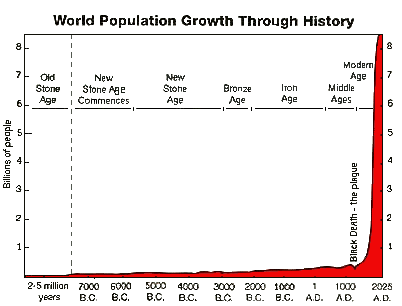
Nothing can maintain a parabloic growth rate forever. Especially on a finite planet.

Expect some major changes the next 50 years. We reached a point of acceleration of consumption growth that will end badly for most on this planet.

My guess this century.

worldpopgr.gif

Even the UN predicts global population will top out at 8 Billion.

Globalization and China's one-child policy, will see to it.

The earth is a VAST place. Humans just inhabit the skin on the apple. Then, to the stars.
 
Quote from maxpi:

I live in California and right next door is Mexico... Mexico has the natural resources that the US does, probably a lot more really... they have the Sonoran Desert where it gets to 140 degrees. They could supply at the very least, their entire country with very cheap electricity. But they are a lawless shithole where you can't even drink the water... It's about the people and their own decisions to be barbaric or to understand what cooperation brings.. some people have it, some don't. Expecting much to change is silly...

Good example.
 
Quote from Debaser82:

China is the most poluting country in the world.

The 10 most poluting cities in the world are either in India or China.

In India at a Managerial level, a person generally works for 11 hours a day and 6 days a week. A typical office will open at 09:00 or 09:30 and officially end the work day at about 19:00. However, many workers and especially managers will stay later in the office due to additional work load. This is equivalent to 66 hours a week, or 3,400+ hours per year.


The short answer is technology.

Technology is productivity.

1 US hour worked could equate to 30 or 40 hours worked, per Chinese or Indian.

A highly educated workforce and mechanization are responsible for that.

Imagine the Telephone. Invented by one smart dude. Does the work of 1,000 Chinese couriers.
:p
 
Quote from Debaser82:

Ofcourse, hence the reason for instance why the western world has nothing to gain by allowing commodity basket of the world Africa to install any form of rule of law as it would damage most of our interests there.


If you follow that way of thinking strict you could say the US would be better of in the long run allowing the banks to collapse and send them through bankruptcy court then propping them up as they did but then again that would kick of Great Depression nr 2 and now why would anyone would be in favor of that?:)

if system does not rid itself of excesses it eventually collapses completely or stagnates for very long periods.
the US would have been much better off to let the banks collapse by breaking them up into parts and selling them off.


what is better a short sharp pain or a long lingering pain?
 
I think the number one factor is private ownership of land and buildings, and the ability to sell and buy them. You guys don't know how important that was to the creation of wealth

:cool:
 
Back
Top