
You are using an out of date browser. It may not display this or other websites correctly.
You should upgrade or use an alternative browser.
You should upgrade or use an alternative browser.
White House: Don’t Mention Temperature When Analyzing Global Warming
- Thread starter JamesL
- Start date

As this chart clearly shows, the change in CO2 lags the change in temps.
FC, I don't understand why you are so obtuse in this matter. Even the AGW nutters admit that CO2 lags temps.
But I agree. In the past temps go up before CO2. The rising CO2 levels then further rise temps which causes more CO2 release. It's called a feedback loop.
Now show me a period in the past where 9 billion tons per year of CO2 was being pumped into the atmosphere like we are doing today and maybe we can make some valid comparison to today.
Your quote is, of course, from the now famous, or infamous, paper that Lacis published on the GISS site five years ago. A paper that has been thoroughly critiqued by now and found wanting. I'll briefly summarize it. In 2010, Lacis, et al. used one of the better radiative forcing models then available to explore what would happen (according to the model) if CO2 were removed from the atmosphere. The results showed, that in the absence of CO2, clouds would disappear and this would lead to plummeting temperature (over time of course). This is what justified (according to the model, and Lacis' thinking at the time) the statement, often repeated by our own FC, that CO2 is the Earth's "thermostat" and "the most important greenhouse gas" despite it being not nearly so effective in its greenhouse properties as water.Piehole seems to forget that CO2 is the most important GHG on earth and is responsible for setting the temp levels. Solar is actually just an initiating force. CO2 is responsible for around 80% of the greenhouse effect. Without which the earth would be much much colder.
Radiative modeling analyses of the terrestrial greenhouse structure described in a parallel study in theJournal of Geophysical Research(Schmidt et al., 2010) found that water vapor accounts for about 50% of the Earth's greenhouse effect, with clouds contributing 25%, carbon dioxide 20%, and the minor greenhouse gases (GHGs) and aerosols accounting for the remaining 5%, as shown in Fig. 1. Thus, while the non-condensing greenhouse gases account for only 25% of the total greenhouse effect, it is these non-condensing GHGs that actually control the strength of the terrestrial greenhouse effect since the water vapor and cloud feedback contributions are not self-sustaining and as such, only provide amplification.
http://www.giss.nasa.gov/research/briefs/lacis_01/
I can now categorically say that this statement made by Lacis back in 2010 is wrong. CO2 is not the Earth's thermostat , and it is not by any means more important than water in moderating the Earths climate.
If one insists on choosing what is important to moderating,i.e., tending to keep the Earths temperature constant, it is of course the oceans and hence water. The thermal and mass exchanges that take place at the interface between atmosphere and ocean along with the Ocean's albedo, are extremely important. There are four other interfaces, however, that are important as well. One is the interface at the upper boundary of clouds, another is the interface at the lower boundary. A fourth interface that plays a critical role is that between the atmosphere and outer space. And of course the fifth important interface is that between land and the atmosphere. These five interfaces, their albedoes, and the mass and energy exchanges across them are the Earth's true thermostat, but only in the sense that they function together to keep the Earth's surface temperature from changing dramatically from day to night. Their function is to hold the temperature somewhere near the midpoint of what the range would be were there no atmosphere at all. The Sun and the planet's core comprise the Earth's furnace. What exactly is the Earth's "control knob", as Lacis put it, is yet to be determined, but there is almost certainly more than a single knob involved.
Although CO2 is hugely important to the existence of life on Earth, it plays only a minor and indirect role in affecting climate. Where then did Lacis, in his "Earth's Thermostat" paper, go wrong? Well, we could start with his model's not forming any clouds in the absence of CO2, and ignoring wind. The only clouds his model produced were those that formed from radiative forcing due to CO2, so when CO2 was removed the model stopped making clouds!!! Outside the model world, however, wind comes from uneven heating, and if solar heating and water is present, clouds will form, whether or not CO2 is present!
Lacis' model produced clouds when CO2 was present, but none when CO2 content was reduced to zero. The clouds produced by the model resulted in further radiative heating (positive feedback that is a ubiquitous feature needed to get exponential temperature rises out of smallish increases in CO2). But, in the model, clouds formed only when radiative heating from the greenhouse effect of CO2 was present. Cloud formation was dependent on CO2 being present! Clouds are impermanent; CO2 is permanent (until you instruct your model to remove it). Based on these results from the model's simulation of what would happen if CO2 was removed from the atmosphere, Lacis apparently felt justified in proclaiming that CO2 was the "Thermostat" and "control knob".
The result, naturally, of removing both CO2 and clouds, was that the Earth got unbearably cold, -20 deg C. (Presumably that is the average temperature, since during the model day it should have been damn hot. (I am assuming Lacis did not forget to turn on the Sun.) Everything reported is, by definition, true and correct in that Model's world. The results it produced, however, have nothing to do with the real world, where if all CO2 suddenly vanished, we would vanish but clouds would go on forming and playing their dual role of both cooling during the day and heating during the night -- assuming of course the Sun hadn't burned out.
The air over the desert has about the same CO2 content as the air over the prairie. The prairie is cooler during the day and warmer at night than the desert! The difference is not CO2, it is water vapor! If CO2 is the control knob it needs to be returned for manufacturing defects!
I my opinion, Hansen and Lacis formulated their problem incorrectly from the very beginning, and they have not recognized it yet. Atmospheric components such as water and CO2 alter the rate of heating and cooling, and can therefore only indirectly affect temperature maximum and minimum, as dictated by the length of time the "furnace", i.e., Sun and Earth's core, is on, and how much fuel is on the fire. (The main furnace is on during the day and off at night. The portable heater, i.e., volcanoes, are on and off on their own schedule. Think of these things, the next time, after a day of parching heat in the desert, you bed down for the night. Your going to need a blanket despite that nearly 400 ppm of CO2 that's up there!
Last edited:
We have only to look at the failure of all the recent models.
You're right in that we have pumped billions of tons of CO2 into the air. And look what happened. Temps actually leveled off and there has been no net increase in temps for 18 years.
So much for "settled" science.
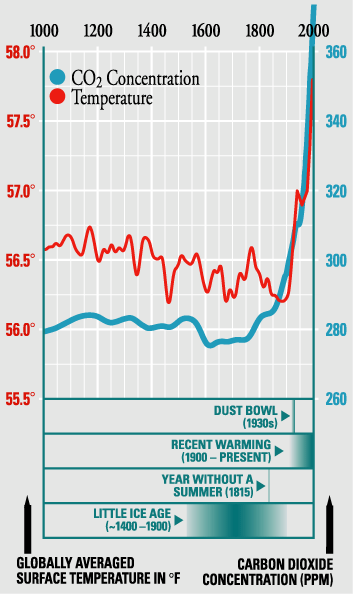
It's clear what's happening as we pump CO2 into the air. Anyone who thinks temps go in a straight line is an idiot.
The following chart is clear proof of what happens when CO2 levels increase. Because CO2 is an important greenhouse gas. There is no question about it.
Your quote is, of course, from the now famous, or infamous, paper that Lacis published on the GISS site five years ago. A paper that has been thoroughly critiqued by now and found wanting. I'll briefly summarize it. In 2010, Lacis, et al. used one of the better radiative forcing models then available to explore what would happen (according to the model) if CO2 were removed from the atmosphere. The results showed, that in the absence of CO2, clouds would disappear and this would lead to plummeting temperature (over time of course). This is what justified (according to the model, and Lacis' thinking at the time) the statement, often repeated by our own FC, that CO2 is the Earth's "thermostat" and "the most important greenhouse gas" despite it being not nearly so effective in its greenhouse properties as water.
I can now categorically say that this statement made by Lacis back in 2010 is wrong. CO2 is not the Earth's thermostat , and it is not by any means more important than water in moderating the Earths climate.
If one insists on choosing what is important to moderating,i.e., tending to keep the Earths temperature constant, it is of course the oceans and hence water. The thermal and mass exchanges that take place at the interface between atmosphere and ocean along with the Ocean's albedo, are extremely important. There are four other interfaces, however, that are important as well. One is the interface at the upper boundary of clouds, another is the interface at the lower boundary. A fourth interface that plays a critical role is that between the atmosphere and outer space. And of course the fifth important interface is that between land and the atmosphere. These five interfaces, their albedoes, and the mass and energy exchanges across them are the Earth's true thermostat, but only in the sense that they function together to keep the Earth's surface temperature from changing dramatically from day to night. Their function is to hold the temperature somewhere near the midpoint of what the range would be were there no atmosphere at all. The Sun and the planet's core comprise the Earth's furnace. What exactly is the Earth's "control knob", as Lacis put it, is yet to be determined, but there is almost certainly more than a single knob involved.
Although CO2 is hugely important to the existence of life on Earth, it plays only a minor and indirect role in affecting climate. Where then did Lacis, in his "Earth's Thermostat" paper, go wrong? Well, we could start with his model's not forming any clouds in the absence of CO2, and ignoring wind. The only clouds his model produced were those that formed from radiative forcing due to CO2, so when CO2 was removed the model stopped making clouds!!! Outside the model world, however, wind comes from uneven heating, and if solar heating and water is present, clouds will form, whether or not CO2 is present!
Lacis' model produced clouds when CO2 was present, but none when CO2 content was reduced to zero. The clouds produced by the model resulted in further radiative heating (positive feedback that is a ubiquitous feature needed to get exponential temperature rises out of smallish increases in CO2). But, in the model, clouds formed only when radiative heating from the greenhouse effect of CO2 was present. Cloud formation was dependent on CO2 being present! Clouds are impermanent; CO2 is permanent (until you instruct your model to remove it). Based on these results from the model's simulation of what would happen if CO2 was removed from the atmosphere, Lacis apparently felt justified in proclaiming that CO2 was the "Thermostat" and "control knob".
The result, naturally, of removing both CO2 and clouds, was that the Earth got unbearably cold, -20 deg C. (Presumably that is the average temperature, since during the model day it should have been damn hot. (I am assuming Lacis did not forget to turn on the Sun.) Everything reported is, by definition, true and correct in that Model's world. The results it produced, however, have nothing to do with the real world, where if all CO2 suddenly vanished, we would vanish but clouds would go on forming and playing their dual role of both cooling during the day and heating during the night -- assuming of course the Sun hadn't burned out.
The air over the desert has about the same CO2 content as the air over the prairie. The prairie is cooler during the day and warmer at night than the desert! The difference is not CO2, it is water vapor! If CO2 is the control knob it needs to be returned for manufacturing defects!
I my opinion, Hansen and Lacis formulated their problem incorrectly from the very beginning, and they have not recognized it yet. Atmospheric components such as water and CO2 alter the rate of heating and cooling, and can therefore only indirectly affect temperature maximum and minimum, as dictated by the length of time the "furnace", i.e., Sun and Earth's core, is on, and how much fuel is on the fire. (The main furnace is on during the day and off at night. The portable heater, i.e., volcanoes, are on and off on their own schedule. Think of these things, the next time, after a day of parching heat in the desert, you bed down for the night. Your going to need a blanket despite that nearly 400 ppm of CO2 that's up there!
Blah blah blah. I'm not reading this steaming pile of empty horseshit. See the chart in the above post.
The burden of proof is on the denialists to show how a rise of one of earth's most important greenhouse gas could NOT cause a rise in temps.
Since the denialists are staking out the least logical position it is up to them to prove why the most logical thing - a rise in temps - should NOT happen.
Until they do, which they can't, the science is as outlined by the following sci orgs....and the overwhelming scientific consensus remains unmoved.
Since the denialists are staking out the least logical position it is up to them to prove why the most logical thing - a rise in temps - should NOT happen.
Until they do, which they can't, the science is as outlined by the following sci orgs....and the overwhelming scientific consensus remains unmoved.
- Statement on climate change from 18 scientific associations
"Observations throughout the world make it clear that climate change is occurring, and rigorous scientific research demonstrates that the greenhouse gases emitted by human activities are the primary driver." (2009)2

American Association for the Advancement of Science
"The scientific evidence is clear: global climate change caused by human activities is occurring now, and it is a growing threat to society." (2006)3

American Chemical Society
"Comprehensive scientific assessments of our current and potential future climates clearly indicate that climate change is real, largely attributable to emissions from human activities, and potentially a very serious problem." (2004)4

American Geophysical Union
"Human‐induced climate change requires urgent action. Humanity is the major influence on the global climate change observed over the past 50 years. Rapid societal responses can significantly lessen negative outcomes." (Adopted 2003, revised and reaffirmed 2007, 2012, 2013)5

American Medical Association
"Our AMA ... supports the findings of the Intergovernmental Panel on Climate Change’s fourth assessment report and concurs with the scientific consensus that the Earth is undergoing adverse global climate change and that anthropogenic contributions are significant." (2013)6

American Meteorological Society
"It is clear from extensive scientific evidence that the dominant cause of the rapid change in climate of the past half century is human-induced increases in the amount of atmospheric greenhouse gases, including carbon dioxide (CO2), chlorofluorocarbons, methane, and nitrous oxide." (2012)7

American Physical Society
"The evidence is incontrovertible: Global warming is occurring. If no mitigating actions are taken, significant disruptions in the Earth’s physical and ecological systems, social systems, security and human health are likely to occur. We must reduce emissions of greenhouse gases beginning now." (2007)8

The Geological Society of America
"The Geological Society of America (GSA) concurs with assessments by the National Academies of Science (2005), the National Research Council (2006), and the Intergovernmental Panel on Climate Change (IPCC, 2007) that global climate has warmed and that human activities (mainly greenhouse‐gas emissions) account for most of the warming since the middle 1900s." (2006; revised 2010)9
- International academies: Joint statement
"Climate change is real. There will always be uncertainty in understanding a system as complex as the world’s climate. However there is now strong evidence that significant global warming is occurring. The evidence comes from direct measurements of rising surface air temperatures and subsurface ocean temperatures and from phenomena such as increases in average global sea levels, retreating glaciers, and changes to many physical and biological systems. It is likely that most of the warming in recent decades can be attributed to human activities (IPCC 2001)." (2005, 11 international science academies)10

U.S. National Academy of Sciences
"The scientific understanding of climate change is now sufficiently clear to justify taking steps to reduce the amount of greenhouse gases in the atmosphere." (2005)11

U.S. Global Change Research Program
"The global warming of the past 50 years is due primarily to human-induced increases in heat-trapping gases. Human 'fingerprints' also have been identified in many other aspects of the climate system, including changes in ocean heat content, precipitation, atmospheric moisture, and Arctic sea ice." (2009, 13 U.S. government departments and agencies)12

Intergovernmental Panel on Climate Change
“Warming of the climate system is unequivocal, as is now evident from observations of increases in global average air and ocean temperatures, widespread melting of snow and ice, and rising global average sea level.”13
“Most of the observed increase in global average temperatures since the mid-20th century is very likely* due to the observed increase in anthropogenic greenhouse gas concentrations.”14
*IPCC defines ‘very likely’ as greater than 90 percent probability of occurrence.
- List of worldwide scientific organizations
The following page lists the nearly 200 worldwide scientific organizations that hold the position that climate change has been caused by human action.
http://opr.ca.gov/s_listoforganizations.php
Blah blah blah. I'm not reading this steaming pile of empty horseshit. See the chart in the above post.


That chart is a steaming pile of horse shit.It's clear what's happening as we pump CO2 into the air. Anyone who thinks temps go in a straight line is an idiot.
The following chart is clear proof of what happens when CO2 levels increase. Because CO2 is an important greenhouse gas. There is no question about it.

That chart is a steaming pile of horse shit.
Want a spoon?