John Authers @johnauthers 4h4 hours ago
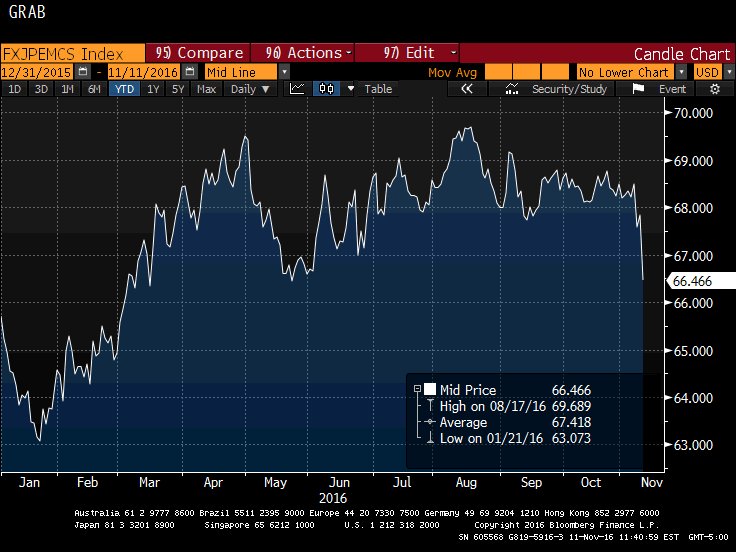
The Tariff Tantrum continues apace: this is the JPM EM FX index:
------------------------------------------------------------------------------------------
Income Investing
News, analysis and commentary on income-generating investments.
- November 11, 2016, 2:58 P.M. ET
Auto Industry Is Most at Risk from Trump Trade Plans


 By Amey Stone
U.S. automakers would suffer more than any other sector if President-elect Donald Trump succeeds in implementing tariffs and barriers to trade,
Standard & Poor‘s concludes in a report published Friday.
Here’s what analysts have to say about that sector:
We see autos as the only industry facing a high and negative impact from policies the new administration may adopt. President-elect Trump has vowed, in his first 100 days, to renegotiate the North American Free Trade Agreement (NAFTA), which would have a clear effect on the sector’s supply chain. Changes to the agreement could weigh heavily on long-term profitability for automakers that plan to shift small-car production to Mexico, and others that want to use Mexico as a production hub for emerging markets. Higher tariffs could raise costs, hurt profit margins, and worsen credit metrics. To the extent such renegotiation leads to uncertainty, it may create downside risks for some ratings and outlooks in the sector.
Despite the risk, automakers rose in the past week as investor expectations that the Republican sweep in Washington will lead to a stronger economy lifted stocks.
General Motors (
GM) and
Ford Motor (
F). They climbed about 8% in the past week.
David Tesher, one of the analysts who wrote the report, notes that some policy changes would be positive for some sectors. He comments:
We don’t assume all campaign platform rhetoric will transform into government policy. Nonetheless, we believe that, on balance, some of the more realistic policy changes could be positive for corporate taxes, coal-related activities, infrastructure, defense spending, and business regulation; but possibly negative for sectors that are more dependent on trade and immigration.