
Where are all the Trading and/or Investing topics showing Funnymentals work ....

Trading is hard, it is not easy. But if you decide to go down that path, before you even get started trading you'd want to spend some time getting acquainted with the literature. I'll use oil as an example.

There's a large body of research you can read to get caught up on how current market actors are evaluating and forecasting the price of oil: (this is from a Fed paper published over a decade ago)
View attachment 308371

For oil you have some distinct steps between production and market prices, mainly, production capacity, inventories, and marginal changes in demand. Each step needs to be monitored and you would ideally have some type of model that links the delta of production to a prediction to a delta of inventories and vice versa. Inventory fluctuations are more sensitive to changes in marginal demand ex-bottle necks.

So your building blocks for trading are:
(a) supply/demand imbalances are you table stakes (keeping track of eco releases, having a model that links them all)
(b) must know street views (what's the consensus forecast for oil this q and fy?), rationale, etc. -- this is a proxy of real-time investor positioning
(c) unique insight or view that diverges from the street view

For example:
The context is that global economic growth is expected to ramp up in 2023 driven by Chinese reopening, an improving economic situation in Europe, and a very strong labor market in the US. (This is an example of a so called "narrative")

(Example) Lately, US supply data has improved (oil rig counts, etc.) which has put downward pressure on oil prices as inventories increased. However, street views (Goldman, JP, MS, etc.) are still calling for a super cycle in commodities and higher energy prices.

You do some research and find that Chinese demand is cooling given that the stimulus announced is much less than what was expected... but the impact to global oil demand is not massive; you plug in your new demand per day and get an oil price that would clear inventories -- say it's $5 below current prices. It's not necessarily worth going outright short unless the price moves higher. This is an earned insight... you now have a reason to disagree with street views.

Now you can make a few trades -- you might look at oil futures or options to see how the curve is structured.
View attachment 308372

Trade ideas:
(1) go outright short spot/current month futures around eco releases IF you have conviction in view; if not, go short after to ride momentum -- ultimately looking to fade all rallies based upon reopening/accelerating GDP views
(2) sell future/buy near as you expect the oil curve to invert further
(3) etc. etc.

You could trade this tactically e.g. around eco releases, or carry a short position until you start to see Street Views revised lower (means info is now priced in, there's no big position on the other side of your trade).
I appreciate your thoughtful and detailed response. Really. However, in all candor, the scope of your proposed analysis is frankly beyond my ability to juggle so many moving parts coherently and reliably. I have no doubt that the professionals engage in this form of analysis. However, they also have resources at their disposal to play this game far better than I can ever hope to do. And so, I am left to play a different game. (There is more than just one in the market ecosystem, as I'm sure you know.)

Forgive me, but I almost equate your recommendation to someone advising a duck or rabbit hunter to study zoology and biology to understand his prey, and the physics of firearm discharges. And while that may have merit, one can arguably also practice shooting at moving targets when the getting looks good.
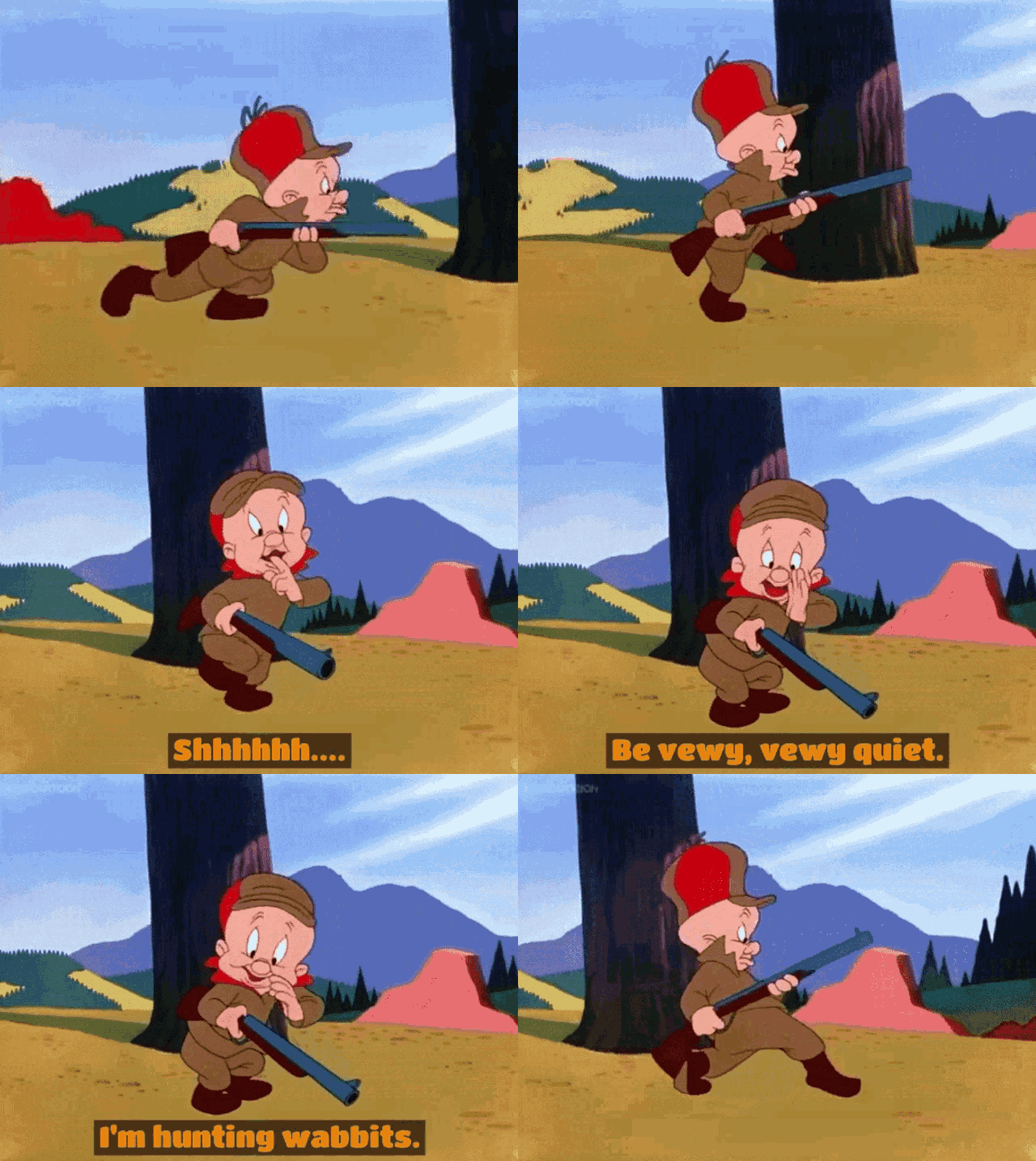
elmer-fudd-very-quiet.gif


:D
 
Objective chart pattern analysis.
If you show different people the same chart and they arrive at different assessments or conclusions using the standard chart patterns covered in TA books, then those patterns are arguably subjective. (Or they may have different time horizons, skill levels, etc. But usually, I'm guessing they will just read the chart differently and draw different lines or whatever.) Not that there is necessarily anything wrong with subjectivity, since I suppose that's how discretionary trading works in large part. I just prefer to minimize subjectivity to the extent possible, whereby the same pattern would be assessed by different people in the exactly same way. To me, that makes for a better starting point from which to throw in some discretion into the mix.
 
If you show different people the same chart and they arrive at different assessments or conclusions using the standard chart patterns covered in TA books, then those patterns are arguably subjective. (Or they may have different time horizons, skill levels, etc. But usually, I'm guessing they will just read the chart differently and draw different lines or whatever.) Not that there is necessarily anything wrong with subjectivity, since I suppose that's how discretionary trading works in large part. I just prefer to minimize subjectivity to the extent possible, whereby the same pattern would be assessed by different people in the exactly same way. To me, that makes for a better starting point from which to throw in some discretion into the mix.
Objectivity.
That's what clearcut setup and entry trigger instructions, rules, and stats are for.
Look at a classic double bottom setup as detailed in the link below. Please tell me which of the
numbered steps in that setup is subjective. Are you blaming the setup for the actions of the
operator? Yuge difference.
Double Top and Bottom
https://elitetrader.com/et/threads/...t-right-here-baby.335635/page-18#post-5309309
 
Objectivity.
That's what clearcut setup and entry trigger instructions, rules, and stats are for.
Look at a classic double bottom setup as detailed in the link below. Please tell me which of the
numbered steps in that setup is subjective. Are you blaming the setup for the actions of the
operator? Yuge difference.
Double Top and Bottom
https://elitetrader.com/et/threads/...t-right-here-baby.335635/page-18#post-5309309
I am not going to argue with you if what you use works for you. I don't like trend lines, I don't like H&S, and I don't like profit targets. I bought into them when I first read about them years ago, but found they were not for me.

As an aside, I've seen different people draw trend lines differently, interpret muddled "H&S" patterns differently, and found measured-move targets to be without value. To his credit, Vic Sperandeo wrote a couple of trading books in the '90s where he objectively drew a trend line that anyone would draw in exactly the same way following his steps. Even so, I still don't find them useful. For me.

Interestingly, Peter Brandt wrote a book over a decade ago:


He's principally a TA guy who reportedly managed hedge funds or some such. I don't know. In any event, at the conclusion of his book, he reports that diagonal lines (i.e., trend lines) did not serve him well. And, if I remember correctly, he also found that measure move price targets did not serve him well. (My only question was, why did it take him so long to arrive at that conclusion?)

Here's an exchange I had about the book with another member a dozen years ago when I had a different user name:

https://www.elitetrader.com/et/thre...rading-perspective.212857/page-2#post-3122156
 
Last edited:
I am not going to argue with you if what you use works for you.
No argument to it.
If it is subjective, you can have it, lol.

For me, objective wins the day.
First the alternative: According to what those who claim to be such here on ET say, the artistic intuitive approach, especially before objective setup mastery, appears to be a tough, long, ill-defined row to hoe littered with confusion and pain, especially after the days of buy and hope helicopter money run down.

If a setup / trigger pair is objective, on the other hand, it is amenable to testable black and white rules without handwaving longwinded explanations and special cases and predictions.
That makes it possible for a trader to do their own stats, not rely on rumour, but actually test each setup before putting it into their toolbox for use when appropriate, which allows one be a self reliant trader.
How many actually do the testing? LOL.
 
Last edited:
Back
Top