
We can now see clearly to the outcome of Trump's Tariffs.

Exclusive: As Trump trashes NAFTA, Mexico turns to Brazilian corn


HICAGO/MEXICO CITY (Reuters) - Mexican buyers imported ten times more corn from Brazil last year amid concern that NAFTA renegotiations could disrupt their U.S. supplies, according to government data and top grains merchants.

Mexico is on track to buy more Brazilian corn in 2018, which would hurt a U.S. agricultural sector already struggling with low grains prices and the rising competitive threat from South America.

U.S. farmers, food processors and grain traders have spent months trying to prevent trade relationships from falling apart if the North American Free Trade Agreement implodes. They are trying to protect more than $19 billion in sales to Mexican buyers of everything from corn and soybeans to dairy and poultry.

Despite their efforts, South American corn shipments to Mexico are surging. Mexican buyers imported a total of more than 583,000 metric tonnes of Brazilian corn last year – a 970 percent jump over 2016, according to data from Mexico’s Agrifood and Fishery Information Service (SIAP).


The purchases all came in the last four months of last year. They followed visits by Mexican government officials and grains buyers to Brazil and Argentina to explore alternative supply options in the months after U.S. President Donald Trump took office and threatened to tear up the trade pact.

Mexico has long been the top importer of U.S. corn, and is the second largest buyer of U.S. soybeans, giving Mexico leverage in corn-belt states that are staunch Trump supporters but also strongly back the trade status quo.

Mexico’s Economy Minister Ildefonso Guajardo, who is overseeing Mexico’s NAFTA neogitating team, encouraged the country’s major grain buyers last year to explore South American corn to strengthen his hand at the negotiating table, saying the country needed a “Plan B” in case Washington pulled out of the trade deal.

Cheaper prices for Brazilian corn drove some of purchases by Mexican buyers. But in other cases, they bought Brazilian corn even when it cost more than U.S. supplies, executives and traders told Reuters.

“We bought from Brazil for two reasons,” said Edmundo Miranda, commercial director of Grupo Gramosa, one of Mexico’s top grains merchants. “One, because it was competitive. Two, to see how practical and profitable it was to buy from Brazil or Argentina given the possibility of trade tariffs because of NAFTA renegotiations.”

-----------
-----------

Wow all that NAFTA talk and looky there, Mexico buying from other countries. Good job Mr. President.


Trump's tariffs will enrich the special interests at the expense of consumers.


Some truth in that article but a massive amount of bullfeathers there too.

The truth is that the Mexican peso/dollar was in the shitter during that period and they could not afford as much American corn as before so they went looking for cheaper corn in Brazil. Meanwhile the value of American corn exports was up over 33% because Japan increased their import of American corn over 50% and they were able to pay a better price than Mexico because they are not a shit-hole country. So things worked out for the Mexicans and for the Americans, and that's fine. And sales to Mexico are beginning to pick up as the Mexican peso recovers.

As an aside, but related, as long as we are still having a good business flow in all sectors I do like to see countries increasing their capacity through trade with some countries other than the U.S. I get sick of this constant drumbeat of horseshit in regard to countries like Cuba and Venezula making the case that they are poor because we do or do not do business with them. Screw you for chrissake. There is a whole world out there. It is not America's fault that all your commie buddy allies are broke and that the Revolution apparently requires American dollars to work. Go find some business partners or sit there in your shit hole country and be broke. Learn something about how to do business as commie countries like China and VietNam did. Mexico is doing more business with Brazil? Good for them and good for Brazil. That much less foreign aid that you will be needing. And Japan wanted the corn at a better price than Mexico, then good for them and good for the U.S. It's not all a zero sum game.
 
Last edited:
Some truth in that article but a massive amount of bullfeathers there too.

The truth is that the Mexican peso/dollar was in the shitter during that period and they could not afford as much American corn as before so they went looking for cheaper corn in Brazil. Meanwhile the value of American corn exports was up over 33% because Japan increased their import of American corn over 50% and they were able to pay a better price than Mexico because they are not a shit-hole country. So things worked out for the Mexicans and for the Americans, and that's fine. And sales to Mexico are beginning to pick up as the Mexican peso recovers.

As an aside, but related, as long as we are still having a good business flow in all sectors I do like to see countries increasing their capacity through trade with some countries other than the U.S. I get sick of this constant drumbeat of horseshit in regard to countries like Cuba and Venezula making the case that they are poor because we do or do not do business with them. Screw you for chrissake. There is a whole world out there. It is not America's fault that all your commie buddy allies are broke and that the Revolution apparently requires American dollars to work. Go find some business partners or sit there in your shit hole country and be broke. Learn something about how to do business as commie countries like China and VietNam did. Mexico is doing more business with Brazil? Good for them and good for Brazil. That much less foreign aid that you will be needing. And Japan wanted the corn at a better price than Mexico, then good for them and good for the U.S. It's not all a zero sum game.

There was a long period of time where there were articles about Mexico not being able to afford to pay for American corn and how this was impacting all of their traditional cooking. Naturally they went looking for a cheaper source and found Brazil - which increased their growing and exports.
 
There was a long period of time where there were articles about Mexico not being able to afford to pay for American corn and how this was impacting all of their traditional cooking. Naturally they went looking for a cheaper source and found Brazil - which increased their growing and exports.


Yup. Venezuela once was and may still be the biggest south American purchaser of American wheat and rice. Now they crow about not doing business with the capitalist gringos and Trump. Being dead broke could be another reason why they are doing less business. And having a currency where a large denomination bill is worth slightly more than a potato chip does not help.

Breakfast anyone?
http://www.latimes.com/world/mexico-americas/la-fg-venezuela-inflation-0531-snap-htmlstory.html
 
The story of corn in Mexico should be a cautionary tale on free trade policies. Corn has been long associated with Mexican national culture and identity. It is the primary ingredient in many traditional Mexican foods including tortillas and other foods that the poor consume.

Prior NAFTA, Mexico had a high tariff on imported corn and thriving community of corn farmers. When NAFTA came about the corn tariffs were reduced over a number of years, by the early 2000's cheap American corn was freely flowing into Mexico and the domestic corn industry completely went downhill with over 2 million unemployed farmers. In 2008 all the corn tariffs were due to end, but the Mexican corn farmer had already effectively gone out existence by this point.

"Tariffs protecting beans and corn, including the white corn Mexicans use for tortillas, which make up a third of their diet, are to end in January 2008. That is exposing Mexican corn farmers -- two-thirds of whom subsist on 12 acres or fewer and 90 percent of whom lack irrigation -- to competition with U.S. farmers who are so highly mechanized they can produce a metric ton of corn with a half-hour's labor, according to the U.S. Department of Agriculture."

So what happened after the U.S. decimated Mexican corn farming by shipping loads of cheap corn to Mexico -- well the Ethanol made from corn movement got moving in the U.S. driving corn prices through the roof - U.S. appetite for ethanol fuels rise in Mexican corn prices - screwing the entire population of a country that was dependent on reasonably priced corn -- but now no longer had a viable domestic corn farming industry -- and what little corn was produced was being shipped to the U.S. to make ethanol.

Now Mexico is seeking cheap sources of corn in South America -- this should not be surprising.

In this entire story lies a cautionary tale regarding the food security issues for a country relative to free trade agreements.
 
Let's take a look at Canada's reaction to protectionism...

Oh, your economy and currency is tanking...

Loonie dips below 77 cents US as Bank of Canada cites trade fears in interest rate decision
http://www.cbc.ca/news/business/bank-of-canada-rate-decision-1.4565579

Our economy is not tanking; in a recent time period we had the strongest economic growth in the G7. Our government is actively encouraging a lower dollar, and has done so since it was over par. We also raised interest rates in advance of the US, and further hikes are coming. They prevented a hike now because of Trump. Try to do better research.

Canada has legit fears that the US is being run by a nut that is fully capable of ruining perfectly good trade deals. We also know from the last 17 years that the US public can be persuaded to go along with crazy plans far too easily.
 
Eleven nations — but not US — to sign Trans-Pacific trade deal


Anthony Wallace | AFP | Getty Images
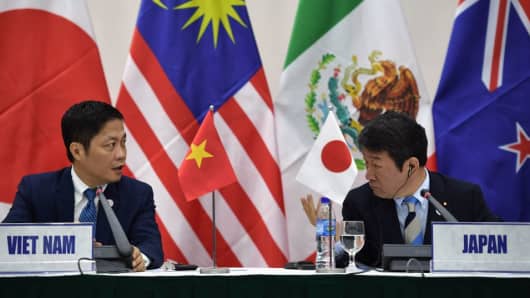
Vietnam's Trade Minister Tran Tuan Anh and Japan's Economic Revitalization Minister Motegi at a TPP press conference on November 11, 2017.
Eleven countries are expected to sign a landmark Asia-Pacific trade agreement in Santiago on Thursday, as an antidote to the increasingly protectionist bent of the United States, which last year pulled out of the pact.

The signing ceremony comes the day after Europe and the International Monetary Fund urged U.S. President Donald Trump to step back from the brink of a trade war sparked by plans to slap duties on steel and aluminum imports.

The Comprehensive and Progressive Agreement for Trans-Pacific Partnership (CPTPP) will reduce tariffs in countries that together amount to more than 13 percent of the global economy - a total of $10 trillion. With the United States, it would have represented 40 percent.

Even without the United States, the deal will span a market of nearly 500 million people, making it one of the globe's three largest trade agreements, according to Chilean and Canadian trade statistics.

The original 12-member agreement, known as the Trans-Pacific Partnership (TPP), was thrown into limbo early last year when Trump withdrew from the deal just three days after his inauguration in a bid to protect U.S. jobs.

The 11 remaining nations, led by Japan and Canada, finalized a revised trade pact in January.

Trump has also threatened to dump the North American Free Trade Agreement unless the other two members of the pact, Canada and Mexico, agree to provisions that Trump says would boost U.S. manufacturing and employment. He argues that the 1994 accord has caused the migration of jobs and factories southward to lower-cost Mexico.

The revised agreement, to be signed at 3 p.m. (1800 GMT) Thursday, eliminates some requirements of the original TPP demanded by U.S. negotiators. Those include rules ramping up intellectual property protection of pharmaceuticals, which governments and activists of other member nations worried would raise the costs of medicine.

The final version of the agreement was released in New Zealand on Feb. 21.

In January, Trump told the World Economic Forum in Switzerland that it was possible Washington might return to the pact if it got a better deal. However, New Zealand's trade minister said that was unlikely in the near term, while Japan has said altering the agreement now would be very difficult.

The 11 member countries are Australia, Brunei, Canada, Chile, Japan, Malaysia, Mexico, New Zealand, Peru, Singapore and Vietnam.
 
Eleven nations — but not US — to sign Trans-Pacific trade deal


Anthony Wallace | AFP | Getty Images
Vietnam's Trade Minister Tran Tuan Anh and Japan's Economic Revitalization Minister Motegi at a TPP press conference on November 11, 2017.
Eleven countries are expected to sign a landmark Asia-Pacific trade agreement in Santiago on Thursday, as an antidote to the increasingly protectionist bent of the United States, which last year pulled out of the pact.

The signing ceremony comes the day after Europe and the International Monetary Fund urged U.S. President Donald Trump to step back from the brink of a trade war sparked by plans to slap duties on steel and aluminum imports.

The Comprehensive and Progressive Agreement for Trans-Pacific Partnership (CPTPP) will reduce tariffs in countries that together amount to more than 13 percent of the global economy - a total of $10 trillion. With the United States, it would have represented 40 percent.

Even without the United States, the deal will span a market of nearly 500 million people, making it one of the globe's three largest trade agreements, according to Chilean and Canadian trade statistics.

The original 12-member agreement, known as the Trans-Pacific Partnership (TPP), was thrown into limbo early last year when Trump withdrew from the deal just three days after his inauguration in a bid to protect U.S. jobs.

The 11 remaining nations, led by Japan and Canada, finalized a revised trade pact in January.

Trump has also threatened to dump the North American Free Trade Agreement unless the other two members of the pact, Canada and Mexico, agree to provisions that Trump says would boost U.S. manufacturing and employment. He argues that the 1994 accord has caused the migration of jobs and factories southward to lower-cost Mexico.

The revised agreement, to be signed at 3 p.m. (1800 GMT) Thursday, eliminates some requirements of the original TPP demanded by U.S. negotiators. Those include rules ramping up intellectual property protection of pharmaceuticals, which governments and activists of other member nations worried would raise the costs of medicine.

The final version of the agreement was released in New Zealand on Feb. 21.

In January, Trump told the World Economic Forum in Switzerland that it was possible Washington might return to the pact if it got a better deal. However, New Zealand's trade minister said that was unlikely in the near term, while Japan has said altering the agreement now would be very difficult.

The 11 member countries are Australia, Brunei, Canada, Chile, Japan, Malaysia, Mexico, New Zealand, Peru, Singapore and Vietnam.


TPP threatens American democracy.
 
The point is our economy is not tanking on any measure. If anything, Toronto is quite strong right now and that's my domain not Alberta. Toronto's economy is more diverse and vibrant then most of the US.

Why would it be tanking? You have the strongest economy and market in the world just a few miles away. No need to thank us.

Try putting Mexico a few miles south of Toronto and see if that shakes it up a little for you. And I don't have the view of an economic immigrant which you express, ie "hey man, my little world is in Toronto so all that Alberta stuff has nothing to do with me." -paraphrased.

Oh, and if your economy is so robust these days, why don't your foreign aid contributions to at least the average of similar countries? Americans and other countries have global responsibilities you know.

I like Canada, and my connections and roots run deeper than yours, but thanks for the lecturettes anyway.
 
Back
Top