
Wanna be a Quant ?

Equalizer,

I beg to differ. I have check out a lot of different texts. Shreve's explanations of risk neutral valuation are very intuitive and easy to understand for a beginner. The first book treats discrete time spaces while the second book goes into the continuous space. The beauty of the second book is how he introduces stochastic calculus to a complete beginner, I have not seen any other text that accomplished a perfect mix of arguments, proofs, and clear explanations.

I recommended Rebonato because he is THE guy who took many of the models and and actually implemented them profitably on trading desks, fist at Barcap then at RBS. He is the perfect complement read to the academic texts because he understands and is able to derive the theoretic framework but explains very clearly how to actually put it to use. Check out the book "Volatility and Correlation". Its a compilation of new stuff and some of his earlier book contents. If you work in fixed income at an exotics desk or fx modeling desk then this is a book you dont wanna miss. His newer book on "Modern Pricing of Interest Rate Derivatives" is a beauty as well.

You are right about Mercurio and Brigo, I should have mentioned them together. Also, great text in the fixed income quant world. I agree with you on reading some of the papers and trying to implement stuff. I actually just did that with Patrick Hagan's paper on the SABR model last week and got some amazingly good results and that with Excel solver and using stale Bloomberg swaption implied vols. He is soon coming out with an extended version to get the dynamic SABR model going in a better way than explained in the Appendix of his original paper.

Lots of stuff out there but if you are serious about learning about stochastic calculus then sorry to advertise my uni but Shreve is THE guy to read for a clear understanding and solid foundation. He does not just talk but walks you through the proofs and derivations. Its a bit tough at times but going through this will eventually pay off by gaining a solid base.


Quote from Equalizer:

Bjork is one of the best books on the subject regardless of its level. Oksendal is a good book to get into SDEs.

I wouldn't call Karatzas and Shreve introductory as far as most people are concerned. In fact, its probably due to the widespread use of texts like K&S that most people do not really understand concepts like risk-neutral valuation. Most think they do, but I know many experienced practioners who really don't - and that lack of understanding has nothing to do with understanding change of measure - but I digress.

Rebonato has worked on rates and vol/correl and I think he did work with Joshi at RBS, Mercurio is actually "Brigo and Mercurio" and that is one of THE interest rates books. I don't see why either one should be annaland's next book.

I'd recommend some practical sheah. Get the "Collector's" book and implement some of the models. Then read some papers and implement them. Figure how to implement Ritchken/Trevor lattice from their paper (GARCH sheah). That is actually useful stuff. Joshi's book has a bunch of projects to implement.

That sheah would be more impressive to more employers than - say - your knowledge of Sobolev spaces.

If you want an advanced book on mainly FX check out Alex Lipton's book. The guy is a practitioner - and if memory serves - has a background in hydrodynamics.
 
ILuvVol,

I haven't seen Shreve's books since I went through this stuff a long time ago. I am aware of his lectures notes that were available as a PDF a while back - I gather his texts are based on that?

Still dissagree on RNV. Most people actually don't get the subtleties - even seasoned professionals. They think that they do but often that is not the case - it appears to deceive people. I don't know how good Shreve's treatment of the area is, but most books are certainly deficient, Bjork being one of the best.
 
Quote from annaland:

No offense to you or any MBA, but generally speaking if you ask any quant or PhD he will attest that an MBA is just a series of power points – nothing quantitative about it. Ask an MBA to derive the Black-Scholes, Vasicek, or CIR model. They probably won’t even know what the latter two are!
Carnegie offers great quant and MBA programs. Compare and contrast for yourself:

MBA:
http://www.tepper.cmu.edu/mba/mba-programs-coursework/fulltime-mba/course-sequence/index.aspx

MSCF:
http://www.tepper.cmu.edu/master-in...ram/curriculum/course-descriptions/index.aspx


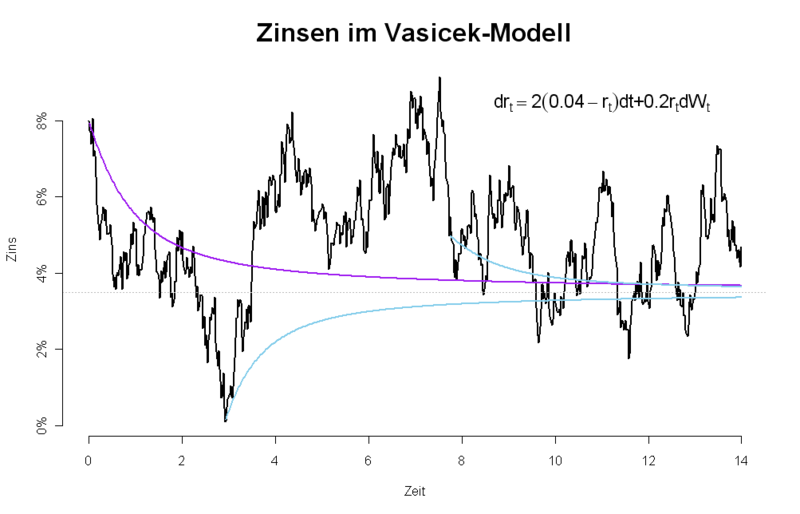
In finance, the Vasicek model is a mathematical model describing the evolution of interest rates. It is a type of "one-factor model" (short rate model) as it describes interest rate movements as driven by only one source of market risk. The model can be used in the valuation of interest rate derivatives, and has also been adapted for credit markets. It was introduced in 1977 by Oldrich Vasicek.

The model specifies that the instantaneous interest rate follows the stochastic differential equation:

dr_t = a(b-r_t)\, dt + \sigma \, dW_t

where Wt is a Wiener process modelling the random market risk factor. The standard deviation parameter, σ, determines the volatility of the interest rate. This model is an Ornstein-Uhlenbeck stochastic process.

800px-Zins-Vasicek.png


Vasicek's model was the first one to capture mean reversion, an essential characteristic of the interest rate that sets it apart from other financial prices. Thus, as opposed to stock prices for instance, interest rates cannot rise indefinitely. This is because at very high levels they would hamper economic activity, prompting a decrease in interest rates. Similarly, interest rates can not decrease indefinitely. As a result, interest rates move in a limited range, showing a tendency to revert to a long run value.

The drift factor a(b − rt) represents the expected instantaneous change in the interest rate at time t. The parameter b represents the long run equilibrium value towards which the interest rate reverts. Indeed, in the absence of shocks (dWt = 0), the interest remains constant when rt = b. The parameter a, governing the speed of adjustment, needs to be positive to insure stability around the long term value. For example, when rt is below b, the drift term a(b − rt) becomes positive for positive a, generating a tendency for the interest rate to move upwards (toward equilibrium).

The main disadvantage is that, under Vasicek's model, it is theoretically possible for the interest rate to become negative, an undesirable feature. This shortcoming was fixed in the Cox-Ingersoll-Ross model. The Vasicek model was further extended in the Hull-White model
 
Quote from ASusilovic:

In finance, the Vasicek model is a mathematical model describing the evolution of interest rates. It is a type of "one-factor model" (short rate model) as it describes interest rate movements as driven by only one source of market risk. The model can be used in the valuation of interest rate derivatives, and has also been adapted for credit markets. It was introduced in 1977 by Oldrich Vasicek.

The model specifies that the instantaneous interest rate follows the stochastic differential equation:

dr_t = a(b-r_t)\, dt + \sigma \, dW_t

where Wt is a Wiener process modelling the random market risk factor. The standard deviation parameter, σ, determines the volatility of the interest rate. This model is an Ornstein-Uhlenbeck stochastic process.

800px-Zins-Vasicek.png


Vasicek's model was the first one to capture mean reversion, an essential characteristic of the interest rate that sets it apart from other financial prices. Thus, as opposed to stock prices for instance, interest rates cannot rise indefinitely. This is because at very high levels they would hamper economic activity, prompting a decrease in interest rates. Similarly, interest rates can not decrease indefinitely. As a result, interest rates move in a limited range, showing a tendency to revert to a long run value.

The drift factor a(b − rt) represents the expected instantaneous change in the interest rate at time t. The parameter b represents the long run equilibrium value towards which the interest rate reverts. Indeed, in the absence of shocks (dWt = 0), the interest remains constant when rt = b. The parameter a, governing the speed of adjustment, needs to be positive to insure stability around the long term value. For example, when rt is below b, the drift term a(b − rt) becomes positive for positive a, generating a tendency for the interest rate to move upwards (toward equilibrium).

The main disadvantage is that, under Vasicek's model, it is theoretically possible for the interest rate to become negative, an undesirable feature. This shortcoming was fixed in the Cox-Ingersoll-Ross model. The Vasicek model was further extended in the Hull-White model

I'm truly impressed! Not only because you were trying to answer something that no one asked, but also because you took something right out of wikipedia and tried making it your own! Nice going.
http://en.wikipedia.org/wiki/Vasicek_model
 
Vasicek's model was the first one to capture mean reversion, an essential characteristic of the interest rate that sets it apart from other financial prices.
However, this CAN apply to stock prices, housing prices, and the like when a long term trend line is applied as the proxy for expected price. When prices move extremely above the proxy, economic forces take place that cause prices to move back to the proxy which acts as the mean. For instance, the result of the housing price run-up in the US resulted in massive over-building...i.e. a huge supply of new houses. Housing prices are now correcting back to the long term expected price.
 
Of course there can be markets where on a historical basis mean reversion can be observed. However, the mentioned models are all short term models of interest rates. I have never seen those models implemented on anything else than rates.


Quote from syswizard:

However, this CAN apply to stock prices, housing prices, and the like when a long term trend line is applied as the proxy for expected price. When prices move extremely above the proxy, economic forces take place that cause prices to move back to the proxy which acts as the mean. For instance, the result of the housing price run-up in the US resulted in massive over-building...i.e. a huge supply of new houses. Housing prices are now correcting back to the long term expected price.
 
Quote from black diamond:

But he is obviously not an MBA or else he would have put it into powerpoint.

On a different note, I talked to the head of one bank's prop group and he said he would NEVER hire MBAs. He mentioned that the guys from top b-schools are increadibly cocky and behave as if they know the world. Coming out of a very quantitative masters program I was very amused because a lot of guys in my program were on the other extreme, total geeks (and extremely smart) but very nice guys and fun to be around with. From my own experience I think the cockiness is to some extend not just the fault of those students but the expectations of the average corporate world, especially in the U.S. The credo is: Be cool, self-confident beyond limits, show everything you got (even though it may not be applicable or nobody asked you to show), and talk talk talk...regardless of whether the talk can be backed up by facts. (I emphasize facts NOT figures/powerpoints ;-)
 
Quote from IluvVol:

...snip snip...

The credo is: Be cool, self-confident beyond limits, show everything you got (even though it may not be applicable or nobody asked you to show), and talk talk talk...regardless of whether the talk can be backed up by facts. (I emphasize facts NOT figures/powerpoints ;-)
You just described every phucking consultant I have met!!! I kid you not. That and powerpoint presentations. The phucking morons must have wet dreams about powerpoint presentations. :D
 
Back
Top