https://www.cnbc.com/2019/03/15/bat...illions-in-the-battle-to-crush-tesla.html?itx[idio]=5844952&ito=792&itq=eeec7b3f-4b19-4f53-99ab-1087df53560f

You are using an out of date browser. It may not display this or other websites correctly.
You should upgrade or use an alternative browser.
You should upgrade or use an alternative browser.
$TSLA
- Thread starter Phill Twist
- Start date

https://www.zerohedge.com/news/2019...perating-cash-flow-has-come-customer-deposits
The funniest part is that the original fraud is spelled out in Elon's bio explained by his cousin...
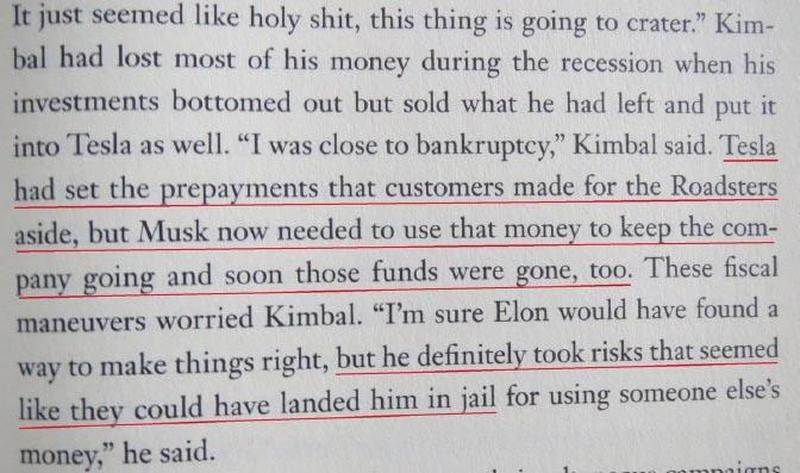
The funniest part is that the original fraud is spelled out in Elon's bio explained by his cousin...

They did get 500 MM Chinese loan, but with lots of strings attached. (the Chinese aren't stupid)
They have to prove they spent it on the factory before they get more. Half billion is clearly not enough to build the whole factory. If Tesla goes bankrupt in the main time, the Chinese keeps the factory.
https://seekingalpha.com/news/3440994-tesla-gets-520m-loans-shanghai-gigafactory
I dunno, I've seen the Chinese throw bad money after bad money in several foreign companies in Trouble before (European car companies come to mind). It's almost an indicator of how much trouble they're in.
I call it noob venture capitalist dumb money.

SEC: Elon Musk fully ignored a key term of settlement
In defiance of an October settlement with the US Securities and Exchange Commission, Elon Musk did not have his tweets pre-approved by an official Tesla babysitter, the SEC says in newly filed court documents. The dispute dates back to August 2018, when Musk tweeted that he had “funding secured” for a plan to take Tesla private. (Wired)
I dunno, I've seen the Chinese throw bad money
They own the land. If Tesla goes bankrupt, they just sell the factory to Nio.

They own the land. If Tesla goes bankrupt, they just sell the factory to Nio.
And Tesla's technology is free!
An excellent explanation how Tesla's business system works:
Value Layman
@Drewworm “Someone please explain to me how selling cars at a loss makes sense when you are making up for it with volume?”
"It is high risk, but possible and requires 4 key assumptions: 1) Volumes will continue to increase substantially. 2) Investors will continue to fund you as a result of growth. 3) Vendors will continue to supply parts, preferrably with 90-day payment terms, and 4) True margins will eventually be positive.
Think about one hypothetical car sold at a loss the same day it was built, and let’s say the parts for that car were purchased, acquired and used for that car the same day. If you include all the costs of the car you would think they had lost money, but there’s actually more money in the bank account....because they don’t have to pay the vendors for those parts for another 90 days.
So, then, how do you cover the costs to the vendors? Well, in this hypothetical, if you sell two cars the next day, the extra money in the bank will cover the costs for the day before. This allows you to continually lose money on every car without ever actually taking a loss in the bank account.
This is obviously untenable because once max production capacity has been reached you’ll have to realize all those losses in reality. So what next? Now, the increase in volumes has proven to investors not only demand, but the distinct possibility for much higher demand going forward. So the investors provide financing for increased production capacity.
This can continue indefinitely until maximum demand/volume has been reached (or volume increase has slowed sufficiently). At this point it is make or break: you’ve parlayed yourself very quickly to extreme volumes...now it’s time for margins. Can you now sell the vehicles for a profit? If the answer is yes, the company is a massive success. If the answer is no, then most likely bankruptcy."
Value Layman
@Drewworm “Someone please explain to me how selling cars at a loss makes sense when you are making up for it with volume?”
"It is high risk, but possible and requires 4 key assumptions: 1) Volumes will continue to increase substantially. 2) Investors will continue to fund you as a result of growth. 3) Vendors will continue to supply parts, preferrably with 90-day payment terms, and 4) True margins will eventually be positive.
Think about one hypothetical car sold at a loss the same day it was built, and let’s say the parts for that car were purchased, acquired and used for that car the same day. If you include all the costs of the car you would think they had lost money, but there’s actually more money in the bank account....because they don’t have to pay the vendors for those parts for another 90 days.
So, then, how do you cover the costs to the vendors? Well, in this hypothetical, if you sell two cars the next day, the extra money in the bank will cover the costs for the day before. This allows you to continually lose money on every car without ever actually taking a loss in the bank account.
This is obviously untenable because once max production capacity has been reached you’ll have to realize all those losses in reality. So what next? Now, the increase in volumes has proven to investors not only demand, but the distinct possibility for much higher demand going forward. So the investors provide financing for increased production capacity.
This can continue indefinitely until maximum demand/volume has been reached (or volume increase has slowed sufficiently). At this point it is make or break: you’ve parlayed yourself very quickly to extreme volumes...now it’s time for margins. Can you now sell the vehicles for a profit? If the answer is yes, the company is a massive success. If the answer is no, then most likely bankruptcy."
Here is the stunning calculation from the report’s author:
“With a sharp demand slowdown as well as the $920 million convertible bond maturity Tesla paid on March 1st, Tesla’s balance sheet is in an increasingly perilous position. We believe the ongoing Department of Justice investigator into potential securities and wire fraud related to Model 3 production statements prior to the company’s 2017 high yield offering as well as the SEC’s ongoing litigation with CEO Elon Musk over the “Funding Secured” debacle have likely blocked the company’s ability to do a registered equity offering. The MXWL merger proxy is taking a surprisingly long time to be declared effective. It’s almost as if the SEC is refusing to approve any registration statements for the company so long as Musk remains CEO. The poor performance of Tesla’s high yield bonds has likely limited the company’s potential access to that market. In theory, Tesla could do some sort of private placement in its equity, but we believe Musk has been unwilling to pursue this path since the likely pricing of such an offering would trigger his margin call and wipe him out personally.
Assuming the company sells ~17k Model SIX, 42k Model 3s, is able to extend payables to 105 days from 87 days in Q-4, raises $50 million in Model Y/Semi/Roadster 2 deposits, spends $3 billion on capex over the course of 2019 ($500 million of which is funded by drawing on the China credit facility) we estimate Tesla will end Q-1 with consolidated cash on its balance sheet of a little over $1.6 billion. When you adjust this cash balance for the ~$600 million likely trapped in China (according to the 10-K Tesla had $749 million in cash outside the U.S.), we estimate Tesla ends Of with only roughly $1 billion in on balance sheet cash accessible in the US compared to over $800 million in consumer deposits.
If they do not get secure funding in Q2, they will very likely default in Q3
“With a sharp demand slowdown as well as the $920 million convertible bond maturity Tesla paid on March 1st, Tesla’s balance sheet is in an increasingly perilous position. We believe the ongoing Department of Justice investigator into potential securities and wire fraud related to Model 3 production statements prior to the company’s 2017 high yield offering as well as the SEC’s ongoing litigation with CEO Elon Musk over the “Funding Secured” debacle have likely blocked the company’s ability to do a registered equity offering. The MXWL merger proxy is taking a surprisingly long time to be declared effective. It’s almost as if the SEC is refusing to approve any registration statements for the company so long as Musk remains CEO. The poor performance of Tesla’s high yield bonds has likely limited the company’s potential access to that market. In theory, Tesla could do some sort of private placement in its equity, but we believe Musk has been unwilling to pursue this path since the likely pricing of such an offering would trigger his margin call and wipe him out personally.
Assuming the company sells ~17k Model SIX, 42k Model 3s, is able to extend payables to 105 days from 87 days in Q-4, raises $50 million in Model Y/Semi/Roadster 2 deposits, spends $3 billion on capex over the course of 2019 ($500 million of which is funded by drawing on the China credit facility) we estimate Tesla will end Q-1 with consolidated cash on its balance sheet of a little over $1.6 billion. When you adjust this cash balance for the ~$600 million likely trapped in China (according to the 10-K Tesla had $749 million in cash outside the U.S.), we estimate Tesla ends Of with only roughly $1 billion in on balance sheet cash accessible in the US compared to over $800 million in consumer deposits.
If they do not get secure funding in Q2, they will very likely default in Q3
https://www.linkedin.com/pulse/tesla-ponzi-scheme-well-kind-steven-weinberg
Understanding that Musk’s true product is stories, in my opinion, explains a lot. For example, it’s why there are constant announcements about the next big thing, whether that is a car, a rocket, a hyperloop, or a boring machine. The hype needs to be kept alive. If the story stays alive, it doesn’t matter if they’re losing money selling cars. But if the hype dies, Tesla dies.
Understanding that Musk’s true product is stories, in my opinion, explains a lot. For example, it’s why there are constant announcements about the next big thing, whether that is a car, a rocket, a hyperloop, or a boring machine. The hype needs to be kept alive. If the story stays alive, it doesn’t matter if they’re losing money selling cars. But if the hype dies, Tesla dies.
But if the hype dies,
It already has...