that you know how to google.alright, I will prove ...
You said "survives on government orders"
Show that. You can't so you have to spin.
All kinds of companies have commercial and government contracts - nothing new there.

that you know how to google.alright, I will prove ...
Who is that directed at? I don't even own a friggen share of either (or any other stock and I only trade futures)....
You sound angry in your posts about mere companies. Seems like a sign of emotional attachment to SpaceX or Tesla or Elon Musk. Easy. Just buy more TSLA next week. Heck, bet the farm on it. Use margins liberally. Come back and gloat in a few months if you managed to make a profit..
 But I also don't like bullshiter. The one above.
Short seller sues Tesla, Elon Musk, claiming buyout tweets were fraudulent
Expect more lawsuits if Musk can't prove he has funding lined up.
Timothy B. Lee - Aug 11, 2018 11:50 am UTC
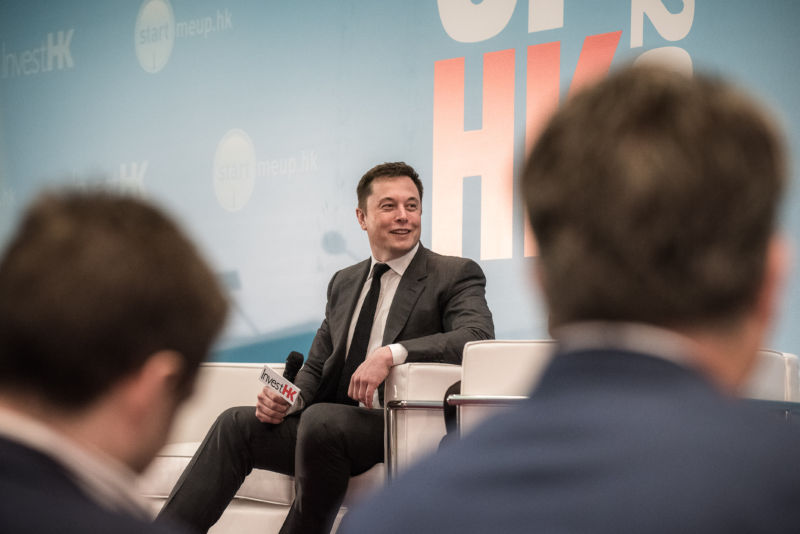
Enlarge / Elon Musk in 2016.
PHILIPPE LOPEZ/AFP/Getty Images
231
Three days after Elon Musk tweeted that he had "funding secured" to take Tesla private, we still don't know who, if anyone, has agreed to provide the billions of dollars needed to buy out the company. But plaintiffs' lawyers aren't waiting any longer for Musk to provide more details.
On Friday, stock trader Kalman Isaacs filed a class-action lawsuit arguing that Musk's Tuesday tweets constituted securities fraud. The lawsuit, first reported by Reuters, appears to be the first one claiming that Musk's Tuesday tweets violated federal securities law.
At the time of Musk's tweet, Isaacs was short at least 3,000 shares of Tesla stock. That means that, at some point prior to Musk's tweet, Isaacs had borrowed Tesla shares and sold them, betting that the price would fall and he would eventually be able to buy them back at a discount, pocketing the difference.
Further Reading
There’s a big problem with Elon Musk’s plan to take Tesla private
The flipside, however, was that Isaacs lost money if Tesla's stock rose—$3,000 for every dollar increase in the stock price. If Musk really did close a $420-a-share buyout deal, Isaacs would have needed to come up with around $420 for each of those 3,000 shares. So on Wednesday, Isaacs panicked and closed out his short position early by buying Tesla shares at the then-current price of $376.
But Isaacs now believes that Musk's tweet was false—that Musk doesn't actually have funding secured. And if that's true, he argues, then Musk violated US securities laws, which prohibit a CEO from spreading false or misleading information about a company in order to manipulate its stock price.
“Short position” explosion?
Isaacs argues that that's exactly what Musk was trying to do with his tweet. He notes that Musk has long taunted short-sellers like himself on Twitter. In mid-June, for example, Musk tweeted that short sellers "have about three weeks before their short position explodes"—presumably referring to the end of the second quarter, when Musk planned to prove doubters wrong by achieving a production rate of 5,000 vehicles per week.
If Musk's buyout tweets prove to be false—and we should emphasize here that we don't know yet—then they likely cost Isaacs tens of thousands of dollars, since they forced him to buy shares at an inflated price. By the close of trading on Friday, Tesla shares had already fallen to $355. If Isaacs kept his short positions open, he would be at least $60,000 richer.
Isaacs isn't just suing on his own behalf; he's seeking approval to become the lead plaintiff in a class-action lawsuit representing all Tesla shareholders who traded after Musk's tweet on Tuesday or at any time on Wednesday.
This is a common tactic in the world of securities legislation, according to William Sjostrom, an expert on securities law at the University of Arizona.
"There's this huge culture of these securities plaintiffs' firms," Sjostrom told Ars on Wednesday—before Isaacs' lawsuit was filed. Sjostrom said that "firms are geared up to file suits immediately," often using "cookie-cutter complaints."
Sometimes, defendant companies will settle these lawsuits for a modest sum, including a few million dollars to the plaintiffs' attorneys. But the stronger a case is, the more likely plaintiffs will take the case to court and seek more significant damages. And the risk to Tesla will be much bigger if Musk cannot prove that he had funding secured when he made his Tuesday tweet.
 The news might even trigger a cascading dumping event.
1. Saudi PIF not interested in Tesla (already happened)
2. Tencent not interested in holding Tesla stocks if it goes private
3. Large mutual funds not to stay long in Tesla
4. the SEC issues criminal indictment against Elon Musk
1 - If they intend on buying more shares, they have a vested interest in playing down their participation
2 - What is your source for this information?
4 - The SEC has no criminal powers. They cant arrest or indict anyone even if they wanted to
TSLA has been a great long term tool for screwing shorts, even though it is inevitable this company fails without permanent government funding.
I suspect when or if short interest finally drops on TSLA, it will gap down a hundred plus points and the shorts will jump in to be screwed again!
 (I'm not a shortie.)
