Howdy Nitro, have you ever looked at price fluctuations in the frequency domain, eg, parsed per frequency of oscillations or del-P?Here is a typical complication. This is the probability distribution of an instrument at high frequency (almost a half million quotes) over just a few days. It doesn't matter what it is and ignore the scale.
How do you fit a model to this? Notice it is nowhere near Normal (news really messes everything). What approach would you take?
View attachment 159347

You are using an out of date browser. It may not display this or other websites correctly.
You should upgrade or use an alternative browser.
You should upgrade or use an alternative browser.
Trading Catechism
- Thread starter nitro
- Start date
yeah thx for the lesson but it was a bit of a puncat·e·chism
ˈkadəˌkizəm/
noun
noun: catechism; plural noun: catechisms
- a summary of the principles of Christian religion in the form of questions and answers, used for the instruction of Christians.
- a series of fixed questions, answers, or precepts used for instruction in other situations.

Over my head. There is no voodoo here I assure you ;-)yeah thx for the lesson but it was a bit of a pun
religion, voodoo, drawing lines on charts, it's all the same to me.Over my head. There is no voodoo here I assure you ;-)

So how about that frequency representation of data then?
Well, I have forever thought that the correct place to do testing of systems is in the frequency domain. Sadly, I have never been able to get it to work.Howdy Nitro, have you ever looked at price fluctuations in the frequency domain, eg, parsed per frequency of oscillations or del-P?
TFR is interesting and powerful, but all of my wavelet transforms give me no information, e.g. for the same data above, there is just a little bit of power at about 225 milliseconds across the entire frequency range, but I don't know what to do with it. It is barely different than white noise TFR:
Yes I have also long suspected that looking at data in frequency representation should, in theory be much much much more useful than a history of price over time. But I am thinking of it perhaps differently... Set up a routine that identifies fluctuations in price (or some other parameter) occurring over a certain period of time (this then becomes the "frequency"), use a matrix calc (I'm thinking Matlab comes in handy here) to do this for many time lengths, and somehow the result can be parced over a range of frequencies. For example the "parameter" could be mean reversion of price. Using layman charts, this is for example the price excitation away from a rolling average (yup moving average), count time, revert to rolling average, stop count, mark, parse into bin... Data is time for the oscillation, magnitude (max), whatever elseWell, I have forever thought that the correct place to do testing of systems is in the frequency domain. Sadly, I have never been able to get it to work.
TFR is interesting and powerful, but all of my wavelet transforms give me no information, e.g. for the same data above, there is just a little bit of power at about 225 milliseconds across the entire frequency range, but I don't know what to do with it. It is barely different than white noise TFR:
View attachment 159365
To be clear, if you have access to data in milliseconds you are not in my league.
Edit: As price fluctuations are essentially random the results you have resembling white noise seem correct (?)
That is all possible. Now you have to see if the real world corresponds to your theory!Yes I have also long suspected that looking at data in frequency representation should, in theory be much much much more useful than a history of price over time. But I am thinking of it perhaps differently... Set up a routine that identifies fluctuations in price (or some other parameter) occurring over a certain period of time (this then becomes the "frequency"), use a matrix calc (I'm thinking Matlab comes in handy here) to do this for many time lengths, and somehow the result can be parced over a range of frequencies. For example the "parameter" could be mean reversion of price. Using layman charts, this is for example the price excitation away from a rolling average (yup moving average), count time, revert to rolling average, stop count, mark, parse into bin... Data is time for the oscillation, magnitude (max), whatever else
To be clear, if you have access to data in milliseconds you are not in my league.
Edit: As price fluctuations are essentially random the results you have resembling white noise seem correct (?)
I am seeing spinors in my models. Simply stated, a spinor is a square root of a vector. At first, I thought this a bit strange that spinors show up in a trading model. However, if I truly believe in the QFT-ness of my model, why should I be surprised? It is for example, why Granger causality oscillates when you think it should be constant.
Last edited:
the effort required for me to do this is prohibitive, just curious if to hear if somebody else has explored this or similar concept. CheersThat is all possible. Now you have to see if the real world corresponds to your theory!

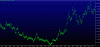
Here are trade opportunities over the last 300 or more days with trend.
this is long the spread IEI/FXC ( a winner) and short SPY/UUP ( a loser) ,
hence the trend. Opportunities not plainly seen by all. There are thousands of
these across asset classes. only need a few I guess due to capital constraints.
4 legs is max. I look at 8 legs for fun at this time.
There are solid, grounded fundamental reasons explaining price here.
this is long the spread IEI/FXC ( a winner) and short SPY/UUP ( a loser) ,
hence the trend. Opportunities not plainly seen by all. There are thousands of
these across asset classes. only need a few I guess due to capital constraints.
4 legs is max. I look at 8 legs for fun at this time.
There are solid, grounded fundamental reasons explaining price here.