To all thee would-be traders out there....

Oh wow you really are an ignorant individual. You seriously think Soros doesn't understand risk management? Now that's funny.

You're gonna tell me A trader has nothing to learn from the greats like buffet, Soros or Zander! Wow! That's like telling computer programmer has nothing to learn from Bill Gates or telling a baseball player he has nothing to learn by studying Babe Ruth. At least I'm humble enough to know what I don't know. I never ever claim to be an expert.
Gotcha, your ego is crazy. Nothing to learn from the greatest of all time. Really?
From my understanding, Soros made the trade based on what he thought the Bank of England had to do. This isn't how any day trader is trading. Its based on fundamental information, which most day traders will not use, and this isn't even fundamental information, but more like a hunch.

The reason he made big coin is because he went in big. Once again, a day trader will more than likely keep the same size on each trade, unless perhaps he has a very good reason for why a certain setup has better odds. More than likely though, a day trader will want to scale into a trade, hopefully a winning trade that is working. You can't scale into a major currency repricing.

For these reasons, there is nothing for a day trader to learn here from Soros and his bet against the pound. If you think there is, then you might as well also bet on stocks prior to company earnings and call this trading.
 
From my understanding, Soros made the trade based on what he thought the Bank of England had to do. This isn't how any day trader is trading. Its based on fundamental information, which most day traders will not use, and this isn't even fundamental information, but more like a hunch.

The reason he made big coin is because he went in big. Once again, a day trader will more than likely keep the same size on each trade, unless perhaps he has a very good reason for why a certain setup has better odds. More than likely though, a day trader will want to scale into a trade, hopefully a winning trade that is working. You can't scale into a major currency repricing.

For these reasons, there is nothing for a day trader to learn here from Soros and his bet against the pound. If you think there is, then you might as well also bet on stocks prior to company earnings and call this trading.
Again buddy you're missing the point. I said Soros was worth respecting not fir one trade but his overall lifetime achievement.

This started with me saying that one of the all time greatest ever, Buffet, uses none of the fancy indicators or charts.

But once again you can't stay on topic.

I think there's a lot to learn from the legends. Just like any endeavor. This applies to sports, business, entertainment, any industry. Saying there's nothing to learn from the very most successful in our field is very very cocky.
 
See following image for debrief.

If we start with your pic, the addition third bar that you drew, change the two-bar internal formation (Internals, Formations) into a Lateral. All four examples fall into that category.
This is known in CW as chop or sideways market. It's just a subfractal where advanced experts are trading in faster timeframes. Beginners and intermediates would be wise to exercise caution within these zones of trading. You, in an earlier post, sussed out the prime entry for an anticipated event resulting from a turn.

In the debrief pic, if we look at the hitch (equal high, equal low) in the center. The blue dotted zone is the Hitch. The Pink doted zone is a Sym. When we use the model, every new bar we evaluate starts at Sym.

View attachment 175032

If by the EOB we see an STB. There is only two possible paths to get there;
1) Sym->FTP->Hitch->STB
What is the other path?

The pic also has the color coding of all the price cases.

We also see the addition of trendlines. In looking at XB, a long trend is defined by the the placements of points 1, 2, 3. Drawing a line through 1 and 3 always gives us a right trend line. The market has symmetry, so the opposite is true as with the XR.
Sometimes pt2 is on the first bar, sometimes the second. Volume will support determining which.

We can also see the path from XB->STB-> OB starts as long sentiment, crossing the rtl and becoming a short sentiment. The same is true for it's opposite the STR.
Interesting enough, if the path included a Hitch->STB then that is a different context. Even though the STB is the same bar, how that bar was built gives an indicator of the current dominant sentiment. Just looking at the bar itself at EOB misses the opposing non-dominant force that is always ready to exert dominance depending on the entry, exit and reversals of market participants at different skill levels.

What's interesting about the hitch is that once we get there, the XB and XR are not possible.

The next task is to take your second chart, use bars and draw more trendlines. Our goal is to build tapes. Tapes are drawing one of the three types of trends between every combination of two bars.

As a tape gets longer with each successive bar, a picture will start to form. The run of the tape has ends and a middle. The ends are where the tape starts to move in the opposite direction, creating an opposite leg of price movement.

The convention is to use light thin black or gray lines drawn only as far as the H or L of the second bar in every two bar combination.

Other path: SYM -> FTP -> XB -> STB
When at Hitch you're "not allowed" to switch trend direction, as in: is trend direction always defined at FTP or FBP? So STB / STR are "failed trends", and may not always show the same trend direction as in the pic of 10 cases?

Is the tape something like this?

tape.png
 
Why do people continue to compare fund management performance with day trading performance? Night and day...can you cross the ocean on a jet ski? Of course not...can you run a white water slalom course in a cruise ship, of course not.
 
Other path: SYM -> FTP -> XB -> STB
When at Hitch you're "not allowed" to switch trend direction, as in: is trend direction always defined at FTP or FBP? So STB / STR are "failed trends", and may not always show the same trend direction as in the pic of 10 cases?

Is the tape something like this?

View attachment 175039

Excellent, you found a third path.

That's a good question and a good hypothesis. The market will give you the answer. Let's help the market give us our answer.

The lines that you have connect the H's and L's of bars and are not parallel.

We create the parallel lines as a way of generating context. Trend lines are parallel to each other. With Sym we see we can place both short and long parallel lines. Sym is found generally after a strong price move. Consider it as the market's way of pausing, to catch it's breath.

It might continue in the dominant direction OR change in the non-dominant direction. The context is created by building tapes. Tapes build traverses. Two traverses build channels. Channels overlap, channels can be of different sizes and durations.

We can suss out channels as they come into view by using the pt 1, pt2, pt3 convention. That convention can also be applied to the two bar trends, which we call tapes.
To build tapes, one draws one line connecting pt1 and pt3 and a parallel line intersecting pt2. On the debrief, the first green channel and the following red channel has been taped. Completing the drawing is for you.

Notice in the debrief the first two bars. It forms a Sym. Trendlines are always parallel. There is a short tape and a long tape on these two bars. The first set of green lines is the fastest tape. The 2nd bar has less volume than the first.

We are on a non-dominant move, looking for the dominant move which must come next. The third bar has decreasing volume. We are still in a non-dominant move. We are on the outlook for increasing volume. We get that with the fourth bar. It's dominant long.

We fan our trendline to include the L of this bar for our new pt3. The fifth bar comes and it has decreasing volume. The tape shows a red dot. The red dots are what comes after pt1, pt2, pt3. They represent the signal for change - decreasing volume with a failure of price to traverse.

Increasing volume represents Dominance. Decreasing -> non-Dom. Pt3 or the bar thereafter always have increasing volume. There is only one situation where this is not the case. We put that aside for now.

At bar 15 we get an FTT. Since trends overlap, we make this our new pt1 for the upcoming short. We don't know how long this short will be. It doesn't matter.

When we partner with the market, the market signals continue or change,... ALWAYS. When we do work, by doing exercises, drills, MADA, annotating, logging and debriefing, our minds get built and we can SEE the market's system of operation.

Bar 15 and 16 is a tape. The tape has a rtl that extends to include 7 bars.
What happens on Bar 17?
A bunch of Dominant volume came in. It caused an acceleration of the tape.

This is considered the start of a new fast paced channel. The previous one is still active and we have an expansion of the bounds of the prior tape. This is known as a VE. This is the bar that has the lowest risk to make money.

This green channel is only 3 bars long. However it gave us an FTT. This becomes our new pt1 long. This is confirmed next by price crossing the rtl. We have a BO of this fast paced green channel yet still within the context of the red channel. The only way for this red channel to stay active is for Dominant Short volume to come into the market. In the next three bars we do not get that.

Instead Dominant Long volume came in on Bar 25 confirming our pt3 long channel. (geometrically bar 24 is pt3). This is OK. When we zoom out or in on timescales we understand the ends of trends might fall on a different bar or a range of bars on a faster fractal.

This channel has a VE, then a FTT, then heads to BO on bar 31 but fails. The FBO has come into view. For this channel to stay active we need to see Dominant long volume to come into the market again. We see increasing volume bars but not to the extent of the previous Dominant volume spikes. We are on the look out for an FTT and price moving in the opposite direction. Price oscillates in this channel from FTT to FBO, and soon we start to see it penetrating the rtl. It skirts this line until we have a BO.

The market auction process begins again.

Annotating creates a dynamic context and reference point - waypoints if you will.

Prediction is static.

Anticipation holds multiple scenarios in mind and what is REQUIRED for those scenarios to play out. Anticipation also monitors very closely what is in fact currently happening from a neutral mindset. Prediction is linear. Anticipation is more tree like - branches of possibilities yet the choices keep getting limited as one nears the outer edge of the canopy.
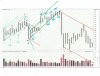

tape-debrief.jpg
 
Last edited:
I find it interesting and pleasant in this thread, and also in a number of other newly started threads, that there are so many TA fans and they are discussing TA in a friendly and constructive manner without the usual interruption of those on the other side of the fence. Can't remember ever having seen such on ET in the last 10 years.
Because the 'price drivers' man has gone, yes, very refreshing discussion as you've correctly mentioned.
 
Back
Top