Other path: SYM -> FTP -> XB -> STB
When at Hitch you're "not allowed" to switch trend direction, as in: is trend direction always defined at FTP or FBP? So STB / STR are "failed trends", and may not always show the same trend direction as in the pic of 10 cases?
Is the tape something like this?
View attachment 175039
Excellent, you found a third path.
That's a good question and a good hypothesis. The market will give you the answer. Let's help the market give us our answer.
The lines that you have connect the H's and L's of bars and are not parallel.
We create the parallel lines as a way of generating context. Trend lines are parallel to each other. With Sym we see we can place both short and long parallel lines. Sym is found generally after a strong price move. Consider it as the market's way of pausing, to catch it's breath.
It might continue in the dominant direction OR change in the non-dominant direction. The context is created by building tapes. Tapes build traverses. Two traverses build channels. Channels overlap, channels can be of different sizes and durations.
We can suss out channels as they come into view by using the pt 1, pt2, pt3 convention. That convention can also be applied to the two bar trends, which we call tapes.
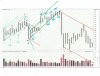
To build tapes, one draws one line connecting pt1 and pt3 and a parallel line intersecting pt2. On the debrief, the first green channel and the following red channel has been taped. Completing the drawing is for you.
Notice in the debrief the first two bars. It forms a Sym. Trendlines are always parallel. There is a short tape and a long tape on these two bars. The first set of green lines is the fastest tape. The 2nd bar has less volume than the first.
We are on a non-dominant move, looking for the dominant move which must come next. The third bar has decreasing volume. We are still in a non-dominant move. We are on the outlook for increasing volume. We get that with the fourth bar. It's dominant long.
We fan our trendline to include the L of this bar for our new pt3. The fifth bar comes and it has decreasing volume. The tape shows a red dot. The red dots are what comes after pt1, pt2, pt3. They represent the signal for change - decreasing volume with a failure of price to traverse.
Increasing volume represents Dominance. Decreasing -> non-Dom. Pt3 or the bar thereafter always have increasing volume. There is only one situation where this is not the case. We put that aside for now.
At bar 15 we get an FTT. Since trends overlap, we make this our new pt1 for the upcoming short. We don't know how long this short will be. It doesn't matter.
When we partner with the market, the market signals continue or change,... ALWAYS. When we do work, by doing exercises, drills, MADA, annotating, logging and debriefing, our minds get built and we can SEE the market's system of operation.
Bar 15 and 16 is a tape. The tape has a rtl that extends to include 7 bars.
What happens on Bar 17?
A bunch of Dominant volume came in. It caused an acceleration of the tape.
This is considered the start of a new fast paced channel. The previous one is still active and we have an expansion of the bounds of the prior tape. This is known as a VE. This is the bar that has the lowest risk to make money.
This green channel is only 3 bars long. However it gave us an FTT. This becomes our new pt1 long. This is confirmed next by price crossing the rtl. We have a BO of this fast paced green channel yet still within the context of the red channel. The only way for this red channel to stay active is for Dominant Short volume to come into the market. In the next three bars we do not get that.
Instead Dominant Long volume came in on Bar 25 confirming our pt3 long channel. (geometrically bar 24 is pt3). This is OK. When we zoom out or in on timescales we understand the ends of trends might fall on a different bar or a range of bars on a faster fractal.
This channel has a VE, then a FTT, then heads to BO on bar 31 but fails. The FBO has come into view. For this channel to stay active we need to see Dominant long volume to come into the market again. We see increasing volume bars but not to the extent of the previous Dominant volume spikes. We are on the look out for an FTT and price moving in the opposite direction. Price oscillates in this channel from FTT to FBO, and soon we start to see it penetrating the rtl. It skirts this line until we have a BO.
The market auction process begins again.
Annotating creates a dynamic context and reference point - waypoints if you will.
Prediction is static.
Anticipation holds multiple scenarios in mind and what is REQUIRED for those scenarios to play out. Anticipation also monitors very closely what is in fact currently happening from a neutral mindset. Prediction is linear. Anticipation is more tree like - branches of possibilities yet the choices keep getting limited as one nears the outer edge of the canopy.