This is the kind of thing that happens when a society accepts homosexuality

Quote from jem:
I see your argument is now hinging on the 14th amendment.
It isn't.

Predictably and as ever, you're confused.
All these pages and you don't actually know what my argument is , but you've been trying to argue against it.
That's pretty dumb even by your standards.

Quote from jem:
...you now understand the separation of powers and the concept of limited Federal govt.
...whereas you obviously don't, or you wouldn't be trying to use that.
On the other hand you are clearly inclined to pick up anything to throw against an argument, even when you don't actually know what the argument is.

Quote from jem:
You have learned that the establishment clause of Bill of Rights protected citizens from from Federal interference with the states right to tie to and establish religion.
I see you've returned to that perverse form of absurd response where you learn something, so that means, I learned something.
Not very convincing.

Prohibiting the making of any law which is respecting an establishment of religion, is the exact opposite intent for any so called "right" to establish religion.
You really are being too ridiculous.

Quote from jem:
You have learned that protection stood until after the 14th amendment was passed and the courts developed the incorporation doctrine.
The "protection" is in your head.
There was no "protection" to endorse religion, anymore than there was "protection" to endorse slavery.

The omission of one and an exclusion for the other in the Constitution does not suggest "protection".
Unless you are deviant toward the Constitution of course.

Quote from jem:
By the way this is easy for me.
Yes I can see that. Making a complete ass of yourself is evidently easy for you.


The ethos is freedom.
Freedom is not the imposition of a superstitious christian or other belief onto the people through any government state or fed.
If you want to practice that nonsense in your own home in your own state then fine.
But you, nor any state, nor the government, should have the ability to force anyone through law to practice juju if they don't want.
That is what the Constitution is protecting.

Get a clue.
 
Since stu can not even explain... what he is trying to say.

I will point out again that...

Article 6 does not say what Stu pretends it says...

And that we know I am correct about the establishment clause not being applied to the states until there was a 14th amendment... because the supreme court said so.

Quote from jem:


I will again quote the U.S. Supreme Court on this matter.
Stu would like to point out that in his opinion this is dicta.
What Stu does not explain is that he does not understand the effect of Supreme Court dicta.

And what he never do - is explain away the facts the court makes.

The states had all these ties to religion... and these ties were constitutional.

Which makes STU arguments delusional...


"If we examine the constitutions of the various states, we find in them a constant recognition of religious obligations. Every Constitution of every one of the forty-four states contains language which, either directly or by clear implication, recognizes a profound reverence for religion, and an assumption that its influence in all human affairs is essential to the wellbeing of the community. This recognition may be in the preamble, such as is found in the Constitution of Illinois, 1870:

"We, the people of the State of Illinois, grateful to Almighty God for the civil, political, and religious liberty which He hath so long permitted us to enjoy, and looking to Him for a blessing upon our endeavors to secure and transmit the same unimpaired to succeeding generations,"

etc.

It may be only in the familiar requisition that all officers shall take an oath closing with the declaration, "so help me God." It may be in clauses like that of the Constitution of Indiana, 1816, Art. XI, section 4: "The manner of administering an oath or affirmation shall be such as is most consistent with the conscience of the deponent, and shall be esteemed the most solemn appeal to God." Or in provisions such as are found in Articles 36 and 37 of the declaration of rights of the Constitution of Maryland, 1867:

"That, as it is the duty of every man to worship God in such manner as he thinks most acceptable to Him, all persons are equally entitled to protection in their religious liberty, wherefore no person ought, by any law, to be molested in his person or estate on account of his religious persuasion or profession, or for his religious practice, unless, under the color of religion, he shall disturb the good order, peace, or safety of the state, or shall infringe the laws of morality, or injure others in their natural, civil, or religious rights; nor ought any person to be compelled to frequent or maintain or contribute, unless on contract, to maintain any place of worship or any ministry; nor shall any person, otherwise competent, be deemed incompetent as a witness or juror on account of his religious belief, provided he

Page 143 U. S. 469

believes in the existence of God, and that, under his dispensation, such person will be held morally accountable for his acts, and be rewarded or punished therefor, either in this world or the world to come. That no religious test ought ever to be required as a qualification for any office of profit or trust in this state, other than a declaration of belief in the existence of God; nor shall the legislature prescribe any other oath of office than the oath prescribed by this constitution."

Or like that in Articles 2 and 3 of part 1st of the Constitution of Massachusetts, 1780:

"It is the right as well as the duty of all men in society publicly, and at stated seasons, to worship the Supreme Being, the great Creator and Preserver of the universe. . . . As the happiness of a people and the good order and preservation of civil government essentially depend upon piety, religion, and morality, and as these cannot be generally diffused through a community but by the institution of the public worship of God and of public instructions in piety, religion, and morality, therefore, to promote their happiness, and to secure the good order and preservation of their government, the people of this commonwealth have a right to invest their legislature with power to authorize and require, and the legislature shall, from time to time, authorize and require, the several towns, parishes, precincts, and other bodies politic or religious societies to make suitable provision at their own expense, for the institution of the public worship of God and for the support and maintenance of public Protestant teachers of piety, religion, and morality, in all cases where such provision shall not be made voluntarily."

Or, as in sections 5 and 14 of Article 7 of the Constitution of Mississippi, 1832:

"No person who denies the being of a God, or a future state of rewards and punishments, shall hold any office in the civil department of this state. . . . Religion morality, and knowledge being necessary to good government, the preservation of liberty, and the happiness of mankind, schools, and the means of education, shall forever be encouraged in this state."

Or by Article 22 of the Constitution of Delaware, (1776), which required all officers, besides an oath of allegiance, to make and subscribe the following declaration:

"I, A. B., do profess

Page 143 U. S. 470

faith in God the Father, and in Jesus Christ His only Son, and in the Holy Ghost, one God, blessed for evermore, and I do acknowledge the Holy Scriptures of the Old and New Testament to be given by divine inspiration."

Even the Constitution of the United States, which is supposed to have little touch upon the private life of the individual, contains in the First Amendment a declaration common to the constitutions of all the states, as follows: "Congress shall make no law respecting an establishment of religion, or prohibiting the free exercise thereof," etc., and also provides in Article I, Section 7, a provision common to many constitutions, that the executive shall have ten days (Sundays excepted) within which to determine whether he will approve or veto a bill.

There is no dissonance in these declarations. There is a universal language pervading them all, having one meaning. They affirm and reaffirm that this is a religious nation. These are not individual sayings, declarations of private persons. They are organic utterances. They speak the voice of the entire people. While, because of a general recognition of this truth, the question has seldom been presented to the courts, yet we find that in Updegraph v. Commonwealth, 11 S. & R. 394, 400, it was decided that

"Christianity, general Christianity, is, and always has been, a part of the common law of Pennsylvania; . . . not Christianity with an established church and tithes and spiritual courts, but Christianity with liberty of conscience to all men."

And in People v. Ruggles, 8 Johns. 290, 294-295, Chancellor Kent, the great commentator on American law, speaking as Chief Justice of the Supreme Court of New York, said:

"The people of this state, in common with the people of this country, profess the general doctrines of Christianity as the rule of their faith and practice, and to scandalize the author of these doctrines is not only, in a religious point of view, extremely impious, but, even in respect to the obligations due to society, is a gross violation of decency and good order. . . . The free, equal, and undisturbed enjoyment of religious opinion, whatever it may be, and free and decent discussions on any religious

Page 143 U. S. 471

subject, is granted and secured; but to revile, with malicious and blasphemous contempt, the religion professed by almost the whole community is an abuse of that right. Nor are we bound by any expressions in the Constitution, as some have strangely supposed, either not to punish at all, or to punish indiscriminately the like attacks upon the religion of Mahomet or of the Grand Lama, and for this plain reason, that the case assumes that we are a Christian people, and the morality of the country is deeply engrafted upon Christianity, and not upon the doctrines or worship of those impostors."

And in the famous case of @ 43 U. S. 198, this Court, while sustaining the will of Mr. Girard, with its provision for the creation of a college into which no minister should be permitted to enter, observed: "It is also said, and truly, that the Christian religion is a part of the common law of Pennsylvania."

If we pass beyond these matters to a view of American life, as expressed by its laws, its business, its customs, and its society, we find every where a clear recognition of the same truth. Among other matters, note the following: the form of oath universally prevailing, concluding with an appeal to the Almighty; the custom of opening sessions of all deliberative bodies and most conventions with prayer; the prefatory words of all wills, "In the name of God, amen;" the laws respecting the observance of the Sabbath, with the general cessation of all secular business, and the closing of courts, legislatures, and other similar public assemblies on that day; the churches and church organizations which abound in every city, town, and hamlet; the multitude of charitable organizations existing every where under Christian auspices; the gigantic missionary associations, with general support, and aiming to establish Christian missions in every quarter of the globe. These, and many other matters which

 
Quote from jem:

Since stu can not even explain... what he is trying to say.

I will point out again that...

Article 6 does not say what Stu pretends it says...

And that we know I am correct about the establishment clause not being applied to the states until there was a 14th amendment... because the supreme court said so.

So this is what religious apologetics looks like when it accomplishes utter denial.

The christian brainwashing so complete in distorting perception, that even the direct and precise wording of the United States Constitution is a pretence.

Whoever "we" is, you are not correct Jem.
Here's a tip. If you ignore what I am saying, then you are going to continue looking silly and ignorant arguing with yourself.

You've just been informed that the establishment clause being applied by the Supreme Court, is not my argument. In fact it is yours.

I merely pointed out the irony in the Bill of Rights you said was supposed to protect religion from government.
But in reality it had the effect of removing religion from all government by constituting in law how state governance as well as fed, was intended to be free from, and free of, the very thing you imagine the country was founded on.

You can't come to terms with that so "we" get a whole lot of illogical nonsense from you about so called law the Supreme Court has never made, along with a bunch of state constitution cut&paste that was always out of line with the Constitution anyway, as confirmed in the Bill of Rights.

Freedom is not about having religion forced upon someone as a condition of government office or anything else. The Constitution always protected against that.

That certain states wouldn't follow that manifestly self-evident truth, but were later made to do so by the 14th Amendment, does not make their inappropriate religiously based constitutions right, or good law, whilst they were out of line with the ethos of the Constitution and underlying framework in the 1st Amendment; in which the Founders saw a danger, especially including an exclusion for any religion.

It's so obvious everything starts with freedom and liberty , it's laughable watching you trying to put some infantile superstitious christian beliefs in front.
 
Stu vs. the Supreme Court.

In the past it has been:

Stu vs. noble prize winning physicists (whether our universe appears designed)
Stu vs. the dictionary (definition of atheist)
Stu vs. Josepheus ( whether there is a historical record of Jesus)

Only a zealout whose mind is not open to fact and science ...would make anyu of the claims you have made.

In this argument I refer to the Supreme Court. You just make shit up.


Why, because the U.S. Supreme Court defines the law in situation.

Nothing Stu can do to change that.

Its ironic that instead of discussing case law to support his delusions... he prefers to try and discredit the messanger.


1. You have no support for your statement that Article 6 had any impact on the states ties to religion during our nations first 100 years.

In fact you produced no case law at all on any point.

I understand you do not understand authority... but that is pathetic.

2. I produce case law showing the establishment clause and the rest of the bill of rights could not be applied to the states until after the passage of the 14 th amendment.

The establishment clause was part of the bill or right protecting the states from too strong a federal govt.

and I produced a U.S. Supreme court that cited all those state ties to Religion.

Those citations can not be denied by any one who can read.

3. You have produced nothing but atheist delusion in support of you initial argument that the establishment clause prevented the states from having ties to religion. You belief is counter factual... Which makes it delusional.

4. Your belief that Article 6 prevented states from having ties to religion for the first 100 years of our nations history.... is the manifestation of a warped reality.

On its face Article 6 only addresses a very limited scope of activities. It can also be argued it only applies to Federal offices.

so for you to be right you would have to show history and U.S. Supreme Court case law. You have done neither. And once again your arguments run counter to historical fact.
 
Quote from jem:

Stu vs. the Supreme Court.

In the past it has been:

Stu vs. noble prize winning physicists (whether our universe appears designed)
Stu vs. the dictionary (definition of atheist)
Stu vs. Josepheus ( whether there is a historical record of Jesus)

Only a zealout whose mind is not open to fact and science ...would make anyu of the claims you have made.

In this argument I refer to the Supreme Court. You just make shit up.


Why, because the U.S. Supreme Court defines the law in situation.

Nothing Stu can do to change that.

Its ironic that instead of discussing case law to support his delusions... he prefers to try and discredit the messanger.


1. You have no support for your statement that Article 6 had any impact on the states ties to religion during our nations first 100 years.

In fact you produced no case law at all on any point.

I understand you do not understand authority... but that is pathetic.

2. I produce case law showing the establishment clause and the rest of the bill of rights could not be applied to the states until after the passage of the 14 th amendment.

The establishment clause was part of the bill or right protecting the states from too strong a federal govt.

and I produced a U.S. Supreme court that cited all those state ties to Religion.

Those citations can not be denied by any one who can read.

3. You have produced nothing but atheist delusion in support of you initial argument that the establishment clause prevented the states from having ties to religion. You belief is counter factual... Which makes it delusional.

4. Your belief that Article 6 prevented states from having ties to religion for the first 100 years of our nations history.... is the manifestation of a warped reality.

On its face Article 6 only addresses a very limited scope of activities. It can also be argued it only applies to Federal offices.

so for you to be right you would have to show history and U.S. Supreme Court case law. You have done neither. And once again your arguments run counter to historical fact.
Nope, no good Jem. The arguments you've tried to make are untenable and absurd.
Of course they are, your only answer to the points raised against them, is to is to keep repeating the same dumb arguments.

If you ever did stop grabbing at staws to summon enough intellect to even follow what’s going on, you'd understand at least two simple things.

1..
(a.) Historical fact: The US Constitution specifically excludes and rejects the use of religion in government. So do Amendments/Bill of Rights.
(b.) Historical fact: The Supreme Court has never passed any law at any time declaring the country was founded on [christian] religion.
(c.) Historical fact: With no law anywhere to found this country on religion this country is not founded on [christian] religion. duh!

2.
That the "noble prize winning physicists" you constantly refer to
(a.) is nothing to do with any of this
(b.) is not a nobel prize winning physicist
(c) you’re quite happy to be dishonest in what you assert as he did make it completely and perfectly clear in his own video by saying, the universe appears designed but it isn't.

Bit of friendly advice. Don't be dick brain all your life.
 
Quote from jem:

This case quoted below is a U.S. Supreme Court case -.. I do not know why you can't read english (Stu).

Question 1.

1. Does this case cite numerous states ties to Religion.. Yes or No Stu.

2. Is this a U.S. Supreme Court Case Stu. Yes or No.

3. If you answered Yes - you STU were delusional.
If you just answered NO you STU are still delusional.


"If we examine the constitutions of the various states, we find in them a constant recognition of religious obligations. Every Constitution of every one of the forty-four states contains language which, either directly or by clear implication, recognizes a profound reverence for religion, and an assumption that its influence in all human affairs is essential to the wellbeing of the community. This recognition may be in the preamble, such as is found in the Constitution of Illinois, 1870:

"We, the people of the State of Illinois, grateful to Almighty God for the civil, political, and religious liberty which He hath so long permitted us to enjoy, and looking to Him for a blessing upon our endeavors to secure and transmit the same unimpaired to succeeding generations,"

etc.

It may be only in the familiar requisition that all officers shall take an oath closing with the declaration, "so help me God." It may be in clauses like that of the Constitution of Indiana, 1816, Art. XI, section 4: "The manner of administering an oath or affirmation shall be such as is most consistent with the conscience of the deponent, and shall be esteemed the most solemn appeal to God." Or in provisions such as are found in Articles 36 and 37 of the declaration of rights of the Constitution of Maryland, 1867:

"That, as it is the duty of every man to worship God in such manner as he thinks most acceptable to Him, all persons are equally entitled to protection in their religious liberty, wherefore no person ought, by any law, to be molested in his person or estate on account of his religious persuasion or profession, or for his religious practice, unless, under the color of religion, he shall disturb the good order, peace, or safety of the state, or shall infringe the laws of morality, or injure others in their natural, civil, or religious rights; nor ought any person to be compelled to frequent or maintain or contribute, unless on contract, to maintain any place of worship or any ministry; nor shall any person, otherwise competent, be deemed incompetent as a witness or juror on account of his religious belief, provided he

Page 143 U. S. 469

believes in the existence of God, and that, under his dispensation, such person will be held morally accountable for his acts, and be rewarded or punished therefor, either in this world or the world to come. That no religious test ought ever to be required as a qualification for any office of profit or trust in this state, other than a declaration of belief in the existence of God; nor shall the legislature prescribe any other oath of office than the oath prescribed by this constitution."

Or like that in Articles 2 and 3 of part 1st of the Constitution of Massachusetts, 1780:

"It is the right as well as the duty of all men in society publicly, and at stated seasons, to worship the Supreme Being, the great Creator and Preserver of the universe. . . . As the happiness of a people and the good order and preservation of civil government essentially depend upon piety, religion, and morality, and as these cannot be generally diffused through a community but by the institution of the public worship of God and of public instructions in piety, religion, and morality, therefore, to promote their happiness, and to secure the good order and preservation of their government, the people of this commonwealth have a right to invest their legislature with power to authorize and require, and the legislature shall, from time to time, authorize and require, the several towns, parishes, precincts, and other bodies politic or religious societies to make suitable provision at their own expense, for the institution of the public worship of God and for the support and maintenance of public Protestant teachers of piety, religion, and morality, in all cases where such provision shall not be made voluntarily."

Or, as in sections 5 and 14 of Article 7 of the Constitution of Mississippi, 1832:

"No person who denies the being of a God, or a future state of rewards and punishments, shall hold any office in the civil department of this state. . . . Religion morality, and knowledge being necessary to good government, the preservation of liberty, and the happiness of mankind, schools, and the means of education, shall forever be encouraged in this state."

Or by Article 22 of the Constitution of Delaware, (1776), which required all officers, besides an oath of allegiance, to make and subscribe the following declaration:

"I, A. B., do profess

Page 143 U. S. 470

faith in God the Father, and in Jesus Christ His only Son, and in the Holy Ghost, one God, blessed for evermore, and I do acknowledge the Holy Scriptures of the Old and New Testament to be given by divine inspiration."

Even the Constitution of the United States, which is supposed to have little touch upon the private life of the individual, contains in the First Amendment a declaration common to the constitutions of all the states, as follows: "Congress shall make no law respecting an establishment of religion, or prohibiting the free exercise thereof," etc., and also provides in Article I, Section 7, a provision common to many constitutions, that the executive shall have ten days (Sundays excepted) within which to determine whether he will approve or veto a bill.

There is no dissonance in these declarations. There is a universal language pervading them all, having one meaning. They affirm and reaffirm that this is a religious nation. These are not individual sayings, declarations of private persons. They are organic utterances. They speak the voice of the entire people. While, because of a general recognition of this truth, the question has seldom been presented to the courts, yet we find that in Updegraph v. Commonwealth, 11 S. & R. 394, 400, it was decided that

"Christianity, general Christianity, is, and always has been, a part of the common law of Pennsylvania; . . . not Christianity with an established church and tithes and spiritual courts, but Christianity with liberty of conscience to all men."

And in People v. Ruggles, 8 Johns. 290, 294-295, Chancellor Kent, the great commentator on American law, speaking as Chief Justice of the Supreme Court of New York, said:

"The people of this state, in common with the people of this country, profess the general doctrines of Christianity as the rule of their faith and practice, and to scandalize the author of these doctrines is not only, in a religious point of view, extremely impious, but, even in respect to the obligations due to society, is a gross violation of decency and good order. . . . The free, equal, and undisturbed enjoyment of religious opinion, whatever it may be, and free and decent discussions on any religious

Page 143 U. S. 471

subject, is granted and secured; but to revile, with malicious and blasphemous contempt, the religion professed by almost the whole community is an abuse of that right. Nor are we bound by any expressions in the Constitution, as some have strangely supposed, either not to punish at all, or to punish indiscriminately the like attacks upon the religion of Mahomet or of the Grand Lama, and for this plain reason, that the case assumes that we are a Christian people, and the morality of the country is deeply engrafted upon Christianity, and not upon the doctrines or worship of those impostors."

And in the famous case of @ 43 U. S. 198, this Court, while sustaining the will of Mr. Girard, with its provision for the creation of a college into which no minister should be permitted to enter, observed: "It is also said, and truly, that the Christian religion is a part of the common law of Pennsylvania."

If we pass beyond these matters to a view of American life, as expressed by its laws, its business, its customs, and its society, we find every where a clear recognition of the same truth. Among other matters, note the following: the form of oath universally prevailing, concluding with an appeal to the Almighty; the custom of opening sessions of all deliberative bodies and most conventions with prayer; the prefatory words of all wills, "In the name of God, amen;" the laws respecting the observance of the Sabbath, with the general cessation of all secular business, and the closing of courts, legislatures, and other similar public assemblies on that day; the churches and church organizations which abound in every city, town, and hamlet; the multitude of charitable organizations existing every where under Christian auspices; the gigantic missionary associations, with general support, and aiming to establish Christian missions in every quarter of the globe. These, and many other matters which
 
Regarding physics.

You know damn well the noble prize winning physicist said that the universe we live in looks spectacularly designed. But, the scientist proposes there almost infinite universes which therefore combats the inference of designer.


Now I will produce another quote on the subject.
--


Bernard Carr is an astronomer at Queen Mary University, London. Unlike Martin Rees, he does not enjoy wooden-panelled rooms in his day job, but inhabits an office at the top of a concrete high-rise, the windows of which hang as if on the edge of the universe. He sums up the multiverse predicament: “Everyone has their own reason why they’re keen on the multiverse. But what it comes down to is that there are these physical constants that can’t be explained. It seems clear that there is fine tuning, and you either need a tuner, who chooses the constants so that we arise, or you need a multiverse, and then we have to be in one of the universes where the constants are right for life.”

But which comes first, tuner or tuned? Who or what is leading the dance? Isn’t conjuring up a multiverse to explain already outlandish fine-tuning tantamount to leaping out of the physical frying pan and into the metaphysical fire?

Unsurprisingly, the multiverse proposal has provoked ideological opposition. In 2005, the New York Times published an opinion piece by a Roman Catholic cardinal, Christoph Schönborn, in which he called it “an abdication of human intelligence.” That comment led to a slew of letters lambasting the claim that the multiverse is a hypothesis designed to avoid “the overwhelming evidence for purpose and design found in modern science.” But even if you don’t go along with the prince of the church on that, he had another point which does resonate with many physicists, regardless of their belief. The idea that the multiverse solves the fine-tuning of the universe by effectively declaring that everything is possible is in itself not a scientific explanation at all: if you allow yourself to hypothesize any number of worlds, you can account for anything but say very little about how or why.

http://www.philosophypress.co.uk/?p=137
 
Quote from jem:

Regarding physics.

You know damn well the noble prize winning physicist said that the universe we live in looks spectacularly designed. But, the scientist proposes there almost infinite universes which therefore combats the inference of designer.


Now I will produce another quote on the subject.
--


Bernard Carr is an astronomer at Queen Mary University, London. Unlike Martin Rees, he does not enjoy wooden-panelled rooms in his day job, but inhabits an office at the top of a concrete high-rise, the windows of which hang as if on the edge of the universe. He sums up the multiverse predicament: “Everyone has their own reason why they’re keen on the multiverse. But what it comes down to is that there are these physical constants that can’t be explained. It seems clear that there is fine tuning, and you either need a tuner, who chooses the constants so that we arise, or you need a multiverse, and then we have to be in one of the universes where the constants are right for life.”

But which comes first, tuner or tuned? Who or what is leading the dance? Isn’t conjuring up a multiverse to explain already outlandish fine-tuning tantamount to leaping out of the physical frying pan and into the metaphysical fire?

Unsurprisingly, the multiverse proposal has provoked ideological opposition. In 2005, the New York Times published an opinion piece by a Roman Catholic cardinal, Christoph Schönborn, in which he called it “an abdication of human intelligence.” That comment led to a slew of letters lambasting the claim that the multiverse is a hypothesis designed to avoid “the overwhelming evidence for purpose and design found in modern science.” But even if you don’t go along with the prince of the church on that, he had another point which does resonate with many physicists, regardless of their belief. The idea that the multiverse solves the fine-tuning of the universe by effectively declaring that everything is possible is in itself not a scientific explanation at all: if you allow yourself to hypothesize any number of worlds, you can account for anything but say very little about how or why.

http://www.philosophypress.co.uk/?p=137
Before you "produce another quote on the subject" which actually is not on the subject, are you done with mutilating Constitution and Supreme Court law?

Absurdity is a big contributor in the making of your un-grounded argument for the country being founded on religion, so being an idiot is obviously not helping you get out of it.


First off it's Nobel, not noble. you uneducated dimmy. Not the first time you've done that. At least 6 or 7 times previously and before you try to squirm yet again, it can be no more a typo than when you used the word site for cite.

If you're going to use "typing fast" or "my browser isn't working properly" as you also do, then why not stop posting until you can type within your capabilities (which would seem to be about 1 word per hour) or get your computer fixed, which must be trying to dumb itself down to get as stupid as you are.

Second, the Nobel prize winning physicist you are indirectly referring to would be (Susskind) . He is not a Nobel prize winning scientist.

Third, he (Susskind) said that the universe we live in looks spectacularly designed but it isn't.


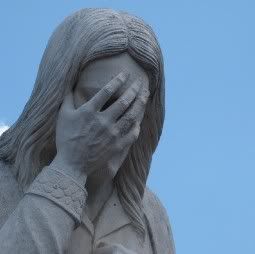
btw. you've no credibility left. Even the Jesus guy can't believe how dumb you are being.

JesusFacepalmSmall.jpg
 
Why don't you check to see who introduced both the scientists to you.

Why don't you check to see the dozens of times I spelled nobel correctly..

Regarding Susskind you are incorrect - Susskind says that he believes our universe is not designed because he believes that we will find there are almost infinite other universes.

When you understand what Susskind has said... you will close the door on you atheist delusion.

---------
 
Quote from peilthetraveler:

Why do you think its funny? You think its funny because you know its weird and not normal. Then you go and pretend it is normal.

And you people are seriously idiots when you say because I protest homosexuality, I only do so because I am one of them. By that logic, if I protest socialism and protest big government, that means I really want socialism and big government? If I protest a war, I'm secretly a warmonger? If I protest abortion, I'm really a baby killer?

Maybe I should use that logic for you atheists out there. If you protest religion, you secretly want to be a priest!

Lame.

Are you a closet gay ????
A quote from another post of yours ... "long & hard"... . The facts are strongly suggesting you are a homosexual peil !!!!!
 
Back
Top