Theoretically, shouldn't any indicator-based or relatively simplistic strategy have no edge at all?

There’s a reason why programmers generally fail in trading. Programming is just a tool like a hammer. A hammer doesn’t make you a great carpenter.
 
Last edited:

There’s a reason why programmers generally fail in trading. Programming is a just a tool like a hammer. A hammer doesn’t make you a great carpenter.
It is pretty obvious that Trading and Programming are not the same thing.

But programmers have a huge personality edge when it comes to systematic trading (but not discretionary trading). Most programmers are rationally minded (xNTx) and introverts (INTJ), obviously not all, but most.

Assuming they can find an edge and develop discipline, they will find it much easier to go down the systematic trading route than almost any other personality type.

Of course most cant find an edge or develop the required discipline.. Those two are the hardest part.
 
Computers can't understand either context or character (of price action) so they'll never in our lifetimes be able to out-perform a good human trader.

Of course they can outperform humans in the micro second world. That's their forte.
 
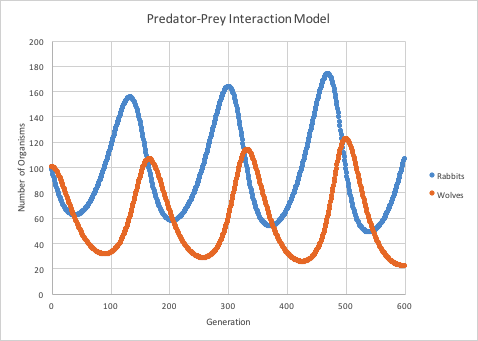
The bots and algos that are dominating directional instruments/spreads are usually some variation of predator prey models.

It's something like this picture.
rabbit_wolf_graph.png

Blue would represent the volume buying/selling, while the orange represents price. This is so that they can do the most volume, while minimizing the market impact of the trades.

Real prices will be trending even while this is occurring, and depending on how this unfolds, the market will make highs and lows as this goes on. Markets are adversarial.

Basically, the big guys are forcing the turns in the market and then fading the resulting moves, with a bias. They have a goal to move the market up or down, or keep it where it is.

They're bullying the smaller traders and exploiting a size advantage so that they can manage the interaction in order to manipulate price levels relative to VWAP and other stuff.

This is a simplification. But it's the basic idea. Size moves/turns the market to create perception and manage speculative participation.
 
If you're using an indicator, or some combination of indicators that any algorithm could easily backtest, wouldn't algorithms have arbitrated any edge away?

If there exists a pattern that has an edge, wouldn't an algorithm be able to trade it far faster and earlier than you? Quants could easily get paid to write an algo that tries out every combination of indicators on every timeframe...

Granted, by the same logic, that edge would eventually no longer exist to the algorithm either thru alpha decay...

Suffice it to say, it seems that any good edge is outside the realm of inside-the-box thinking with regards to indicators or simple price-action.

I'm a fan of technical analysis, but if I follow the logic of "if it works, somebody or some machine has already leveraged it to the maximum" then it seems that only leaves fundamental predictions?

Or is it like Heisenberg's uncertainty principle; everybody interacting with the same pattern will fundamentally alter the pattern so that it doesn't end up being what everyone predicted, and we can only see the true patterns in hindsight?


You are taking an example of a poor tool, used in a poor way for an incorrect purpose, and then extending this to the whole of the tool-box. Indicators are set-up indicators, not entry signallers.

At the basic level the simplest chart price pattern is a trend. It remains that the most probable next price move within a trend will be a continuation of the trend. Its perhaps not much of an edge but it is there and can be used.
 
It is pretty obvious that Trading and Programming are not the same thing.

But programmers have a huge personality edge when it comes to systematic trading (but not discretionary trading). Most programmers are rationally minded (xNTx) and introverts (INTJ), obviously not all, but most.

Assuming they can find an edge and develop discipline, they will find it much easier to go down the systematic trading route than almost any other personality type.

Of course most cant find an edge or develop the required discipline.. Those two are the hardest part.

But most programmers lack market knowledge and an understanding of how markets work. This is not easily acquired and it can't be solved by brute force.

To once again use the carpentry analogue.

If you want to efficiently and rationally build a house - you don't show up with a hammer and insist to build the house only with a hammer as a hammer is a poor tool for chopping beams and joists.

Instead - you figure out what it is you want to do, how you want to do it and then use the best tools to achieve your end goal in the best possible way.

Knowing how to program is a huge edge - but it's no substitute for market knowledge/understanding. :)
 
Everyone looking for that elusive edge, either looks too hard in the wrong places or thinks computer power is the answer.

The answer lies right in front of you and it's as simple as can be -

THE LAW OF SUPPLY AND DEMAND.

That's stood since the beginning of intelligent human life and it will continue until we humans blow up the world (probably in less than 200 years).

So all you have to do is work out on the chart if there are more buyers or sellers, and if so join them. This is where CHARCTER (of price action) comes in. This is where CONTEXT comes in. This is where an UNDERSTANDING of the PREVIOUS price action comes in which is basically the CONTEXT part.

Now, you can't just put up a chart of a trending market and say, oh more buyers than sellers so I'll be a buyer. That won't work over a series of trades. The reason why is many of those buyers aren't FORCED buyers. So you have to look for places on the chart where people are FORCED to buy at the same time there aren't many sellers. Then, prices will not only rise but you'll be able to use a (generally) tight stop and you must understand the importance of using a tight stop in relation to risk-reward.

All of the above information is on the charts, and those charts haven't changed for hundreds of years, they're the same then as now. But the charts aren't used for forecasting, they're used for working out how people are positioned, how people are getting fucked, and WHAT they will have to do to get out of the mess they've got themselves in to. That's your edge, nice and simple, and something that computers will never be able to replicate as well as a savvy human trader (because they can't understand character and context)...
 
You’re right. There’s no edge in technical analysis. I’m honestly confused as to why so many people use it — a lot of those indicators were developed in the 70s-90s. There are much better ways to trade now, but for some people, trading is all about the “experience” (point and click on a chart) and not the outcome (making money on a signal you identified after rigorous analysis).
And to add to you comment and include IAmThe Casino diatribe about institutional vs retail vol, indicators only see volume - retail or institutional all look the same.
 
There are zero "edges" for retail screen jockeys like us. You may think you have edge, but that's only edge over other traders for your being smarter and more disciplined. But that's not edge over the market*.

*What is "edge over the market"?... insider information and front-running trades... both illegal.
 
Yogi Berra applies here about theory and practice. This is like asking if everyone jumped up and landed at the same time would there be a tremendous earthquake?
%%
LOL.Actually, that would be dangerous to do in a second story building/because they are NOT designed for that.
Yogi Beara has a great quote/dont make predictions/especially about the future.
NOT to be confused with weather forecasting maybe 80% accurate.@ least Farmers Almanac has been long term...………………………………………………………………………………………………………………...
 
Back
Top