The ACD Method

Shhhhhuuuuuuussssshhhhhh.

I actually got that one from another poster in this thread. Its highly dependent on how its interpreted and the majority of people I see using it don't understand how to use it correctly.

I would like to know how to use it correctly if you don't mind sharing.
 
Rather than give you the answers its far better to dig into the data and see for yourself.

I would recommend that you read up on any articles by Charles Le Beau and how he applied ADX to trading then play with it and let the data show you.
 
if 5min_bar is within regular trading hours+1 then observations++
if Close_Of_Current_Bar>Opening_Range_High then var1++
if ((var1*100)/observations)>=75 AND High_Of_Day is within 9 Bars from Close_Of_Day

MoneyMathew

I have coded this up and done a run over 1.5 years of data spanning 30 etfs, using a 5min opening range and a 10 day average range. My data is 1min granularity so I have changed variables to be the same as using 5 min data as you use.

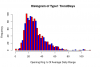
The first chart here shows the distribution of opening rng as a percentage of the average daily range, when I subset for observations meeting the criteria that you specified in the quoted post above, but for both up and down trend days. I have labelled your criteria above as a "Type1TrendDay".

MM_Type1TrendDays.png
Min. 1st Qu. Median Mean 3rd Qu. Max.
0.00 19.22 26.70 29.82 36.68 112.90

As you will notice we have a left skewed distribution with a bulge showing that trend days have a tendency to have an opening range size of around 15-30% of the 10 day average range. Yes this is significant but before getting excited we have to ask ourselves how does this compare to the distribution on non trend days to see if there is any significant difference.

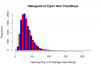
The next chart you will see shows what happened on the remainder of days which did not fit your description of a trend day.

MM_Type1NonTrendDays.png
Min. 1st Qu. Median Mean 3rd Qu. Max.
0.00 21.66 30.25 33.52 41.81 221.50

Looks pretty similar to the one above. As you will see again the histogram displays left skewed distribution with a bulge showing that non trend days also have a tendency to have an opening range size of around 15-30% of the 10 day average range.

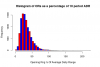
In fact if we compare all opening ranges as a percentage of the 10 day average range you will see that all the opening ranges have a tendency to be left skewed and around 15-30% of the 10 day average range. See the below chart displaying all opening ranges as a percentage of the 10 day average range.

MM_Overall Distro OR as percentage 10adr.png

Min. 1st Qu. Median Mean 3rd Qu. Max.
0.00 21.01 29.33 32.50 40.63 221.50


The overall hypothesis we were trying to prove or disprove, is whether or not a small opening range increases the likelihood of the day becoming a trend day. A trend day has a mean of 29.82% opening range as % adr vs a non trend day which has a mean of 33.52% and the overall of all observations has a mean of 32.50%.

So yes trend days do show a tendency to have smaller opening range as percentage to the average daily range however, is a difference in mean of 3.7% from one to the other significant and worth getting excited about? I would say no but will invite others to comment or critique but please guys post objectively and have the statistics to back you up.

If I get the time I will do a second run using the criteria for Type#2 Trend days as posted here, but fear that this will also yield similar results.

Thanks.

 
You could also do this for an up day:

if Current_Bar_High>Last_Bar_High AND Current_Bar_Low>Last_Bar_Low then UpTrend++

if High_Of_Day is within 9 Bars from Close_Of_Day AND ((UpTrend*100)/Total_Number_Of_Bars)>45 then
{
printf ("Congrats you have a Trend Day UP!");
Trend_Day_Up=True
Trend_Day_Up_Count++
}

I just ran this criteria which returned 0 candidates. This could be due to me using 1 min data and the 45% up/dn bars meeting the said criteria.
 
MoneyMathew

I have coded this up and done a run over 1.5 years of data spanning 30 etfs, using a 5min opening range and a 10 day average range. My data is 1min granularity so I have changed variables to be the same as using 5 min data as you use.

The first chart here shows the distribution of opening rng as a percentage of the average daily range, when I subset for observations meeting the criteria that you specified in the quoted post above, but for both up and down trend days. I have labelled your criteria above as a "Type1TrendDay".

View attachment 171721
Min. 1st Qu. Median Mean 3rd Qu. Max.
0.00 19.22 26.70 29.82 36.68 112.90

As you will notice we have a left skewed distribution with a bulge showing that trend days have a tendency to have an opening range size of around 15-30% of the 10 day average range. Yes this is significant but before getting excited we have to ask ourselves how does this compare to the distribution on non trend days to see if there is any significant difference.

The next chart you will see shows what happened on the remainder of days which did not fit your description of a trend day.

View attachment 171722
Min. 1st Qu. Median Mean 3rd Qu. Max.
0.00 21.66 30.25 33.52 41.81 221.50

Looks pretty similar to the one above. As you will see again the histogram displays left skewed distribution with a bulge showing that non trend days also have a tendency to have an opening range size of around 15-30% of the 10 day average range.

In fact if we compare all opening ranges as a percentage of the 10 day average range you will see that all the opening ranges have a tendency to be left skewed and around 15-30% of the 10 day average range. See the below chart displaying all opening ranges as a percentage of the 10 day average range.

View attachment 171723

Min. 1st Qu. Median Mean 3rd Qu. Max.
0.00 21.01 29.33 32.50 40.63 221.50


The overall hypothesis we were trying to prove or disprove, is whether or not a small opening range increases the likelihood of the day becoming a trend day. A trend day has a mean of 29.82% opening range as % adr vs a non trend day which has a mean of 33.52% and the overall of all observations has a mean of 32.50%.

So yes trend days do show a tendency to have smaller opening range as percentage to the average daily range however, is a difference in mean of 3.7% from one to the other significant and worth getting excited about? I would say no but will invite others to comment or critique but please guys post objectively and have the statistics to back you up.

If I get the time I will do a second run using the criteria for Type#2 Trend days as posted here, but fear that this will also yield similar results.

Thanks.
If you cut corners on defining what a trend day is then I can't take your chart output at face value. The only solution to compare notes is to output your data to a text file/csv. You must include each date tested.

Here is a study I did last year that goes from 2008-06-02 to 2016-04-25. So about 8 years of intraday data.

If everyone reading this can take a look in The Logical Trader at the statement Mark Fisher makes at the bottom of page 12. I wanted to test it for myself.

My question is what percent of the time is the High or Low of the day in the first 30 Minutes of Trading in the S&P 500 ETF (SPY)? Out of 1989 Days tested the High was located in the first 30 Minutes 461 times. The Low was located in the first 30 Minutes 544 times.

The High will be in the first 30 minutes 23.18% of the time.
The Low will be in the first 30 minutes 27.35% of the time.

Fisher's initial claim of 20% holds true.

So if you divide the trading day into 13 Half Hour "Buckets" and if you believe in Random Walk Theory then you would expect to see the High or Low of the day to be in the first 30 minutes about 7.69% of the time. If you have a problem with this data and Mark Fisher's initial claims then I have to ask why you even are a follower of the ACD Method?

I know our original debate was about the OR% and what leads to a trend day but we needed to start from square one here. I can't trust anyone's visual output at face value. I need the raw data.

I don't expect everyone to take my data at face value so I have included a text file where each field is separated by a comma delimiter. Every data point in time series data must be documented. I have also included 8 years of intraday half hour data for the SPY. Every data point must be documented. It is attached to this post.

Here is 8 years of data:

The File Format is:
Date,Question,Answer (Yes/No),

The File Format for Raw Intraday Data is:
Symbol,Date,Open,High,Low,Close,Time,Volume,
 

Attachments

Last edited:
If you cut corners on defining what a trend day is then I can't take your chart output at face value. The only solution to compare notes is to output your data to a text file/csv. You must include each date tested.

I used the criteria that you defined for a trend day so please do not make false accusations.

So if you divide the trading day into 13 Half Hour "Buckets" and if you believe in Random Walk Theory then you would expect to see the High or Low of the day to be in the first 30 minutes about 7.69% of the time. If you have a problem with this data and Mark Fisher's initial claims then I have to ask why you even are a follower of the ACD Method?

There is absolutely no point in debating this as I agree with you about when lows and highs are formed and have carried out the research to verify this.

I know our original debate was about the OR% and what leads to a trend day but we needed to start from square one here. I can't trust anyone's visual output at face value. I need the raw data.

If I can be bothered then I will do this when I have the time. My OHLC data was purchased from a very reputable source and was not cheap. I am also very hesitant to share it online because I am unsure if doing so will breach the data vendors policies. To be honest spending time on here arguing with people like yourself is not as financially rewarding as other ACD projects that I am working on.

I have no idea why you skipped of one subject onto another without finishing first and I am quite tired with your smart ass attitude. For the first time in years I am considering hitting the un-subscribe button to save myself having to read your posts anymore.
 
Back
Top