MoneyMathew
I have coded this up and done a run over 1.5 years of data spanning 30 etfs, using a 5min opening range and a 10 day average range. My data is 1min granularity so I have changed variables to be the same as using 5 min data as you use.
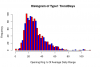
The first chart here shows the distribution of opening rng as a percentage of the average daily range, when I subset for observations meeting the criteria that you specified in the quoted post above, but for both up and down trend days. I have labelled your criteria above as a "Type1TrendDay".
View attachment 171721
Min. 1st Qu. Median Mean 3rd Qu. Max.
0.00 19.22 26.70 29.82 36.68 112.90
As you will notice we have a left skewed distribution with a bulge showing that trend days have a tendency to have an opening range size of around 15-30% of the 10 day average range. Yes this is significant but before getting excited we have to ask ourselves how does this compare to the distribution on non trend days to see if there is any significant difference.
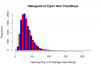
The next chart you will see shows what happened on the remainder of days which did not fit your description of a trend day.
View attachment 171722
Min. 1st Qu. Median Mean 3rd Qu. Max.
0.00 21.66 30.25 33.52 41.81 221.50
Looks pretty similar to the one above. As you will see again the histogram displays left skewed distribution with a bulge showing that non trend days also have a tendency to have an opening range size of around 15-30% of the 10 day average range.
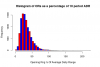
In fact if we compare all opening ranges as a percentage of the 10 day average range you will see that all the opening ranges have a tendency to be left skewed and around 15-30% of the 10 day average range. See the below chart displaying all opening ranges as a percentage of the 10 day average range.
View attachment 171723
Min. 1st Qu. Median Mean 3rd Qu. Max.
0.00 21.01 29.33 32.50 40.63 221.50
The overall hypothesis we were trying to prove or disprove, is whether or not a small opening range increases the likelihood of the day becoming a trend day. A trend day has a mean of 29.82% opening range as % adr vs a non trend day which has a mean of 33.52% and the overall of all observations has a mean of 32.50%.
So yes trend days do show a tendency to have smaller opening range as percentage to the average daily range however, is a difference in mean of 3.7% from one to the other significant and worth getting excited about? I would say no but will invite others to comment or critique but please guys post objectively and have the statistics to back you up.
If I get the time I will do a second run using the criteria for Type#2 Trend days as posted
here, but fear that this will also yield similar results.
Thanks.