The ACD Method

Here is something I have been thinking about. If understand that the daily opening range can give a small trader an advantage because large firms have to move money on a daily basis. This can't necessarily be taken advantage of by other firms because they also have to move large amounts of money to exploit this. However I am trying to understand why a monthly edge would continue to exist when this timeframe should allow nearly anyone to take advantage of it. Thoughts?

The first day of the month is "not" an edge Bagger. It's just a significant data point. There is a difference.
 
It's showing the significance compared to other days. The first day of the month clearly is not like any other day of the month and those graphs clearly show that.

Assume for a moment a purely hypothetical commodity whose only characteristic is that over a substantial period of time it exhibits a steady trend up or down. Then the first trading day of a month ( or indeed of any specified period of time) would tend to be either the high or low point for that period of time, as would equally the last day of the month (or indeed any specified period of time) would tend to be either the high or low point for that period of time

Also, these graphs count days from the beginning of the month and therefore the first day is always day 1. But the last day of the month is not isolated as such, rather it sometimes day 18 or 19 or 20 or 21. To get the percent of time that the last day of the month was the high or low some part of each of those days must be added together. This would for our purely hypothetical commodity tend to give a U shape distribution.

An actual commodity of course has its own characteristics and perhaps it is bought heavily on the first day of a month, or sold heavily on the first day of the month. But it appears that these specific characteristics could superimpose themselves upon, but would not necessarily displace the underlying U distribution
 
The theory behind the first day of the month is the idea that hedge funds, CTA's, RIAs and other money managers put new money to work on the first of the month. Then as the month moves along, less and less capital is deployed. I suspect the last day of the month and qtr show increased liquidity as funds exercise redemptions. The pressure to put money to work immediately is obvious of course, cash positions dilute existing equity returns. Of course cash itself is a position and perhaps a fund manager wants to hold cash. It just gets harder to justify the fees when one can perform that activity on their own.
 
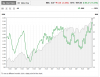
IMX index from TOS highest reading eva! Way to go retail folks.
 

Attachments

  • IMX.PNG
    IMX.PNG
    69.6 KB · Views: 74
The first day of the month is "not" an edge Bagger. It's just a significant data point. There is a difference.

I knew you would call me out on that choice of words. For me the edge I believe I have is placing my trades in a good location in time and price. The first part of that comes from ACD the second from my take on price action. Both of which I am working on quantifying better by learning to program. BTW just finished that book on Marc Rich and I'm starting oil 101 today. What a great story that was, and an interesting look at commodity trading.
 
I knew you would call me out on that choice of words. For me the edge I believe I have is placing my trades in a good location in time and price. The first part of that comes from ACD the second from my take on price action. Both of which I am working on quantifying better by learning to program. BTW just finished that book on Marc Rich and I'm starting oil 101 today. What a great story that was, and an interesting look at commodity trading.

The irony of course is one can learn more about trading from the Marc Rich book then any book on chart reading. Of course who doesn't like to look at pretty charts. :)
 
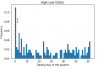
I've learned a lot from this thread but never really contributed anything. I've been learning python and my first project was to write code to analyze the distribution of monthly highs and lows. So here is a graph showing the percentage of the time that each trading day holds either a high or low for the month. Days are listed on the bottom as trading day of the month. This is going back 10-25 years depending on product.

Interesting charts. I have a file of old charts that showed a similar effect for Monday vs the rest of the week. It was consistent across a very broad basket of futures with no deviations. I don't remember where I got them from unfortunately. I'd be curious to know if the effect within your data was more pronounced on the first days of the quarters (Apr, July, Oct and Jan ) relative to the other 8 months?
 
Interesting charts. I have a file of old charts that showed a similar effect for Monday vs the rest of the week. It was consistent across a very broad basket of futures with no deviations. I don't remember where I got them from unfortunately. I'd be curious to know if the effect within your data was more pronounced on the first days of the quarters (Apr, July, Oct and Jan ) relative to the other 8 months?

Yes it is signifigant. Here is GC first day is around 11%. Keep in mind I am a complete and total beginner with this stuff so I can't guarantee the accuracy of my output yet.
 

Attachments

  • pythonw_2017-03-07_17-58-57.png
    pythonw_2017-03-07_17-58-57.png
    9.7 KB · Views: 42
Back
Top