You are using an out of date browser. It may not display this or other websites correctly.
You should upgrade or use an alternative browser.
You should upgrade or use an alternative browser.
The ACD Method
- Thread starter sbrowne126
- Start date
Wow what a rocket..I think I mentioned some of the grains confirming but damn just look at Oats. Confirmed earlier this month for the first time in a LONG time, quickly made a Qtr A up... what a pop!
If you think that is a rocket take a look at the Dec/Mar Oats spread.
I can't upload images for some reason but check it out.
I can't upload images for some reason but check it out.
The old mavers discussion on convexity will indeed happen this weekend. It will be Sunday evening. I already have the excel charts done. Stay tuned...
The blood bath in natty continues going into delivery. I apologize for the delay in the convexity commentary...it's coming today.
OK guys, sorry for the delay here on Natty. I did not know we can't upload excel files so I'm going to snap shot the images and try to walk through the concept here. So the question is, what are the pros and cons of being in energy spreads vs flat price and more specifically what are the pros and cons of being long an instrument or spread that offers a convex payoff vs a linear payoff.
The problem in general, as can be seen the last few days with natty flat price, is that it's extremely volatile. There is also a lot of noise in this volatility just in case anyone tries to say volatility is good what's the problem. LOL. Volatility is good when it can be modeled. When it's simply white noise, it's a concern because assuming one has some respect and consideration for risk, you have to make allowances for it. What convex payoffs allow us to do is capture what we want when we are right and minimize what we don't want when we are wrong. This clearly describes the non linear payoff of say being long a call option.
The natural gas widowmaker spread, otherwise known as HJ named after the corresponding months (march and april) offers this unique convex payoff. Now I'm going to try to simplify things here for those who don't care about fundamentals and how they get played out in energy spreads but what you do need to know about HJ is that it's really a fundamental trade at it's core. From October through the end of March, natural gas gets drawn down from storage to supply heat to the Midwest and northeast predominantly. From april to October gas gets injected into storage. The march/april inflection point offers a unique opportunity to make a specific bet on how the supply and demand mechanism will resolve itself. As we get to march the supply of natural gas will become sparse. Any shocks to demand (cold weather) will put serious pressure on the remaining supply. However, any unforeseen warm weather late in spring or just a lack of overall demand throughout the winter will rapidly suck out any excess premium in this spread.
The spread almost always trades in backwardation, meaning the march month will trade at a premium to april since march is where the demand is. As time draws nearer to expiration, the conditional probabilities are dynamically changing in terms of the likelihood of a stockout (meaning dry storage). Any shock to demand or supply during the winter months will change these conditional probabilities. But as we get closer to the roll, just like a call option, whatever excess premium is still embedded in the spread will evaporate. And last minute shocks though can send this spread vertical.
When one trades this spread early in the winter season, such as now, the spread more or less tracks the overall movement of the futures and spot price. Therefore one can trade HJ in lieu of the front month futures. The question is, should we? The answer depends on where prices are. As I'm about to show, the payoffs change dramatically depending on the price of HJ. As with an convex product, as prices go down, the slope or the rate of change of the price relative to the futures decreases. This is GOOD. As prices go in our favor, the slope steepens. This is also GOOD, it means our profits will increase at an exponential rate. This is exactly why we trade options, to capture the benefits of this curvature.
What is unique to HJ vs say buying options on natty is there really is no time decay in the traditional sense. Meaning the decay is not continuous. It's much more akin to owning an option going into earnings where the outcome is binary. Options going into earnings usually do not decay much if at all then suddenly implode after the report. HJ behaves in a similar fashion. But early in the season you get a product that basically trades cheap with a modest premium and if conditions warrant, the spread explodes. If nat gas prices fall, this spread will trade down to this baseline level and usually hold. The reason for this is fundamental of course. Front month nat gas futures are a specific bet on time and place. Place being Henry Hub and time being that months delivery date. This is why Nov gas is getting crushed right now going into delivery and Dec gas is holding bid. The demand for march gas is not the same demand for nov gas or dec gas. Each month is like it's own separate market. So there is no reason for HJ to trade down at the same velocity as Nov gas.
The main advantage for using HJ as it allows us to eliminate the noise of front month pricing and the delivery process and instead focus on the really driver of higher prices which is premium capacity pricing. Over the next few posts I will show some graphs that illustrate this.
The problem in general, as can be seen the last few days with natty flat price, is that it's extremely volatile. There is also a lot of noise in this volatility just in case anyone tries to say volatility is good what's the problem. LOL. Volatility is good when it can be modeled. When it's simply white noise, it's a concern because assuming one has some respect and consideration for risk, you have to make allowances for it. What convex payoffs allow us to do is capture what we want when we are right and minimize what we don't want when we are wrong. This clearly describes the non linear payoff of say being long a call option.
The natural gas widowmaker spread, otherwise known as HJ named after the corresponding months (march and april) offers this unique convex payoff. Now I'm going to try to simplify things here for those who don't care about fundamentals and how they get played out in energy spreads but what you do need to know about HJ is that it's really a fundamental trade at it's core. From October through the end of March, natural gas gets drawn down from storage to supply heat to the Midwest and northeast predominantly. From april to October gas gets injected into storage. The march/april inflection point offers a unique opportunity to make a specific bet on how the supply and demand mechanism will resolve itself. As we get to march the supply of natural gas will become sparse. Any shocks to demand (cold weather) will put serious pressure on the remaining supply. However, any unforeseen warm weather late in spring or just a lack of overall demand throughout the winter will rapidly suck out any excess premium in this spread.
The spread almost always trades in backwardation, meaning the march month will trade at a premium to april since march is where the demand is. As time draws nearer to expiration, the conditional probabilities are dynamically changing in terms of the likelihood of a stockout (meaning dry storage). Any shock to demand or supply during the winter months will change these conditional probabilities. But as we get closer to the roll, just like a call option, whatever excess premium is still embedded in the spread will evaporate. And last minute shocks though can send this spread vertical.
When one trades this spread early in the winter season, such as now, the spread more or less tracks the overall movement of the futures and spot price. Therefore one can trade HJ in lieu of the front month futures. The question is, should we? The answer depends on where prices are. As I'm about to show, the payoffs change dramatically depending on the price of HJ. As with an convex product, as prices go down, the slope or the rate of change of the price relative to the futures decreases. This is GOOD. As prices go in our favor, the slope steepens. This is also GOOD, it means our profits will increase at an exponential rate. This is exactly why we trade options, to capture the benefits of this curvature.
What is unique to HJ vs say buying options on natty is there really is no time decay in the traditional sense. Meaning the decay is not continuous. It's much more akin to owning an option going into earnings where the outcome is binary. Options going into earnings usually do not decay much if at all then suddenly implode after the report. HJ behaves in a similar fashion. But early in the season you get a product that basically trades cheap with a modest premium and if conditions warrant, the spread explodes. If nat gas prices fall, this spread will trade down to this baseline level and usually hold. The reason for this is fundamental of course. Front month nat gas futures are a specific bet on time and place. Place being Henry Hub and time being that months delivery date. This is why Nov gas is getting crushed right now going into delivery and Dec gas is holding bid. The demand for march gas is not the same demand for nov gas or dec gas. Each month is like it's own separate market. So there is no reason for HJ to trade down at the same velocity as Nov gas.
The main advantage for using HJ as it allows us to eliminate the noise of front month pricing and the delivery process and instead focus on the really driver of higher prices which is premium capacity pricing. Over the next few posts I will show some graphs that illustrate this.
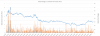
This first curve shows us the volatility associated with front month nat gas futures. To make this data more discernible, I took the futures prices since jan 2014 along with each day's daily corresponding volatility and then sorted the prices from left to right or low to high. This allows one an easy visual to see the volatility one can expect as prices get cheap or expensive. Here is what you need to draw from this, no matter how low or high the front month prices goes, daily volatility is rather constant. Meaning you are not catching a break when prices are low. Please note these daily vol readings in orange are absolute changes, not percentage. So it's showing you that even at very very low prices, the daily volatility one has to endure is still painful. Clearly at very high prices vol spikes do increase but only modestly so. Vol is uniformly high across the entire spectrum.
Attachments
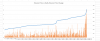
The next graph shows the exact same information from jan 2014 to about oct 2016 this time with the daily absolute price changes in HJ as a function of the front month natural gas futures price. Something should immediately stick out to you here. At low levels of futures prices, the HJ spread exhibits very small daily changes. This is GOOD. It means when natty is cheap and HJ is cheap the product sits and trades around a baseline value. If and when natty starts heating up, you will notice on the right side of the graph, the daily prices changes increase substantially. This is in sharp contrast to the front month futures prices. This is what we want, explosive upside action when natty starts moving higher and quiet baseline prices when gas prices are cheap or going down.
The important concept to draw from this chart is if you are long front month natty and it starts going down, you HAVE to endure the same volatile price action as if it was moving in your favor. With HJ you endure the volatile price action only when its moving in your favor and you get quiet subdued action when natty prices are dropping.
Important note here, this does NOT mean you are not losing money on HJ as spot prices drop, it simply means HJ is dropping incrementally with low vol vs sharpe downward action. Also as mentioned earlier, the benefits are given to those who are long HJ "near" the baseline levels. If one buys HJ at premium prices especially late in the season, you are no longer benefitting from this curvature and are taking substantially more risk. Remember, at feb roll, this spread will usually fall to the marginal cost of physical storage which is somewhere between -.03 to .-10 cents per month.
The important concept to draw from this chart is if you are long front month natty and it starts going down, you HAVE to endure the same volatile price action as if it was moving in your favor. With HJ you endure the volatile price action only when its moving in your favor and you get quiet subdued action when natty prices are dropping.
Important note here, this does NOT mean you are not losing money on HJ as spot prices drop, it simply means HJ is dropping incrementally with low vol vs sharpe downward action. Also as mentioned earlier, the benefits are given to those who are long HJ "near" the baseline levels. If one buys HJ at premium prices especially late in the season, you are no longer benefitting from this curvature and are taking substantially more risk. Remember, at feb roll, this spread will usually fall to the marginal cost of physical storage which is somewhere between -.03 to .-10 cents per month.
Attachments
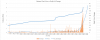
This next graph is the same information but this time not sorted from low to high. It shows gas prices in proper order of time with the orange spikes being the daily prices changes for front month futures and the grey bars are the daily price changes for HJ. Notice how when prices are high, front month futures and HJ are almost equally volatile. But as prices in spot go lower, the orange bars stay high but the grey bars disappear. This is because as prices go down, HJ becomes quiet and the slope flattens. So if you are long HJ and natty is dropping, the move lower is stable but the front month futures holder is riding a screaming roller coaster on the way down.