
The Guardian. blahahahahahahaClimate models are even more accurate than you thought
The difference between modeled and observed global surface temperature changes is 38% smaller than previously thought
There’s a common myth that models are unreliable, often based on apples-to-oranges comparisons, like looking at satellite estimates of temperatures higher in the atmosphere versus modeled surface air temperatures. Or, some contrarians like John Christy will only consider the temperature high in the atmosphere, where satellite estimates are less reliable, and where people don’t live.
This new study has shown that when we do an apples-to-apples comparison, climate models have done a good job projecting the observed temperatures where humans live. And those models predict that unless we take serious and immediate action to reduce human carbon pollution, global warming will continue to accelerate into dangerous territory.
http://www.theguardian.com/environm...odels-are-even-more-accurate-than-you-thought

You are using an out of date browser. It may not display this or other websites correctly.
You should upgrade or use an alternative browser.
You should upgrade or use an alternative browser.
The 95% consensus is now just 43%
- Thread starter WeToddDid2
- Start date
The Guardian. blahahahahahaha
You find great newspapers funny? Typical moron righty.
The Guardian. blahahahahahaha
The Guardian - printing complete drivel since 1821.
lol at ignorant righties
Awards
Received
The Guardian has been awarded the National Newspaper of the Year in 1999, 2006,[160] 2011[161] and 2014[13] by the British Press Awards, and "Front Page of the Year" in 2002 ("A declaration of war", 12 September 2001).[160][162] It was also co-winner of the World's Best-designed Newspaper as awarded by the Society for News Design (2006).
Guardian journalists have won a range of British Press Awards, including:[160]
In 2007 the newspaper was ranked first in a study on transparency that analysed 25 mainstream English-language media vehicles, which was conducted by the International Center for Media and the Public Agenda of the University of Maryland.[166] It scored 3.8 out of a possible 4.0.
The Guardian and The Washington Post shared the 2014 Pulitzer Prize for public service reporting for their coverage of the NSA's and GCHQ's worldwide electronic surveillance program and the documents leaks by whistleblower Edward Snowden.[167]
Awards
Received
The Guardian has been awarded the National Newspaper of the Year in 1999, 2006,[160] 2011[161] and 2014[13] by the British Press Awards, and "Front Page of the Year" in 2002 ("A declaration of war", 12 September 2001).[160][162] It was also co-winner of the World's Best-designed Newspaper as awarded by the Society for News Design (2006).
Guardian journalists have won a range of British Press Awards, including:[160]
- "Reporter of the Year" (Nick Davies, 2000; Paul Lewis, 2010);
- "Foreign Reporter of the Year" (James Meek, 2004; Ghaith Abdul-Ahad, 2008);
- "Columnist of the Year" (Polly Toynbee, 2007; Charlie Brooker, 2009);
- "Feature Writer of the Year" (Emma Brockes, 2002; Tanya Gold, 2010; Amelia Gentleman, 2011);[161]
- "Cartoonist of the Year" (Steve Bell, 2003);
- "Political Journalist of the Year" (Patrick Wintour, 2007; Andrew Sparrow, 2011);[161]
- "Interviewer of the Year" (Decca Aitkenhead, 2009);
- "Sports Photographer of the Year" (Tom Jenkins, 2004, 2006, 2007).
- Bevins Prize for investigative journalism (Paul Lewis, 2010);
- Martha Gellhorn Prize for Journalism (Nick Davies, 1999; Chris McGreal, 2003; Ghaith Abdul-Ahad, 2005; Ian Cobain, 2009).
In 2007 the newspaper was ranked first in a study on transparency that analysed 25 mainstream English-language media vehicles, which was conducted by the International Center for Media and the Public Agenda of the University of Maryland.[166] It scored 3.8 out of a possible 4.0.
The Guardian and The Washington Post shared the 2014 Pulitzer Prize for public service reporting for their coverage of the NSA's and GCHQ's worldwide electronic surveillance program and the documents leaks by whistleblower Edward Snowden.[167]
None of this really matters. You can't settle scientific questions with surveys. There are two separate questions that have been conflated, and the media, public and politicians are hopelessly confused.
One question is: Is the Hansen hypothesis correct? Hansen's hypothesis was that rising CO2 would cause a dangerous amount of exponentially rising global warming. CO2 is too weak in its greenhouse gas properties and present at too low a concentration to directly cause such a catastrophe; thus Hansen realized his hypothesis must assume a positive feedback mechanism, whereby a little warming could lead to more warming, and magnify the effect of relatively small increases in the mole fraction of CO2.
Based on what we know now, thirty years after Hansen formulated his hypothesis, the hypothesis is wrong. The Earth's climate system responds to warming with negative feedback; not the positive feedback required by Hansen's Hypothesis. Early, Hypothesis based models assumed positive feedback. These models all predicted exponentially rising temperature with rising CO2. But many observations have not been in accord with the models predictions. Also, it has been discovered that short term cyclical swings in CO2 and temperature are linked and closely mirror one another. However temperature change leads the CO2 change. This is evidence that short term, regular swings in CO2 content are driven by similar swings in temperature, and not the other way around as predicted by Hansen's Hypothesis. If positive Feedback is present, it is insufficient to overcome countervailing negative feedback, so net feedback is negative. Another error incorporated into early, temperature predicting Hansen models, and in particular the IPCC models, is that they assumed a very long half life for anthropomorphic CO2 emitted to the atmosphere. It is now known that the half life is short, on the order of a few years. Still another defect in the early models is their failure to properly account for convection cooling which is now known to be a very important cooling mechanism and a component of negative feedback.
The second question is not whether climate changes over time. The paleorecord and other data tells us it does. The important question is whether we are in a period of statistically unusual climate change, or even if we are not, what is the current direction of change and how much change might we reasonably expect? The Earth's climate is a large, chaotic system. Consequently, these are extremely difficult questions to answer, except after the fact and very long periods of observation spanning many years.
So if you bothered to read this far, you might still be wondering what the point of all this is. Well it is this: There is hardly any thinking person that is a climate change denier. And many are convinced that we are in a warming period. (That's less certain if one considers the entire Earth, than if one only considers certain regions of the Earth.)
There are, however, many climate scientists, which include meteorologists and atmospheric physicists, that are Hansen Hypothesis deniers. Their view is that while our Earth may indeed be warming, the evidence is overwhelming that the warming has nothing to do with CO2.
One question is: Is the Hansen hypothesis correct? Hansen's hypothesis was that rising CO2 would cause a dangerous amount of exponentially rising global warming. CO2 is too weak in its greenhouse gas properties and present at too low a concentration to directly cause such a catastrophe; thus Hansen realized his hypothesis must assume a positive feedback mechanism, whereby a little warming could lead to more warming, and magnify the effect of relatively small increases in the mole fraction of CO2.
Based on what we know now, thirty years after Hansen formulated his hypothesis, the hypothesis is wrong. The Earth's climate system responds to warming with negative feedback; not the positive feedback required by Hansen's Hypothesis. Early, Hypothesis based models assumed positive feedback. These models all predicted exponentially rising temperature with rising CO2. But many observations have not been in accord with the models predictions. Also, it has been discovered that short term cyclical swings in CO2 and temperature are linked and closely mirror one another. However temperature change leads the CO2 change. This is evidence that short term, regular swings in CO2 content are driven by similar swings in temperature, and not the other way around as predicted by Hansen's Hypothesis. If positive Feedback is present, it is insufficient to overcome countervailing negative feedback, so net feedback is negative. Another error incorporated into early, temperature predicting Hansen models, and in particular the IPCC models, is that they assumed a very long half life for anthropomorphic CO2 emitted to the atmosphere. It is now known that the half life is short, on the order of a few years. Still another defect in the early models is their failure to properly account for convection cooling which is now known to be a very important cooling mechanism and a component of negative feedback.
The second question is not whether climate changes over time. The paleorecord and other data tells us it does. The important question is whether we are in a period of statistically unusual climate change, or even if we are not, what is the current direction of change and how much change might we reasonably expect? The Earth's climate is a large, chaotic system. Consequently, these are extremely difficult questions to answer, except after the fact and very long periods of observation spanning many years.
So if you bothered to read this far, you might still be wondering what the point of all this is. Well it is this: There is hardly any thinking person that is a climate change denier. And many are convinced that we are in a warming period. (That's less certain if one considers the entire Earth, than if one only considers certain regions of the Earth.)
There are, however, many climate scientists, which include meteorologists and atmospheric physicists, that are Hansen Hypothesis deniers. Their view is that while our Earth may indeed be warming, the evidence is overwhelming that the warming has nothing to do with CO2.
Last edited:
There are, however, many climate scientists, which include meteorologists and atmospheric physicists, that are Hansen Hypothesis deniers. Their view is that while our Earth may indeed be warming, the evidence is overwhelming that the warming has nothing to do with CO2.
http://joecrubaugh.com/blog/wp-content/uploads/2007/03/Co2ClimateChangeAndFossilFuel.jpg
http://joecrubaugh.com/blog/wp-content/uploads/2007/03/Co2ClimateChangeAndFossilFuel.jpg
It is the sun stupid!!!There are, however, many climate scientists, which include meteorologists and atmospheric physicists, that are Hansen Hypothesis deniers. Their view is that while our Earth may indeed be warming, the evidence is overwhelming that the warming has nothing to do with CO2.
http://joecrubaugh.com/blog/wp-content/uploads/2007/03/Co2ClimateChangeAndFossilFuel.jpg
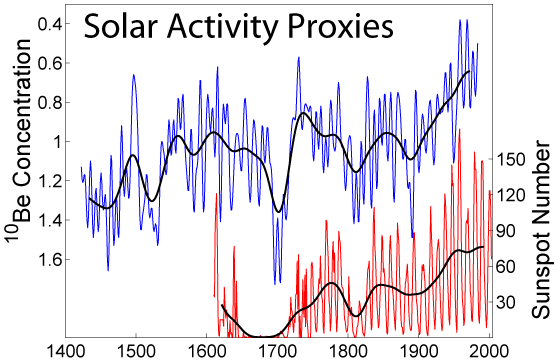
It is the sun stupid!!!
No stupid, it's not the sun.

http://www.bloomberg.com/graphics/2015-whats-warming-the-world/

This conclusion is confirmed by many studies finding that while the sun contributed to warming in the early 20th Century, it has had little contribution (most likely negative) in the last few decades:
- Huber and Knutti (2011): "Even for a reconstruction with high variability in total irradiance, solar forcing contributed only about 0.07°C (0.03-0.13°C) to the warming since 1950."
- Erlykin 2009: "We deduce that the maximum recent increase in the mean surface temperature of the Earth which can be ascribed to solar activity is 14% of the observed global warming."
- Benestad 2009: "Our analysis shows that the most likely contribution from solar forcing a global warming is 7 ± 1% for the 20th century and is negligible for warming since 1980."
- Lockwood 2008: "It is shown that the contribution of solar variability to the temperature trend since 1987 is small and downward; the best estimate is -1.3% and the 2? confidence level sets the uncertainty range of -0.7 to -1.9%."
- Lean 2008: "According to this analysis, solar forcing contributed negligible long-term warming in the past 25 years and 10% of the warming in the past 100 years..."
- Lockwood 2008: "The conclusions of our previous paper, that solar forcing has declined over the past 20 years while surface air temperatures have continued to rise, are shown to apply for the full range of potential time constants for the climate response to the variations in the solar forcings."
- Ammann 2007: "Although solar and volcanic effects appear to dominate most of the slow climate variations within the past thousand years, the impacts of greenhouse gases have dominated since the second half of the last century."
- Lockwood 2007: "The observed rapid rise in global mean temperatures seen after 1985 cannot be ascribed to solar variability, whichever of the mechanism is invoked and no matter how much the solar variation is amplified."
- Foukal 2006 concludes "The variations measured from spacecraft since 1978 are too small to have contributed appreciably to accelerated global warming over the past 30 years."
- Scafetta 2006 says "since 1975 global warming has occurred much faster than could be reasonably expected from the sun alone."
- Usoskin 2005 conclude "during these last 30 years the solar total irradiance, solarUV irradiance and cosmic ray flux has not shown any significant secular trend, so that at least this most recent warming episode must have another source.
- Solanki 2004 reconstructs 11,400 years of sunspot numbers using radiocarbon concentrations, finding "solar variability is unlikely to have been the dominant cause of the strong warming during the past three decades".
- Haigh 2003 says "Observational data suggest that the Sun has influenced temperatures on decadal, centennial and millennial time-scales, but radiative forcingconsiderations and the results of energy-balance models and general circulation models suggest that the warming during the latter part of the 20th century cannot be ascribed entirely to solar effects."
- Stott 2003 increased climate model sensitivity to solar forcing and still found "most warming over the last 50 yr is likely to have been caused by increases ingreenhouse gases."
It is the sun stupid!No stupid, it's not the sun.
http://www.bloomberg.com/graphics/2015-whats-warming-the-world/
This conclusion is confirmed by many studies finding that while the sun contributed to warming in the early 20th Century, it has had little contribution (most likely negative) in the last few decades:
- Huber and Knutti (2011): "Even for a reconstruction with high variability in total irradiance, solar forcing contributed only about 0.07°C (0.03-0.13°C) to the warming since 1950."
- Erlykin 2009: "We deduce that the maximum recent increase in the mean surface temperature of the Earth which can be ascribed to solar activity is 14% of the observed global warming."
- Benestad 2009: "Our analysis shows that the most likely contribution from solar forcing a global warming is 7 ± 1% for the 20th century and is negligible for warming since 1980."
- Lockwood 2008: "It is shown that the contribution of solar variability to the temperature trend since 1987 is small and downward; the best estimate is -1.3% and the 2? confidence level sets the uncertainty range of -0.7 to -1.9%."
- Lean 2008: "According to this analysis, solar forcing contributed negligible long-term warming in the past 25 years and 10% of the warming in the past 100 years..."
- Lockwood 2008: "The conclusions of our previous paper, that solar forcing has declined over the past 20 years while surface air temperatures have continued to rise, are shown to apply for the full range of potential time constants for the climate response to the variations in the solar forcings."
- Ammann 2007: "Although solar and volcanic effects appear to dominate most of the slow climate variations within the past thousand years, the impacts of greenhouse gases have dominated since the second half of the last century."
- Lockwood 2007: "The observed rapid rise in global mean temperatures seen after 1985 cannot be ascribed to solar variability, whichever of the mechanism is invoked and no matter how much the solar variation is amplified."
- Foukal 2006 concludes "The variations measured from spacecraft since 1978 are too small to have contributed appreciably to accelerated global warming over the past 30 years."
- Scafetta 2006 says "since 1975 global warming has occurred much faster than could be reasonably expected from the sun alone."
- Usoskin 2005 conclude "during these last 30 years the solar total irradiance, solarUV irradiance and cosmic ray flux has not shown any significant secular trend, so that at least this most recent warming episode must have another source.
- Solanki 2004 reconstructs 11,400 years of sunspot numbers using radiocarbon concentrations, finding "solar variability is unlikely to have been the dominant cause of the strong warming during the past three decades".
- Haigh 2003 says "Observational data suggest that the Sun has influenced temperatures on decadal, centennial and millennial time-scales, but radiative forcingconsiderations and the results of energy-balance models and general circulation models suggest that the warming during the latter part of the 20th century cannot be ascribed entirely to solar effects."
- Stott 2003 increased climate model sensitivity to solar forcing and still found "most warming over the last 50 yr is likely to have been caused by increases ingreenhouse gases."
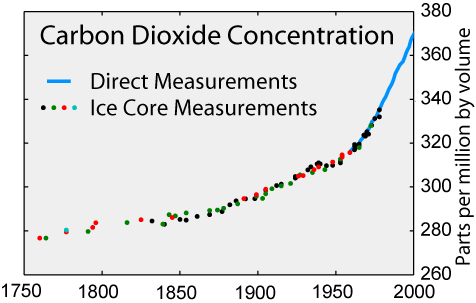
It is the sun stupid!
Oh I get it. You have just been pretending to be a moron and actually you knew all along that it's due to CO2 increase due to man.