
Tape reading Software ??

Over the years I've done a lot of analysis of intra-day Buying/Selling volume for individual NYSE stocks and my own custom indexes. I've looked at it from a tick by tick basis, all the way up to minute and hourly bars. My honest conclusion of a huge amount of effort is that it is almost worthless. The futures are the only thing really worth analyzing. If the futures are diving, then the stocks will be weak, and vice versa. Look for stocks that are diverging from their corresponding futures index. Keep in mind that I'm talking about this in the context of day trading, and finding a rigorous and testable edge. Something for which rules can be defined, and then back tested to show profitability. I believe that for discretionary trading, some of the analysis may be useful, but I doubt it is anything that could be verified through rigorous testing. This information used to be invaluable in previous years, and stock buying would actually lead or show the real market strength, but the stock market is now merely a slave to the futures market. Most intraday institutional trading is done electronically, so the orders are sliced and diced via various algorithms i.e. the real buying is now essentially obfuscated. For the NYSE, program trading constitutes almost 60% of the daily trading volume. If you remove the opening and closing print volume, there is very little trading that is not done programmatically.

I tried performing similar analysis of NASDAQ stocks, but due to the fragmented market structure (numerous ECNs); I found it impossible to truly determine if buys or sells were occurring at the bid or ask. One can analyze the various ECN quote data streams individually, but when aggregated it became a mess. Maybe this is where your software excels?

As with all trading ideas, it's always easy to show cases where it works, but the hard work comes when one analyzes all the false signals. Like most discretionary strategies ... they work when they work, and don't when they don't.

Regards,

Slave2Market

P.S. I'm not trying to knock the usefulness of your software, but I'd love to be proven wrong. I also don’t doubt that you find your software invaluable, but I wonder whether it really provides an edge, or is just something that confirms what is already being telegraphed by the futures market.
 
Well said... Slave2Market...

i totally agreed that analysis of intra-day Bid/Ask volume is of limited accuracy, similar to guessing 50/50, thus no edge. i've spent abt 6 months researching on this topics and arriving in the above conclusion. (anyone pls prove me wrong too. :) i love to be wrong so that i can learn new thing. )
currently, i'm researching on L2 market depth bid/ask "movements". any comments / ideas will be appreciated. i've forward my findings to traders who provide me with ideas, comments and exchanges.


Quote from Slave2Market:

Over the years I've done a lot of analysis of intra-day Buying/Selling volume for individual NYSE stocks and my own custom indexes. I've looked at it from a tick by tick basis, all the way up to minute and hourly bars. My honest conclusion of a huge amount of effort is that it is almost worthless. The futures are the only thing really worth analyzing. If the futures are diving, then the stocks will be weak, and vice versa. Look for stocks that are diverging from their corresponding futures index. Keep in mind that I'm talking about this in the context of day trading, and finding a rigorous and testable edge. Something for which rules can be defined, and then back tested to show profitability. I believe that for discretionary trading, some of the analysis may be useful, but I doubt it is anything that could be verified through rigorous testing. This information used to be invaluable in previous years, and stock buying would actually lead or show the real market strength, but the stock market is now merely a slave to the futures market. Most intraday institutional trading is done electronically, so the orders are sliced and diced via various algorithms i.e. the real buying is now essentially obfuscated. For the NYSE, program trading constitutes almost 60% of the daily trading volume. If you remove the opening and closing print volume, there is very little trading that is not done programmatically.

I tried performing similar analysis of NASDAQ stocks, but due to the fragmented market structure (numerous ECNs); I found it impossible to truly determine if buys or sells were occurring at the bid or ask. One can analyze the various ECN quote data streams individually, but when aggregated it became a mess. Maybe this is where your software excels?

As with all trading ideas, it's always easy to show cases where it works, but the hard work comes when one analyzes all the false signals. Like most discretionary strategies ... they work when they work, and don't when they don't.

Regards,

Slave2Market

P.S. I'm not trying to knock the usefulness of your software, but I'd love to be proven wrong. I also don’t doubt that you find your software invaluable, but I wonder whether it really provides an edge, or is just something that confirms what is already being telegraphed by the futures market.
 
Quote from Slave2Market:

... but the stock market is now merely a slave to the futures market...
Well said Slave2Market, and I can personally attest to this - I've observed that the ES (futures) and SPX prints do lead the INDU and COMP indeces when all are starting to move in the same direction. This is per IB quotes and charting which I watch quite often.

duwdu
 
Quote from topgunsoftware:

No need to be suspicious, tape reading and bid/ask analysis works, especially when you watch what the world's largest traders are doing.

Reading the tape is one of the best ways to identify what is really going on in any given stock. Few people can tape read and no human can read the tape on hundreds of stocks. Our software is the only one on the market that can analyze all the trades going on in up to 1,000 stocks and show you visually whether people are aggressively buying (taking the offer) or aggressively selling (hitting the bid).

Here is a perfect example today in YHOO. It gapped up today and you can see in our Buy/Sell Pressure that there was more selling on the bid than buying on the offer. The second column shows what 5,000+ share traders were doing. They did a little net buying on the first bar, moreso on the second but on the second rally up to the highs the big traders were net sellers even on UP bars. Many traders would have anticipated a breakout in YHOO but when selling dominates buying you won't see a breakout and can instead short the double top.

The third indicator is our custom volume indicator that shows total volume for the bar plus the statistical average volume for that bar. It lets you see immediately if volume is above or below normal for this time of the day and I use it to decide to go with breakouts or to fade them.

<a href="http://www.topgunsoftware.com/"><img src="http://www.topgunsoftware.com/elitetrader/yhoo020205.gif" border=0></a>
How do you calculate normalized volumes at any point of the day? Do you average past EOD volumes and then apply a fixed volume ratio for all stocks given the time of the day or you use a different methodology?
 
This works excellent --- i have used this for a few months now ---

TapeReader Software used in the IOAMT chatroom everyday ---

--------------------------------------------------------------------------------------

MacroEvent


Registered: Jul 2005
Posts: 989


11-11-05 05:35 PM

excellent tool for tape reading will be available on the 12th

http://www.mmti.com/TapeReaderInfo.htm


Edit/Delete • Quote • Complain


here are some screen shots----

http://www.ttrader.com/mycharts/display.php?p=37265&u=macroevent&a=MacroEvent&id=1511

http://www.ttrader.com/mycharts/display.php?p=37266&u=macroevent&a=MacroEvent&id=1511

http://www.ttrader.com/mycharts/display.php?p=37264&u=macroevent&a=MacroEvent&id=1511
 
Quote from ilganzo:

How do you calculate normalized volumes at any point of the day? Do you average past EOD volumes and then apply a fixed volume ratio for all stocks given the time of the day or you use a different methodology?
We use different methods in charts than we do in quote sheets. In quote sheets we have an advanced formula that takes into consideration most stocks have heavy volume in the opening session, less over lunch and increased volume into the close. For our charts we use the exact average volume for each time frame for that specific time of the day.

I looked at some of the other tape reading packages out there and one thing that most have in common is they require the trader to think and analyze. We try to keep the results simple and visual. During the heat of trading traders often overlook things, and the more simple a tool is the more effective it will be.

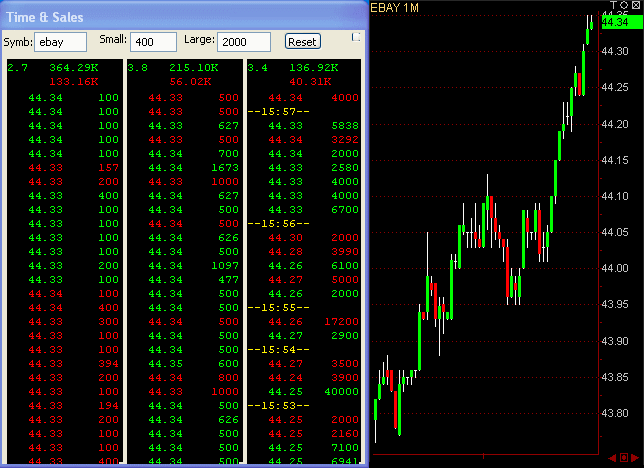
We've recently created a new time and sales window that lets traders watch buying/selling by different size traders. It is very effective in that it does two things, shows what the large traders who move the markets are doing and also shows the pace and trade rate of the market. If this is scrolling by real slow trading activity is slow and volatility will be less than normal. When it is flying by, especially the large size traders, you will see real market movement and a clear sign of which direction to trade in.

I did this example showing the volume accumulate for the last 20 or so minutes today (Dec 7th,2005). You can hit the reset button and reset this at any time. During the last 20 minutes you can see that small traders (up to 400 shares) bought 364k shares and sold 133k shares. Medium sized traders trading 400 to 2,000 shares bought 215k shares and sold 56k shares and larger traders trading more than 2k shares bought almost 137k and sold 40k. There was 340% more buying by large traders and you can see by the chart to the right that during that time the stock went straight up. I personally love this tool for both stocks and futures. In the S&P I have found that the big lot traders (100+) are the only ones who routinely move the market. When the 100 lotters aren't participating the market drifts around with little volatility and is very hard to trade. When the 100 lots traders are heavily buying or selling you will see big moves and easy trading. It really lets you know when to exit a trade and is also helpful for determining when to get in at ends of trends in the opposite direction.


:D Tape Reading
1.gif

2.gif

3.gif

4.gif

5.gif

:D
 
Back
Top