
Over the years I've done a lot of analysis of intra-day Buying/Selling volume for individual NYSE stocks and my own custom indexes. I've looked at it from a tick by tick basis, all the way up to minute and hourly bars. My honest conclusion of a huge amount of effort is that it is almost worthless. The futures are the only thing really worth analyzing. If the futures are diving, then the stocks will be weak, and vice versa. Look for stocks that are diverging from their corresponding futures index. Keep in mind that I'm talking about this in the context of day trading, and finding a rigorous and testable edge. Something for which rules can be defined, and then back tested to show profitability. I believe that for discretionary trading, some of the analysis may be useful, but I doubt it is anything that could be verified through rigorous testing. This information used to be invaluable in previous years, and stock buying would actually lead or show the real market strength, but the stock market is now merely a slave to the futures market. Most intraday institutional trading is done electronically, so the orders are sliced and diced via various algorithms i.e. the real buying is now essentially obfuscated. For the NYSE, program trading constitutes almost 60% of the daily trading volume. If you remove the opening and closing print volume, there is very little trading that is not done programmatically.
I tried performing similar analysis of NASDAQ stocks, but due to the fragmented market structure (numerous ECNs); I found it impossible to truly determine if buys or sells were occurring at the bid or ask. One can analyze the various ECN quote data streams individually, but when aggregated it became a mess. Maybe this is where your software excels?
As with all trading ideas, it's always easy to show cases where it works, but the hard work comes when one analyzes all the false signals. Like most discretionary strategies ... they work when they work, and don't when they don't.
Regards,
Slave2Market
P.S. I'm not trying to knock the usefulness of your software, but I'd love to be proven wrong. I also donât doubt that you find your software invaluable, but I wonder whether it really provides an edge, or is just something that confirms what is already being telegraphed by the futures market.
I tried performing similar analysis of NASDAQ stocks, but due to the fragmented market structure (numerous ECNs); I found it impossible to truly determine if buys or sells were occurring at the bid or ask. One can analyze the various ECN quote data streams individually, but when aggregated it became a mess. Maybe this is where your software excels?
As with all trading ideas, it's always easy to show cases where it works, but the hard work comes when one analyzes all the false signals. Like most discretionary strategies ... they work when they work, and don't when they don't.
Regards,
Slave2Market
P.S. I'm not trying to knock the usefulness of your software, but I'd love to be proven wrong. I also donât doubt that you find your software invaluable, but I wonder whether it really provides an edge, or is just something that confirms what is already being telegraphed by the futures market.
 i love to be wrong so that i can learn new thing. )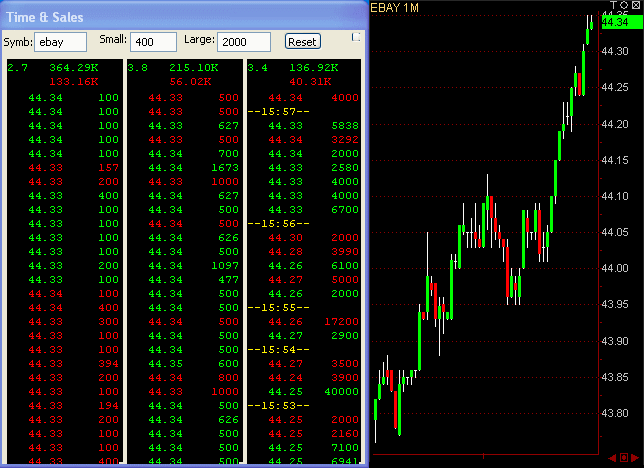
 Tape Reading


