Wow, I'm impressed. Curiosity is critical when studying the market as a prelude to developing a trading plan. Kudos to you.
What you have is correct, but the details are largely unnecessary. Introducing too many elements into your decision-making process -- criteria, checklists, components -- will make the whole thing so complicated that by the time you've been through all this and decided to take the trade, it's gone. Therefore, simple is best.
The perfect example found in books and in software sales literature is correct as far as it goes. But reality doesn't always cooperate. For example, the standard example, which is not difficult to find, consists of price hitting the top of what will become a range, reversing to a level where many trades are conducted, then falling to a level which will become the bottom of the range, then returning to the middle, then back down to the bottom or continuing on to the top and so on. So what you end up with is a lot of trades in the middle -- i.e., "value" -- with comparatively fewer at the top and at the bottom. If you know how to trade reversals and do so at the top and bottom, you can make some money. If you try to trade in the middle, you will most likely be chopped up in the trendlessness. And there are plenty of trends which have tons of trades along the upper level and the lower level, hence loads of volume, but relatively little in the middle, or the "mean". Sometimes price lingers at that mean and this will be revealed in a volume analysis of some sort, like Volume At Price. However, price will often shoot right through the mean on its way to the opposite extreme, creating greater volume at those extremes and two "value areas".
Therefore, if you want to turn all of this to your advantage, you must get past software and theory and guruspeak and focus on what traders want to accomplish and what they're doing in order to accomplish it. Right now, for example, we are at the top of a long-term trend channel in the NQ. We've been here for several days. But at some point sellers will try to entice buyers to pay higher prices and price will rise, perhaps creating a more acute trend channel, or buyers will force sellers to accept lower prices and price will fall. The following chart was posted Saturday and provides an example:
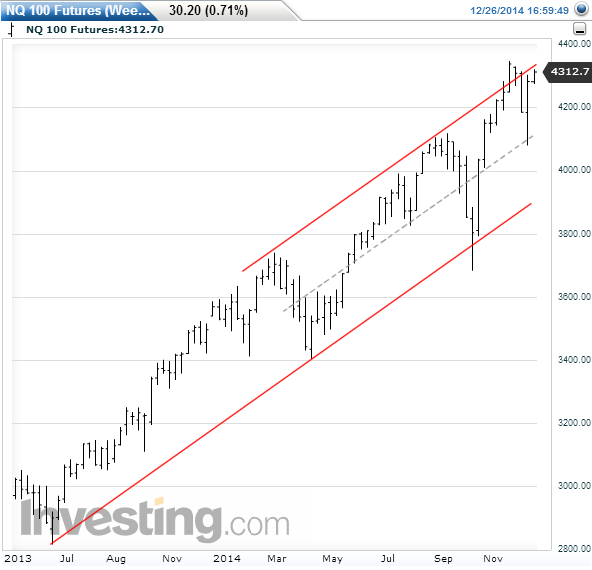
If traders want to take prices lower, or if they don't want to take prices lower but are dragged into doing so anyway, and you trade a longer bar interval, hourly or daily, you may have a nice ride down to the "mean" or even the lower limit of this channel. But even if you trade a shorter interval, something that can be traded within a day (15m, 5m, 1m), an understanding of what traders have in mind may give you a clue as to whether you ought to be focusing on the short side or the long.
Some instruments, like this one, are simple. They're mean-reverting and all one has to do is trade the reversals, sort of like pinball. Other instruments are not mean-reverting and provide few if any clues as to what they're going to do, when they're going to do it, and how far they're likely to go. I prefer the simple, but not everyone does. Then there's scalping, which is still an auction market, but charts aren't going to do you much good, if any.
If you want to read what I came up with after going through essentially the same process you did,
see this, pages 31 through 42. You may find this to be more practical when it comes to actual trading and making actual trading decisions.