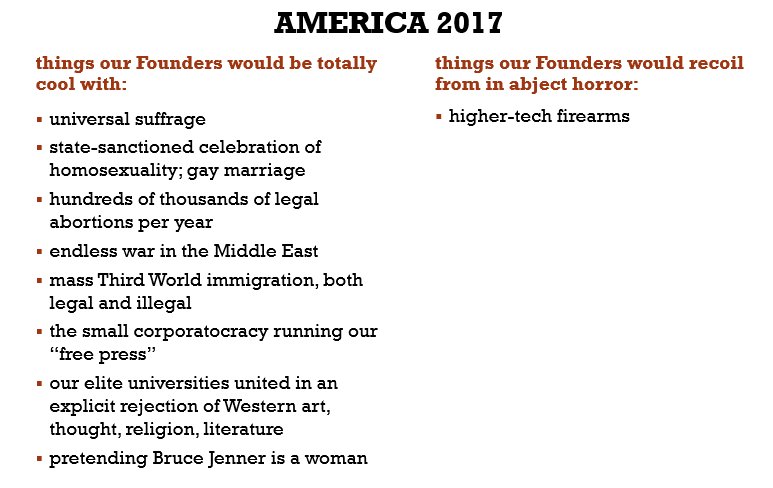
appealing to Europe when it comes to freedom and liberty is the wrong way to go. Europe should be looking to us. Especially after they put Gert Wilders in confinement for what should have been protected free speech... especially from the political opposition...
here is why our founders enshrined our rights to protect our liberty from govt...
http://www.nationalreview.com/article/452368/bret-stephens-guns-columnist-does-not-understand
...
Stephens is not a stupid man, and nor is he unaware of the reach that tyrannies have enjoyed. On the contrary, his is often a welcome voice in the fight for the liberty of all people. This being so, it is remarkable how blithely he elects to invoke Madison as a friend to his cause, and how readily he subordinates the right to bear arms to expediency. In truth, the Second Amendment was not an “amendment” at all, for, unlike some of the subsequent alterations to the charter, it represented neither a change in policy nor a remedy for an error. Rather, along with the rest of the Bill of Rights it was the product of a disagreement as to how to best protect freedoms that were generally considered unalienable. For reasons outlined in The Federalist Papers, Madison believed that the power of the federal government would be constrained by its structure; if the central state had only a handful of carefully enumerated powers, he contended, it would not be able to exceed them. Others, the “Anti-Federalists,” disagreed, demanding a belt to add to the suspenders. The debate that followed was strictly structural — not a fight over speech or due process or arms, but over how best to ensure the maintenance of ancient liberty. Madison acknowledged this when introducing the Bill of Rights in Congress. The rights he had included, he made clear to his peers, were those “against which I believe no serious objection has been made by any class of our constituents.” In encoding the right to bear arms among the set, neither Madison nor his opponents were innovating. Instead, they were channeling Justinian, Locke, and Blackstone, and ensuring that the people of the new country would enjoy a robust right to self-defense, and the auxiliary protections that enabled it. Powered by They were also responding to the lessons of history. Stephens seems convinced that the Second Amendment is contingent; that is, that its meaning and relevance rely upon the continuing prevalence of redcoats. Surely, Stephens insists, if Madison could see the modern world he would change his mind. I must venture that the very opposite is true. Were he to pick up a history book today, Madison would be shocked indeed. But his surprise would be at the sheer scale and disgrace of the tyrannies that have scarred us since he died.
The American Revolution was a beautiful and necessary thing, and yet if one were to have read the litany of complaints to a man in the Warsaw Ghetto, or in Dachau, or in the Gulag, or in the Laogai, or, yes, in the Reconstruction-deprived post-bellum South, he would have laughed in your face. The colonists were that upset over . . . that? Well, yes. They were. And they should have been. But let us not pretend that their anguish was equivalent to what came next — in Germany, in Cuba, in Russia, in China, in Mississippi. And let us not pretend that there was more need for safeguards against George III and the Declaratory Act than against the blood-soaked 20th century. Certainly, Madison could not have imagined the future. But that, in truth, is to say that he could not have imagined how right he would prove to be. Power, ambition, human nature — these are constants, not variables. And it is for that reason above all else that our enduring Constitution must be cherished. There is rarely a good reason to kick over Chesterton’s fence, even when it is chipped and knotted around the edges, and the villagers are scratching their chins. Apostasy or no apostasy, Bret Stephens has made no progress today in convincing anyone otherwise. As you were, America. As you were.
Read more at: http://www.nationalreview.com/article/452368/bret-stephens-guns-columnist-does-not-understand
here is why our founders enshrined our rights to protect our liberty from govt...
http://www.nationalreview.com/article/452368/bret-stephens-guns-columnist-does-not-understand
...
Stephens is not a stupid man, and nor is he unaware of the reach that tyrannies have enjoyed. On the contrary, his is often a welcome voice in the fight for the liberty of all people. This being so, it is remarkable how blithely he elects to invoke Madison as a friend to his cause, and how readily he subordinates the right to bear arms to expediency. In truth, the Second Amendment was not an “amendment” at all, for, unlike some of the subsequent alterations to the charter, it represented neither a change in policy nor a remedy for an error. Rather, along with the rest of the Bill of Rights it was the product of a disagreement as to how to best protect freedoms that were generally considered unalienable. For reasons outlined in The Federalist Papers, Madison believed that the power of the federal government would be constrained by its structure; if the central state had only a handful of carefully enumerated powers, he contended, it would not be able to exceed them. Others, the “Anti-Federalists,” disagreed, demanding a belt to add to the suspenders. The debate that followed was strictly structural — not a fight over speech or due process or arms, but over how best to ensure the maintenance of ancient liberty. Madison acknowledged this when introducing the Bill of Rights in Congress. The rights he had included, he made clear to his peers, were those “against which I believe no serious objection has been made by any class of our constituents.” In encoding the right to bear arms among the set, neither Madison nor his opponents were innovating. Instead, they were channeling Justinian, Locke, and Blackstone, and ensuring that the people of the new country would enjoy a robust right to self-defense, and the auxiliary protections that enabled it. Powered by They were also responding to the lessons of history. Stephens seems convinced that the Second Amendment is contingent; that is, that its meaning and relevance rely upon the continuing prevalence of redcoats. Surely, Stephens insists, if Madison could see the modern world he would change his mind. I must venture that the very opposite is true. Were he to pick up a history book today, Madison would be shocked indeed. But his surprise would be at the sheer scale and disgrace of the tyrannies that have scarred us since he died.
The American Revolution was a beautiful and necessary thing, and yet if one were to have read the litany of complaints to a man in the Warsaw Ghetto, or in Dachau, or in the Gulag, or in the Laogai, or, yes, in the Reconstruction-deprived post-bellum South, he would have laughed in your face. The colonists were that upset over . . . that? Well, yes. They were. And they should have been. But let us not pretend that their anguish was equivalent to what came next — in Germany, in Cuba, in Russia, in China, in Mississippi. And let us not pretend that there was more need for safeguards against George III and the Declaratory Act than against the blood-soaked 20th century. Certainly, Madison could not have imagined the future. But that, in truth, is to say that he could not have imagined how right he would prove to be. Power, ambition, human nature — these are constants, not variables. And it is for that reason above all else that our enduring Constitution must be cherished. There is rarely a good reason to kick over Chesterton’s fence, even when it is chipped and knotted around the edges, and the villagers are scratching their chins. Apostasy or no apostasy, Bret Stephens has made no progress today in convincing anyone otherwise. As you were, America. As you were.
Read more at: http://www.nationalreview.com/article/452368/bret-stephens-guns-columnist-does-not-understand