
Some people assert that the direction is always a 50/50 chance, completely random.
Some assert that it's pretty close to 50/50, but the "edge" is what lets you get a positive expectancy.
Under that assumption, if a trader has a system that commits many trades (so as to rule variance out), shouldn't he not be able to lose money faster than the bleedout of commissions? If people can lose money faster than loss from commissions, and its not due to variance, it should hold that the person can at least go the other way as well.
It all comes back to a simple normal distribution, knowledge is power.
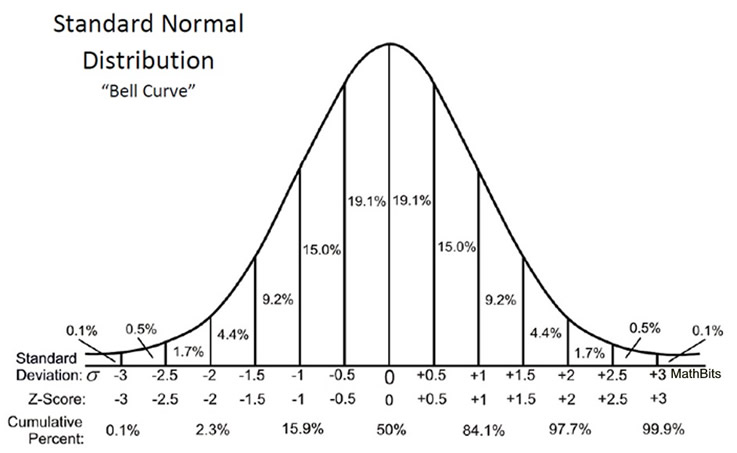
At each timeframe you have different number of people, capital, direction, goals, risk profiles, all fighting among themselves to remove the others of their capital. Is it possible to unwind select parts of that complexity via algos with micro economics, yes. Supporting groups of various combinations you also have a foundation, some people understand those foundations, Buffet for example, and work on macro moves.
Psychology trends towards control of the many by the few, if you have the detail (0) you need the summary(-4) and the conclusion(+4) at each level to understand it. Control is having the knowledge or ability to close -4 at the same level as +4, controlling other people is making sure they don't match. As only very few have the summary and/or conclusion knowledge, the rest produce endless amounts of detail overloading the masses in the process, causing indirect censorship of the few that do. It's the "I don't have it you won't either" combined with "I am an expert with nothing to back it up", both psychological traits of this process.
So is it random, no, but to understand the complexity you either need the foundation knowledge on a macro level or the tools on a micro level. Have both of those and something interesting happens, you generate more out than you put in. Most don't have either so for them it's random, backed up by endless amounts of garbage by those who either don't want to or can't close the summary and conclusion on the same level, generating a self-fulfilling prophecy.
The key to all this, avoiding bureaucracy and red tape, the problem, around the detail that's all there is and hence no clarity. From the detail looking out it's random (focus on money not time), from the summary and conclusion looking in it's transparency (focus on time not money). It's all about perspective, for most the markets are random and they lose money, for a few the markets are perfection and they have the skills and tools to identify the patterns to make enormous wealth. And then you have the 2%/mth crowd in the middle working idiotic hours trying to understand both macro and micro in unison rather than distinct units.
*Or there's the abbreviated version, for 99% it's random. For the top 5% of the best they're neutral and not sure what it is, for the top 1% of the best it's maybe it is maybe it isn't for 2%/mth depending on factors only known to them, and for the top 0.1% of the best it's micro and/or macro level perfection for 20%/mth.
Last edited:
