Options Noob... 1st 100 trades completed

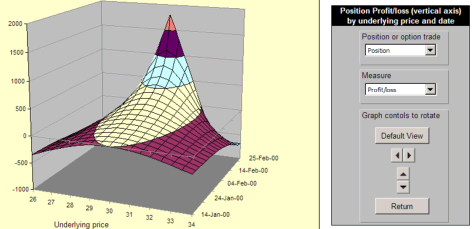
Here's why they're so difficult conceptually. This is time / underlying price / profit graph for a relatively simple short straddle (sliced down the middle from the "v" is similar to the inverse of a long options). Being able to envision that while looking at just the chains seemed to be my tipping point. Once you've mastered this one, try to visualize a calendar spread!

3DProfit.gif


Honestly, were it not for me being conceptually strong in 3D calculus anyway, and having years of experience with insurance to condition my brain for price, I'd agree 100% that it's not worth the time or effort.

Hi
@beerntrading
Please , What is the software to make this kind of 3d graphics.
It is very interesting. It is posible to represent all kind of option strategies or only the basic ones.

Thank you
 
I don't do options but know that there a pros that are trading options by buying (volatility) only just because everyone out there thinks that selling is the only way to go and it's really crowded out there with everyone i.e. shorting volatility.

While option sellers might make a lot of money, they are also prone to spectacular blow outs. Option selling is like trying to be an insurance company. But most forget that insurance business is a regulated industry with mandatory reserves taken from profits each year to cover big losses that will come one day. And you can be assured that they WILL come.
If I follow your logic: In that case what if you are your own government, mandate reserves to cover big loss? If so perhaps you can be printing money going short?
 
Buyers of options rarely make money, but I'm extremely thankful they are in the pool!
And who are all the buyers of your shorts? Seriously, I want to know if there are any studies on who the stupid buyers are (other than me on occasions): small retail mom and pop, gamblers, speculators, institutions, hedge funds...?

Thanks.
 
When you show any interest at all in options, you get bombarded with solicitations. Some of which include free trade recommendations.

I took 100 of those with the strategy:
1. Take profits when +100% gain
2. Stop when -50% loss
3. Close in early July, regardless (all plays were July expiration)

Results...
1. 38% win rate... all were option buys. I understand I could get a higher percentage of small winners writing OTM, but not much appeal. I don't care to wait 3 months to earn $.70, or do a "spread for net credit of $.55"
2. ~$22K net profit... without 3 decent size winners which I let run well past "100% gain", likely would have ended negative.

Assuming average stock price of $50, I traded an options portfolio on $5MM worth of equities... for a gain of <0.5%.

Seems not worth the hassle.

If I am to continue bothering with options, need better trade choices and a higher percentage of winners. Lots of people want to sell me "their picks" for a high price. Seems likely to not be worth it.

FWIW....

Comments?
You mentioned 22k in profit and based your returns on the leveraged amount of 5 million. But you didn't say how much capital you started with and how much you ended with?
 
You mentioned 22k in profit and based your returns on the leveraged amount of 5 million. But you didn't say how much capital you started with and how much you ended with?

That's not really the point. What you're asking is "what was your percentage gain on margin". That can vary widely depending upon allocation of capital. Besides "how much one tranch of capital is leveraged is irrelevant to total capital.
 
Hi
@beerntrading
Please , What is the software to make this kind of 3d graphics.
It is very interesting. It is posible to represent all kind of option strategies or only the basic ones.

Thank you
I presume you can model any strategy with it (ordinary strategies or custom). I don't know the software offhand. I don't use it, and it's not a common feature, that's for sure. I searched Google for that image. I find it mostly conceptually useful because you're still one axis shy of modeling it fully with volatility...and then bid ask spreads (and how the fluctuate relative to volatility) make the real curve a little fuzzy.

Then you overlay the integration of the normal curve for likely expiry prices vs. The likelihood of hitting a target / stop...and what you base the stop on (underlying makes more sense than the option itself for anything more than 1-leg spreads to me)...and how that stop changes with time...and then you overlay your directional call hit rate...

There's a ton of moving parts to it, and each had the power to overcome the others to turn an otherwise good call bad (but also bad calls good)....it takes a long time to get a conceptual grasp of them.

If you're a successful price player I small moves they offer you nothing. If you look for breakouts / down, the offer leverage or downside protection. If you're not good at price plays, they offer a mechanism to shift the odds substantially in your favor.
 
Last edited:
Then you overlay the integration of the normal curve for likely expiry prices vs. The likelihood of hitting a target / stop...and what you base the stop on (underlying makes more sense than the option itself for anything more than 1-leg spreads to me)...and how that stop changes with time...and then you overlay your directional call hit rate...

There's a ton of moving parts to it, and each had the power to overcome the others to turn an otherwise good call bad (but also bad calls good)....it takes a long time to get a conceptual grasp of them.
I read and re-read your comments several times and still cannot understand what you said. Many of us are not pros so can you explain in lay person language to make it easier for us retail traders?

Thanks.
 
I read and re-read your comments several times and still cannot understand what you said. Many of us are not pros so can you explain in lay person language to make it easier for us retail traders?

Thanks.
Sorry...I actually meant for that to be confusing. It was more to illustrate the complexity than try to explain it. And I'm by no means a pro myself.

But...my point about the normal curve (a bell curve) is that is you take it's integral (using calculus to figure out the area under the curve) it will always equal 1. The why and how of it is less important than the fact it does. It's how options calculators calculate the chance of hitting a given price, i.e. When it shows a 30% chance of profitability, it means the bell curve's area above that price is .3...but you can take all this info from a platform with their likelihood of hitting a price by a certain date or closing above oh a certain date.

If you take your expected gain / loss vs. Price on expiry, and multiply that by the normal curve, you get "expected profit". (Be mindful that on long options this figure is hugely inflated because you cut one side of the curve at the strike, while the wing of the curve gets a lot of really high values, even lightly weighted will still push that number up). I also have my doubts that prices truly fit a normal distribution...but that's a different story.

Options aren't really that difficult that understanding all of the above is necessary (in fact I take huge shortcuts that preclude consideration of most of that). My big point is if you're good with price movement and have the capital, trade stocks or futures. Options will tax a lot of time and brainpower that could be spent looking at price. But, there's also a lot of ways to make money with options as price plays, or price agnostic.

 
Sorry...I actually meant for that to be confusing. It was more to illustrate the complexity than try to explain it. And I'm by no means a pro myself.

But...my point about the normal curve (a bell curve) is that is you take it's integral (using calculus to figure out the area under the curve) it will always equal 1. The why and how of it is less important than the fact it does. It's how options calculators calculate the chance of hitting a given price, i.e. When it shows a 30% chance of profitability, it means the bell curve's area above that price is .3...but you can take all this info from a platform with their likelihood of hitting a price by a certain date or closing above oh a certain date.

If you take your expected gain / loss vs. Price on expiry, and multiply that by the normal curve, you get "expected profit". (Be mindful that on long options this figure is hugely inflated because you cut one side of the curve at the strike, while the wing of the curve gets a lot of really high values, even lightly weighted will still push that number up). I also have my doubts that prices truly fit a normal distribution...but that's a different story.

Options aren't really that difficult that understanding all of the above is necessary (in fact I take huge shortcuts that preclude consideration of most of that). My big point is if you're good with price movement and have the capital, trade stocks or futures. Options will tax a lot of time and brainpower that could be spent looking at price. But, there's also a lot of ways to make money with options as price plays, or price agnostic.
Thanks. I appreciate you taking the time to clarify.
 
Back
Top