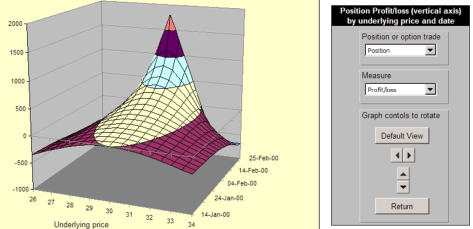
Sorry...I actually meant for that to be confusing. It was more to illustrate the complexity than try to explain it. And I'm by no means a pro myself.
But...my point about the normal curve (a bell curve) is that is you take it's integral (using calculus to figure out the area under the curve) it will always equal 1. The why and how of it is less important than the fact it does. It's how options calculators calculate the chance of hitting a given price, i.e. When it shows a 30% chance of profitability, it means the bell curve's area above that price is .3...but you can take all this info from a platform with their likelihood of hitting a price by a certain date or closing above oh a certain date.
If you take your expected gain / loss vs. Price on expiry, and multiply that by the normal curve, you get "expected profit". (Be mindful that on long options this figure is hugely inflated because you cut one side of the curve at the strike, while the wing of the curve gets a lot of really high values, even lightly weighted will still push that number up). I also have my doubts that prices truly fit a normal distribution...but that's a different story.
Options aren't really that difficult that understanding all of the above is necessary (in fact I take huge shortcuts that preclude consideration of most of that). My big point is if you're good with price movement and have the capital, trade stocks or futures. Options will tax a lot of time and brainpower that could be spent looking at price. But, there's also a lot of ways to make money with options as price plays, or price agnostic.