On 10-case geometry and beyond

What I had before I went to lunch. I feel like there are way too many FS being activated so I'm suspicious of my own log today but this is what I had.


View attachment 188583


Nice looking chart. I like the boxes that define the 30m aggregate. A thing that will help is to program the colors of your OB's.


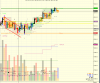
This is how I saw the day.

ESU8-5m-180716 1of.png


I chose notPP1 due to the fact that the EE bar was within the previous day's lateral, the close was within the lateral and even though the price bar shows high volatility, the high volume did not have acceleration.


The 5x5 grid drill demonstrates changes in sentiment. Sentiment is contextual and can be defined as 1 bar or multiple bars. On your log, the three columns have to do with trend cycling.
 
Thanks.
Hmm, I seem to be missing a lot.

On bar 9 or so, the bar was assigned P2 on your chart. Is there a reason for that bar not being a BO,T1? 8:30 bar could also have been P2 but that one was assigned BO,T1. Is it because the first one (BM rev bar) was steep and rtl would have been too steep?

The indicator is actually supposed to color the OB bars but indicators can't override stepan's program for bar coloring mechanism (which I find helpful) because it seems to be embedded into the bar type lol. I ended up resorting to having it labeled on top of the bar for now.

I've actually done the 5x5 drill when I first started reading this but I don't understand the difference between sentiment and single 5 minute bar sentiment (how sentiment can be for multiple bars? vs single bar).

It seems every EE gets a turn type which seems to build the trend set as it progresses (as Jack mentioned every trend starts from set A and B the incomplete to Set C and D the complete normal trends). Is the turn type kind of subjective? (I think tiddlywinks mentioned it but I can't seem to grasp my head around it) I initially thought if I log correctly, I would be ruling out turn types and trend sets according to the modrian table but this area is still much of a blur for me.

I wish I can pinpoint what it is that determines turn types and how to use the modrian table.
 
Thanks.
Hmm, I seem to be missing a lot.

On bar 9 or so, the bar was assigned P2 on your chart. Is there a reason for that bar not being a BO,T1? 8:30 bar could also have been P2 but that one was assigned BO,T1. Is it because the first one (BM rev bar) was steep and rtl would have been too steep?

StR and StB's are internals, therefore a wait. What helps with internals is to 'squish' the wait bar into the prior bar. Doing this on this bar kept the close within the rtl established by the prior bar T1. It was also a UL, so measure volume and log the bar.

StR and StB's can be a logged as a FS, if a FS was more appropriate. Since we are in a drift type D trend, a BO,T1 here would have made this EE a C turn completing the D trend.


The indicator is actually supposed to color the OB bars but indicators can't override stepan's program for bar coloring mechanism (which I find helpful) because it seems to be embedded into the bar type lol. I ended up resorting to having it labeled on top of the bar for now.

I've actually done the 5x5 drill when I first started reading this but I don't understand the difference between sentiment and single 5 minute bar sentiment (how sentiment can be for multiple bars? vs single bar).

The day starts, a 30m bar begins. This 30m bar will eventually contain 6 5m bars. The 5m bars will form the 1,2 or 3rd legs of the 30m. This 30m bar has a sentiment, this sentiment is aligned with the 2nd leg. This sentiment can continue or change throughout the forming of the bar. The 5m bar also has a sentiment composed of 5 1m bars. The 5m also has a form, a price case associated with it. This form also has a sentiment.


It seems every EE gets a turn type which seems to build the trend set as it progresses (as Jack mentioned every trend starts from set A and B the incomplete to Set C and D the complete normal trends).

Correct, trends move forward in an irreversible manner. They can complete or be incomplete and interrupted by trend cycling in the opposite direction. The incomplete trends are defined.


Is the turn type kind of subjective? (I think tiddlywinks mentioned it but I can't seem to grasp my head around it) I initially thought if I log correctly, I would be ruling out turn types and trend sets according to the modrian table but this area is still much of a blur for me.

No, turn type is not subjective. What is critical about turn types are correctly ID'ing EE's. This is supported by having the carryover. That's why I recommend getting into the practice of the VTP and building your reference charts. Building your trading library makes debriefing easier and faster.


I wish I can pinpoint what it is that determines turn types and how to use the modrian table.

You just have to guess at first and be ok with guessing. Refer to the previous posted pattern and see the dashed line as the orthogonal max profit path of the parallelogram. Looking more closely, c turns start with a P1, however not all P1's are c turns. As one follows the path of price, one can see the relationship between the volume bands and the dependent moves of price. Notice where an a turn can begin and where it cannot, same with the b turn.

A good exercise is to create the symmetrical opposite of the above drawing. The cycle would start with the short trend failing into the start of the long.

Let's say you have identified an EE that is in the n-1 column of Set A trend. The n column has the list of the possible c turns that can come after this n-1 EE. If the EE that presents is not in this list, then that EE is the only alternative it can be, which in this case is an a turn.

Now we have an a turn EE assigned as an Set A trend.

On the next EE, one goes to the next trend which is B. The n-1 column of Set B is where you look to find the previous a turn, A trend EE.

The Modrian table has in the n column all the possible c turns from this a turn. If the turn is found this EE is a c turn completing the Set B trend. One then restarts at the beginning with Set A.

If this EE is not in the n column then it is the only other turn that it can be which is a b turn.

This EE would be a b turn which fails to complete Set B and advances the trend to Set C where one continues the process.

Comments with quoted text.
 
Last edited:
Comments with quoted text.

Wow that modrian table explanation is crystal clear. No further questions further there for now. Thank you!


I was thinking internals are wait, but it can also be bo,t1 and on top of that this was a UL. I guess this is more comes with experience type of identification on that bar. BO,T1 and laterals definitely seem to require a learning curve to id properly.
 
Wow that modrian table explanation is crystal clear. No further questions further there for now. Thank you!


I was thinking internals are wait, but it can also be bo,t1 and on top of that this was a UL. I guess this is more comes with experience type of identification on that bar. BO,T1 and laterals definitely seem to require a learning curve to id properly.


Yes, good thinking. There is a hierarchy to discern. It's better to think through it for it practices the very process that operates as MADA is performed and debriefing is completed.

There's something about the unconscious drive to 'fill' a space that Jack created in one's mind that actively searching for an answer works to not only fill but strengthen within a network of associations.

Doing that and printing out threads in 3-ringed binders that one 'marks up' with copious notes. It's old skool but it also gives the freedom and flexibility to do work outside one's normal environment. My progress with the Hershey material accelerated when following this simple recommendation by Jack.
 
This is how I saw the day.

esu8-5m-180716-1of-png.188666

As you know, I am automating EE annotation in SierraChart. I am putting EE pieces together. T2P and T2F is my current area of study. Your F band EE's stood out and prompt me to make this post.

As a common backgrounder, here is a JH snippet regarding F band EE's, origin thread unknown...

F type EE's
Fa, Fb, Fc and Fd

Bands A, B and C occur, then aan extreme bar appears.

It can be very high of very low.

Lets go from least to most in value.

Before in the A band an Ab could appear when the bar value was afte P2 and lower than T1. Later after thyee t2P and T2F have apperaed the F context comes into view.

Fd is a value lower than T1.

Fc is a value lower than T2F.

HVBO's can appear as well.

If P2> P1, then a volume value just less than P1 is an Fa.

If P1> P2, then Fb is a value just greater than P2.

To further the discussion, here is common background from JH defining all the bands.

A band is a high low range. Prior volume element define the bands.

A band is between T1 and P1.

B band is between P2 and T2P

C band is between T2p and T2F.

We will not use or need bands D and E.

F Band is outside of T2P and P2 and not including parts of band H.

G is a value after a specific test on a specifically defined bar. The test is the n+1 bar test after the first T2F or successive T2F's. the value is between T1 and T2F the voume bar is namded P3F if it occurs.

The H band is outside of P1 and T1 after P2t's AND P2F's have occurred. It odes not overlap band F. Band F is inside band H always.

Band K is like band C BUT it is not in effct until a triple alternation of T2P and T2F.

A drill in a few days will be to draw the bands on a blank sheet of paper. They begin and end as events in the volume test procedure are completed.

C band occurs before F band is active. C band requires T2P AND T2F.

So what is a/the proper EE to use when T2P is present, and next is not T2P or T2F?
I am using Ba, Aa, or Ab, the specific EE requirements being the decider.
Bc, may be thrown into the possibles despite the Bc "expectation" mentioned here...

You have a sheet for all the b through K bands.

Here is a run down on these 12 EE's found in various non A bands. I will do A band last.

Ba and Bc

Ba is common and Bc is not seen.

Ba is found when P2 is greater than P1 or an inside bar has a larger volume than the outside bar AND the volume is between P2 and T2P.

If P2 is less than P1, the Bc volume is between P2 and P1.

Regardless of the EE used, other than consistency, P1 assignment on or after the EE is what matters.
 
As you know, I am automating EE annotation in SierraChart. I am putting EE pieces together. T2P and T2F is my current area of study. Your F band EE's stood out and prompt me to make this post.

As a common backgrounder, here is a JH snippet regarding F band EE's, origin thread unknown...


To further the discussion, here is common background from JH defining all the bands.


C band occurs before F band is active. C band requires T2P AND T2F.

So what is a/the proper EE to use when T2P is present, and next is not T2P or T2F?
I am using Ba, Aa, or Ab, the specific EE requirements being the decider.
Bc, may be thrown into the possibles despite the Bc "expectation" mentioned here...

If we are at T2P the next volume bar will be either:
1)wait, until measurable
2)if measurable, then it is a possible T2P or T2F forming intrabar. (provided that a FS is not activated)
3)at lock-in, if volume made it into either of the zones outside the boundary defined by the C band pass, then you have hvbo EE's above the band pass and lvbo EE's below the bandpass.

In other words, as volume builds above the T2F threshold then it can no longer be a lvbo EE. As volume builds above the T2P threshold then it can no longer be a C band pass. As volume builds above the P2 threshold we are in hvbo EE F band country.


Regardless of the EE used, other than consistency, P1 assignment on or after the EE is what matters.

This is true. Since you are exploring automation, it will be important for you to have a platform that can support the ATS of the BO,T1.

BO,T1 and BM,rev are fundamental in ID'ing turn types, trend types and putting the Modrian table to use.

Comments with quoted text.
 
@Sprout.

You missed the point... As I mentioned, your F band EE's prompted the post.

In each of your uses of an F band EE, the C band, which requires T2P *and* T2F was not activated (afai can see). Therefore the F band, could not be active, and the associated EE's are not correct.

HTH
 
@Sprout.

You missed the point... As I mentioned, your F band EE's prompted the post.

In each of your uses of an F band EE, the C band, which requires T2P *and* T2F was not activated (afai can see). Therefore the F band, could not be active, and the associated EE's are not correct.

HTH

@tiddlywinks

Ok, let’s work with that line of thinking.
The Fa I ID’d is a repeat of T2P.
Let’s work with the case that the sequence is correct up to this point of the T2P.

Taking into account the volume element ranges and vol progressing past B-band,
what’s a T2P that’s greater than the leftmost P1 and less than a P2?
 
Back
Top