On 10-case geometry and beyond

This was my view. I logged an Ah on bar78. There's no T1 in the trend series and bar 78 advances a peak to P2. It's an EE so a BM at the bar's low. No measure until lat4 retro then a PP6 and a BM short at bar81's high.


View attachment 188087

Sprout, why do you have the 30 min sentiment long? As a trader with some CW ways, I see nothing but bears.
 
You've had this question before:

Jack answered you:

See, this is what I was talking about. @Sprout has fervor about the method. S/he has the time to commit to this study and can get to the meat of what Jack was saying faster. Personally I still work in a career so while I can check in every day, I cannot do the research of the fine details. I put this post in to say that it is good that there is a curator for the material.
 
Sprout, why do you have the 30 min sentiment long? As a trader with some CW ways, I see nothing but bears.


The top of the hour bar is the start of a fresh 30m bar. This bar is long. The 30m is still long by end of clearing and settlement.

The first bar of the following day would be an early reversal bar short to long. Otherwise at c turn.


ESU8-5m-180630-am debrief.png
 
Last edited:
These discussions are helping so much lately. I feel like I'm getting warmer. I also took some sim trades here to test the waters and see how I would do.

Bar 1 … P1 (since we ID'd Friday's end bar as an EE and Monday's bar 1 has higher volume it would seemed to make sense)
Bar 2 … XB... T1 (got a RTL as a result)
Bar 3 … STR... Bo,T1 (new P1)
Bar 4 … XR... T1 (RTL set)
Bar 5 … Inside bar... UL event + Bo,T1 due to closing outside RTL
Bar 6 … XB... T1
Bar 7 … XB... P2 higher volume than P1 (bar 5) so I ID'd it as Ag VEBO (new P1)
Bar 8 … FTP... Wait
Bar 9 … XR... T1 (since bar 7 was P1 bar 8 was IB wait and Bar 9 has lower volume than Bar 7)
Bar 10... IB... Wait
Bar 11... XB... BO,T1 (wasn't sure but Sprout seems to have it here also. By this bar was expecting following bars to either give a Lat 4 retro with Ab EE or PP type of EE)
Bar 12... XB... P1
Bar 13... XB... PP1
Bar 14... XB... P1
Bar 15... XB... P1
Bar 16... XR... Bo,T1 (BM Short)

7.2.2018 snip.png


My sim trades were from Bar 5 long with Bo,T1 (EOB) 2706.75 (Took 3 points of heat :/ but it didn't break the BM)
Reverse short at Bar 7 2712.50 (almost 6 point gain!)
Then happily trotted along with more gains (almost 9 points on bar 9!!) only to see it cut by less than half on bar 11 where I reversed long again. Exited at bar 12 as I was starting to feel confused about ID'ing following bars.

So then I end up with a lot of questions again lol.

First, I think I'm missing some fine tuning tools but I guess that's okay for now as I still need to work on ID'ing VTP and looks like drawing the RTL correctly for some instances.

I suppose RTL should start FROM first P1 bar? Wasn't too sure about this one. (With exceptions like IB on bar 8)

Second, after bar 9, bar 10 retraced more than half of bar 9 as a Sym IB. Was the correct action to wait here?

Third, Sprout mentioned in a recent post "unless we ID Bo,T1 a wait is a wait" somewhere along those lines... So, I wasn't too sure until now but this means as long as RTL is violated, we can have Bo,T1 from within a lateral?

I ask this because I thought Jack was saying that we fan the RTL for the inside bars that are not UL events or retro yet. Both seems to make sense and both works or not... laterals are just not pleasant experiences to me... hopefully I'll master them sometime...

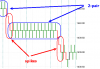
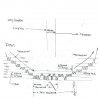
Lastly, I was wondering if anyone has experience using OTR charts or Dom for 2 pair spikes? Jack mentions 2 pair spikes that end a trend and start a new one but I just couldn't understand the concept and how to execute with it? 2pair-spike pic.png 2_pair_spike.jpg


Sorry about the long winded post and so many questions. I'm just really excited as more and more pieces appear.

 
These discussions are helping so much lately. I feel like I'm getting warmer. I also took some sim trades here to test the waters and see how I would do.

Bar 1 … P1 (since we ID'd Friday's end bar as an EE and Monday's bar 1 has higher volume it would seemed to make sense)
Bar 2 … XB... T1 (got a RTL as a result)
Bar 3 … STR... Bo,T1 (new P1)
Bar 4 … XR... T1 (RTL set)
Bar 5 … Inside bar... UL event + Bo,T1 due to closing outside RTL
Bar 6 … XB... T1
Bar 7 … XB... P2 higher volume than P1 (bar 5) so I ID'd it as Ag VEBO (new P1)
Bar 8 … FTP... Wait
Bar 9 … XR... T1 (since bar 7 was P1 bar 8 was IB wait and Bar 9 has lower volume than Bar 7)
Bar 10... IB... Wait
Bar 11... XB... BO,T1 (wasn't sure but Sprout seems to have it here also. By this bar was expecting following bars to either give a Lat 4 retro with Ab EE or PP type of EE)
Bar 12... XB... P1
Bar 13... XB... PP1
Bar 14... XB... P1
Bar 15... XB... P1
Bar 16... XR... Bo,T1 (BM Short)

View attachment 188091

For every EE, a BM is placed. This BM is what gets reversed on the next bar if that bar doesn't create a T1. A T1 is necessary prior to a true BO,T1. Sometimes geometrically the prior bar's high or low is used, other times the P1 is the point that starts the BM and the slope of rtl and yet other times where geometrically a rtl is not possible. I haven't worked out why it's clearly one case or the other at the moment. It's only by constantly doing rev chron in the background checking for missed ID's and during debriefs where it becomes clear why it's one way and not the other. It's a bit of curve-fitting but we are using it in a different way than when CW uses backtesting. I have more differentiation to do in this area.

Using your window, your Ag EE cannot be. All A-band formations require the minimum of 4 bars with the exception of Ah. Trend must progress to the bar that potentially can be a T2P before it can be considered for an A band EE. The BO,T1 on bar5 would be assigned P1.


My sim trades were from Bar 5 long with Bo,T1 (EOB) 2706.75 (Took 3 points of heat :/ but it didn't break the BM)
Reverse short at Bar 7 2712.50 (almost 6 point gain!)
Then happily trotted along with more gains (almost 9 points on bar 9!!) only to see it cut by less than half on bar 11 where I reversed long again. Exited at bar 12 as I was starting to feel confused about ID'ing following bars.

So then I end up with a lot of questions again lol.

First, I think I'm missing some fine tuning tools but I guess that's okay for now as I still need to work on ID'ing VTP and looks like drawing the RTL correctly for some instances.

I suppose RTL should start FROM first P1 bar? Wasn't too sure about this one. (With exceptions like IB on bar 8)

Yes, generally with exceptions.


Second, after bar 9, bar 10 retraced more than half of bar 9 as a Sym IB. Was the correct action to wait here?

Depends on one's TF and the building of the bar. During MADA, the first thing to notice was leg1 of bar9 completed early in the bar and the 2nd leg (dominant) was long. This is an ftt on the Dominant traverse set by bar8 and bar9. The more MADA reps one preforms, the more sensitivity one gets as well as profit taking opportunities.


Third, Sprout mentioned in a recent post "unless we ID Bo,T1 a wait is a wait" somewhere along those lines... So, I wasn't too sure until now but this means as long as RTL is violated, we can have Bo,T1 from within a lateral?

We can if a T1 was present. The logic is BO of rtl AND T1 is present in trend.


I ask this because I thought Jack was saying that we fan the RTL for the inside bars that are not UL events or retro yet. Both seems to make sense and both works or not... laterals are just not pleasant experiences to me... hopefully I'll master them sometime...

Yes, there are instances of fanning and accelerating rtls. However, it's distinct enough from SCT that for learning RDBMS, recommending to NOT fan and accelerate rtl's provides a clarity that when returning to fanning and accelerating one "knows that they know" where to place them correctly. More accurately, it was that way for me.


Lastly, I was wondering if anyone has experience using OTR charts or Dom for 2 pair spikes? Jack mentions 2 pair spikes that end a trend and start a new one but I just couldn't understand the concept and how to execute with it? View attachment 188092 View attachment 188093

One sets these up on the trading platform. Two OTR charts, one uses the ES 5m and the other YM 2m. A DOM ladder in the center. Two T&S streams on one side of the DOM, one filtered at 1 contract, the other at 50+. One wants to set this up on one screen. The order of the windows should support "sweeping" through all the datasets. One's eyes are constantly "sweeping" between the platform screen and the charting/annotating screen. It depends on where a trend is in it's progression where one's eyes "dwell".


Imho, it's easier to work with accelerating tapes and IF1/IF2 APA when learning to "carve" turns. The 3 tick rule off the extreme is used as a WCB as one utilizes IF1/IF2 APA logic. Combined with PRV, it's pretty powerful. The other thing that would make it better is STR/SQU but I haven't gotten to coding that correctly on my platform.


Sorry about the long winded post and so many questions. I'm just really excited as more and more pieces appear.

Comments within quoted text.

Yes, this stuff is pretty exciting !
 
A Jack post on failsafe, thread unknown.

now we have to learn to do two annotation to get the correct top or bottom of the Modrian Table.

Let's tackle this head on.

The BM uses a green ray. the rtl of the BO, T1 uses a sloped line segment between to adjacent values.

a bookmark is placed when an EE has ocurred. It is at the end of the bar that the price is going away from. Rays are horizontal in this world. If you have an end effect that is turning from "long" to "short", put the BookMark at the high of the bar.

On the otherhand, if you are at an EE that is going from "short" to "long", put the BookMark at the bottom of the bar.

As you see we use this failsafe modus for one reason only. the principle for making money is to be on the correct side of the market. If you cease to be on the correct side of the market you cannot make money during the time you commit this error.

So the Bookmark is used to create a turn when the market sentiment changes.

Wonderful. I think you have it. In Spain the rain is mostly on the plain.

the other failsafe is the earlybird for the BookMark. The reasoning is that the early bird gets the worm.

So when you make a Bookmark also make an rtl at that ime. make it on the right side as an rtl for the beginning new sentiment. the point 1 is the same point the BM stats at. The point 3 is the next bar end (adjacent bar of RDBMS) AND on the same end of the bar, relatively speaking.

As you have just reasoned the BO of this rtl comes BEFORE the BO of the BM. It is earlier when it is possible to draw it.

There is a caveat of two parts. This is another way way powerful invention. You may only have a TRUE BO of the rtl if and only if. a T1 is there and a P2 has not appeared before (at a lock in) the BO of the rtl. If you have not annotated the P2 it has not appeared as yet just for the timebeing.

what is happening in your thinking is that you are shifting from CW to RDBMS. RDBMS is all a TRUE/FALSE type algebra.

Everything your mind can do is also possible to do with an ATS. I prevent people who are greedy from making ATS's. As Gordon said Greed is good. So I am really greedy. As a consequence I use my mind to help others solve problems. Most problems need money. so this is a money making system.

above is how the top of the Modrian panels work. the yellow, mustard, orange and rad panels onlt require you to draw a BM and an rtl. then we look for violations called BO's.. THe ones that are important for making money are n - 1 events just before the n turn where you reverse to collect profits from a trend ending.

today you shifted from the Present in trading to the certainty of the near future before a reversal turn.

This is dumping "trend following" to begin to do trend monitoring and analysis. I have a 36 chapter book to replace the book "trend Following". 12 chapeters were done in a week a couple of months ago. All this text can go in the next chapters.

so take out 50 charts and just put in BM and rtls where it looks like an EE happened. notice the BO's and if volume died before and a peak came after. slip into the groove with me. fool around alittle. relax.
 
To the group. Is there a post where Jack explicitly defines a BO? Does there need to be a close in place at the end of the bar or will a violation of price structure do? My awareness of other systems is clouding my thinking in this regard, and it is the last term that I cannot find a clear definition @Sprout, @tiddlywinks, care to chime in? It is odd that I am hung up on this but I like precision, which is why I was drawn to JH in the first place.
 
To the group. Is there a post where Jack explicitly defines a BO? Does there need to be a close in place at the end of the bar or will a violation of price structure do? My awareness of other systems is clouding my thinking in this regard, and it is the last term that I cannot find a clear definition @Sprout, @tiddlywinks, care to chime in? It is odd that I am hung up on this but I like precision, which is why I was drawn to JH in the first place.

When RTL isn't fanned: Close right of RTL is BO and TLs ceased. Close moving back left of RTL within the same bar is FBO, and TLs continues. 2 consecutive closes right of RTL validates BO.

Found this text:
3. You have to know that trading happens in sequences. for channels and such you always know about the next five moves. This is a reli
ef because you can note them ahead of time on your long. I used to post logs but they are as much a flaming target as are prints of tra
ding. I will describe a log for a day for you to let you know what is possible for anyone with a ball point pen to do. It takes five l
andscape preprinted log pages. They are dated (use a stamp) and they have about 15 pages of attachments. One page 1 you will see open
, indexarb. com offset to three significan figures, synch time, bar 4 BO(point 1) and then afew rows below you see point 2, a few rows b
elow point 3 a few rows below FTT( point one), a few rows below BO, a few rows below FBO (point 2) a few rows below point 3, etc.
FTT is point 1 always, BO is not a point on the new channel ever. (If you recall DBPhoenix this was a major screw up in his supply/dema
nd BS.). you ride through BO as the non dominant traverse comes to a place (your current channel ) on the trendline. It pases through
on a surge of volume that is the beginning of a dominant traverse of the new trend the traverses travel in as the old trend which had tr
averses is extinguished.
You are headed to a new point two coincident with an FBO after the BO.
You even know how to ID the difference between a retrace(a non dominant traverse) and a reversal (which always occurs AFTER a retrace an
d AFTER a BO is occurring).

And:
Similarly, if one enters long as price touches the right trendline, a loss would occur if a BO occurs to the downside. At this point, we
would be on the wrong side of the trade in a bearish channel.
when you reverse on a point 1 or an even channel point, you are on the right side of the market headed along a retrace, which at BO runs
into a reversal that continues along the same right side of the market. What you are experiencing at the time is "front running" the h
erd. you jumped on board as the retrace to the RTL happened and you just took the ride through the RTL as a BO and then the beginning o
f the first dom on the new channel. All of this is during what is called the "channel overlap".Quote from RoughTrader:
My point is, starting from the point where price is sitting on the RTL, there can be many bars that fail to reach the LTL. There still e
xists the possibility that eventually the price will make its way back to the LTL without a BO to the downside. If this is the case, do
we need to wait for the close of a bar to BO of the channel to confirm we had an FTT one or more back?
An FTT on level 3 is and FTT on level 2 and the FTT on level 2 is an FTT on level 1. what follows an FTT on level 1 is a BO of the leve
l 1 RTL.

And:
The BO comes and it is a volume trough always. Neoxx so far cannot differentiate between a peak and a trough in volume which is the dif
ference between an FTT and a BO in price. we are working on getting the PV relationship to start working because it is where he will fi
nd out a pair of variables is involved in trading (V and P).
So as a person annotates and logs from FTT to BO it is dull and a move from left to right horizontally speaking.
After the trough and the BO (they happen together) a lot changes. Most important is that the overlap ends and the prior channel is unim
portant usually. BUT it may be still important only if the Volume does not go into the next step of the usual sequence (increasing with
out color change). There was a flaw (I call them WWT for what wasn't that). you can see that black volume did not increase as anticipa
ted.

And:
You had a tape starting on bar 40 and the BO on this tape was not handled properly. The tapeRTL didn't even extend as far as the BO on
the RTL of the tape.
SCT does not do hindsight or simgle element M input decision making. So far you are writing ND in RED for many bars as you sit there lo
ng after the first traverse has (all unannotated) had an FTT, had a BO and the overlap eneded on the first and sceond traverse.
For tomorrow we are past today's FTT, today's BO on RTL and proceding along a traverse forming from two tapes, the second of which is in
a non dominant tape internal. We are OUT of the day's tending channel and between point 1 and point 2 of the next channel.
Recently we added a measure to handle the difficulty involved with staying in a trade longer to be able to derive more profits. This in
volved finding three points to establish the trend channel. Point 1 is usually in the prior formation (comes first in time) and point 2
tends to define the width and volatility of the channel. Finally point 3 shows up on the same side (right side of the forming channel
) as point 1. Points 1 and 3 form the side of the channel from which, at the end of the trend, a breakout (BO) will occur. We will no
use this to exit the trade if at all possible since this point is not the point of maximum profit; it is just the end of the trend.
Having this basis established we can make use of the situation. First, we see it as a beginning and second we must be prepared to modif
y it one particular way. Trends begin as Break Outs (BO’s) of prior price formations. The initial period is very significant and it is
not perfectly sustainable. This surge settles down somewhat in almost all cases. We can use this knowledge to make one adjustment it
turns out.
We do this by setting a new point 3 when called for after the initial period of the BO. Think of an airplane taking off. It climbs ste
eply at a relatively low velocity. As velocity is attained the angle of the climb is lowered for the rest of the length of the haul to
the assigned flight altitude. This is a two step process. The initial channel is adjusted the same way to attain the trend channel wid
th. It is a little wider and it slopes less in money velocity.
Initially I have delt with this to help people stay in trades. To get them past the place in time where they look very diligently for t
he answer to the question “What’s wrong here?” What is wrong is nothing and a trend is making point 3. This occurs on the first declin
e of volume in the trend. The lesser volume affects the momentum of the BO. When the passing time occurs, people think and think hard,
then they begin to act again. The trend moves along with the price then traversing the established channel. A micro cycle of A/D has
occurred in this interval. (A/D is accumulation /distribution, the buyer/ seller market control thing).
 
Thanks Simples, this is what I remember but since time has passed I wanted to make sure that Jack had not updated the glossary somewhere along the line.
 
To the group. Is there a post where Jack explicitly defines a BO? Does there need to be a close in place at the end of the bar or will a violation of price structure do? My awareness of other systems is clouding my thinking in this regard, and it is the last term that I cannot find a clear definition @Sprout, @tiddlywinks, care to chime in? It is odd that I am hung up on this but I like precision, which is why I was drawn to JH in the first place.


I am near certain Spyder defines and discusses BO in the Traders Lab thread. Unfortunately, TL changed their platform and none of my links work anymore. On the positive side, there are now only 176 pages, versus over 500 previously.

Ironically, although quite stealthily, tidbits exist in the previous failsafe post from Jack...

There is a caveat of two parts. This is another way way powerful invention. You may only have a TRUE BO of the rtl if and only if. a T1 is there and a P2 has not appeared before (at a lock in) the BO of the rtl. If you have not annotated the P2 it has not appeared as yet just for the timebeing.

First, I'll wager this is how the name BOT1 came to be. But breaking this down a tad... T1 is DV, P2 is IV. We also know BO is the point in time where non-dom changes/becomes dom, which is what creates the B2B or R2R gaussian signature, as well as movement from container point 1 to container point 2. So recap...
You may only have a TRUE BO of the rtl if and only if. a T1 is there
AND a P2 has not appeared before (at a lock in) the BO of the rtl.

If P2 already appeared, P1-T1-P2, aka B2B/R2R, aka pt1 to pt2, aka M1, aka BO, already occurred!

so take out 50 charts and just put in BM and rtls where it looks like an EE happened. notice the BO's and if volume died before and a peak came after.


Happy 4th to all.
 
Last edited:
Back
Top