Hi folks,
I took a break from RDBMS for awhile as I just didn't understand what it is that I was missing to even ask questions. The recent discussions and materials you guys laid out in the other thread about ending events brought a new light to the understanding of this method and I was wondering if I'm approaching this the right way.
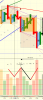
Here's a snippet from yesterday with annotations for bars 21 to 30. Although in terms of gaussians that seemed like the perfect R2R2B2R (with 2B's completed inside the lateral), I realized I'm getting 2 extra P1's during the sequence. Just wanted to check if I understood this correctly.
Btw, the document from JR and Sprout's Band maps are truly golden. Makes it so much easier to understand than just reading through Jack's posts.
You're building a baseline of reference. This is good.
The annotation style that you are using (PVT, SCT) to define tapes/traverses/channels gives you the foundation by which to annotate TL's via RDBMS.
The previous style of annotating tapes/traverses/channels is a layer that one can turn on/off at will.
RDBMS uses a more simplistic method of annotating and use just a single TL for a trend segment. This TL is defined by P1, P1 or P1, T1 of volume defining the rtl of the new trend segment. A new trend segment can only occur if the previous trend segment is complete.
For your specific question, using the red arrow as the leftmost window, the Ag-vebo would get a BM -long at it's low for it's an EE and we are anticipating a change in trend segment dominance and a non-Dom traverse.
bar26,27,28 are all internals of bar25 and are not measured unless 1) a failsafe takes precedence. All bars are degapped, mentally or with software.
bar27 is a lat3, no wait from this point on and all bars are measured within the lateral as long as the lateral exists.
bar28 triggers retro. Retro does rev chron within a qualifying lateral. Rev chron yields the EE PP6 at bar28. Since this is an EE completing a trend segment, a BM-short goes at it's high. PP6 assigns the next bar as P1 in volume. The non-Dom traverse has completed and WMCN (a return to Dominance is anticipated.)
bar29's high is the pt3 of price compared to the BM on the bar before and therefore forms the TL of the new trend segment. WMCN did in fact occur, if it didn't then it becomes a WWT.
Although this sequence "fits", during debriefing another sequence might "fit" better. The difference is in clarity and continuity. The sequence that gives greater clarity and continuity to WCB and WMCN is the correct one.
There's a lot of guessing in the beginning, it's not important to get the fish as a beginner, it's more important to learn the process of fishing. Just like in learning to ride a bike, it's the process by which one gets up from not-balance that will ultimately lead to balance.
Every time that the assigned P1's anticipate a BO, and the BO in fact occurs like clockwork on the next bar, the more one's confidence grows in the precision of the method and the growing skill one has in implementing it.

My weekend aha is the EEs are for segments... huge, HUGE aha, FOR ME!!