
Really?Sprout, when will you stop doing mouth and start to do the real work?
It sucks a bit, don`t you think?
Thank you for proving your own point that people don't read.

Really?Sprout, when will you stop doing mouth and start to do the real work?
It sucks a bit, don`t you think?
Thank you for proving your own point that people don't read.
If the Lat container bar, Bar 93, is P2 then...
Bar 94 Wait becomes T2P.
Bar 95 T2P
Bar 96 T2P
Bar 96 triggers EE PP1c... so here is an example of either a mis-ID'd EE, or an EE on a fractal of no importance for trading. Or a completely wrong sequence analysis. With the EE, Bar 97 can not be another T2P since Bar 97 volume is >P2. That means its P1, or P3... either way the same down container is still has not ended, and a container can only have one set of pt1,2,3
I admit at first that post made me go,... huh?
As I see it there is differentiation between internals and laterals. Hitches and Stitches are considered as internals to OB's similar to SYM, FTP, FBP are internals to XR and XB's. It's the path that price must take to get to the end. Sometimes the end gets interrupted. Once we get to Hitch, XR and XB are not possible. Even though these forms can be seen EOB, the majority of these internals are easiest to see during MADA and the real-time forming of a bar. The internals of a lateral can present all the price cases.
This post clarifies OB's. OB's are not internals. Even though Jack posted as such in your link, logic and the preponderance of evidence dictates otherwise. This is the result of my own due diligence (admittedly which has the possibility of being erroneous.) No matter, the methodology is self-correcting when debriefing, that's where my confidence is sourced. Considering context is important in Jack's writings as well as a bit of mental agility. His posts stimulate thinking which is work,... most will not attempt it, let alone doing drills to expand perception.
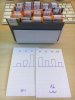
Have you ever done the drill of turning the EE into Index Cards, and then drawing them out on the back? What did you find out? I can see that you do the work and I am curious as to what you found out if you did do this drill.
Transposing your logic on bar97 to bar93.
Bar93 is a P2>P1. At EOB, it's a P1 as per the volume element ranges. Most likely during RTH, I would have gone long off the low of bar93, fanned the tape on bar95 (maybe early reverse) and reversed short on bar96.
Bar95 was the crux bar. IV long didn't arrive. The path of least resistance continued short.
Have you ever done the drill of turning the EE into Index Cards, and then drawing them out on the back? What did you find out? I can see that you do the work and I am curious as to what you found out if you did do this drill.
Ummm... P2 > P1 is not the same as T2P > P2.
More interesting, I don't see/agree on expecting Black IV... You cited Bar 89 as BOT1. Bar 93 is P2 or that sequence ended perhaps another failsafe, between Bar 89 and 93. This homey don't play dat fractal.
None of this matters. My previous writeup is representative of how I work.
Trade On!
The realization that I had was a simple one. End effects are fractal just as the price is. But not all end effects actually end the trend. The further down the volume bands you go the longer the sequences become.Yes, it's what currently has my attention.
Jack's the real deal. He gave all the pieces and left each individual to 'glue' them together.
Some drills are prerequisites to understand some concepts. Paying it forward is a prerequisite to unlock other concepts. Drills build perception. Drills build capacity. Everything he did was by design, including his style of posting. There are logic locks that an individual must work through on their own effort, even with the best of intentions of other helpful and supportive traders paying it forward. There are some mistakes, omissions and errors that have to be sussed out.
If it were not for other earlier posters that engaged with him and asked the questions that they asked, (regardless of their degree of success with the methodology), the collective work would not have gotten as far as it did. If it were not for the incessant flaming derailing threads and taking them OT, it would have gotten much much farther. The work is adaptable and extensible. The infinite variety of pattern expression can be distilled into due-diligence tested principals.
Aha's! are individual in nature and self-realized. Any obstacles with learning the methodology is a function of an individual's pre-existing beliefs. Turning same obstacles into stepping stones require a suspension of dis-belief and DD towards doing work - both inner and outer. This is a holistic paradigm, thoughts and feelings are intertwined, if one is not experiencing support, comfort and confidence in their trading, there's more inner/outer work to do. As one gains facility and capacity, the positive feelings continue to grow as well as the bottomline. When one experiences the market as a endless stream of opportunity and abundance, there's really no going back and one wakes up eager for the day. Trading is fun!
More specifically, the EE to index cards demonstrates that for some things, pencil and paper computing is more conducive to forward progress than attempting to program software. The drill makes it easier to differentiate the relationship between n-1 and n EE's, turns and trend types.
It's difficult to realize without having built a resource of correctly annotated charts, logs and working through ID'ing EE's accurately. The index card drill is similar to a board game. The market deals the cards. The cards can be organized and color-coded by various categories and each can contain multiple permutations. ie. BO'T1's on IV, on DV, in the middle of trends, at the end of trend segments, etc,..
The shells of context have to be built from the ground up. As Jack has said, 'start with the FFF'
This was an earlier attempt at differentiation using d3.
As one combine cards, volume profiles of trends emerge.
View attachment 187153
Thanks for the question. I'm curious as to your realizations, if you are willing to share.
