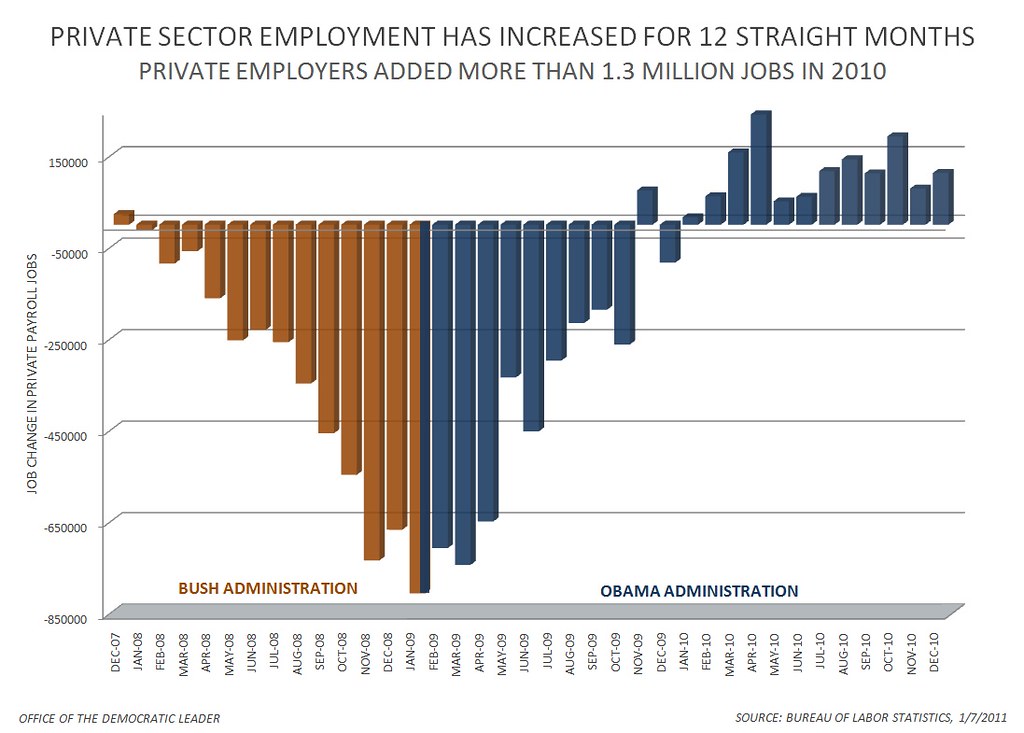
Obama Created More Jobs In One Year Than Bush Created In Eight

Quote from rc8222:

Obama has also spent more in one year than Bush spent in eight years. Obama has spent trillions of dollars on stimulus/job creations packages that have us where? 9.4% unemployment!!!!!! ROFLMAO!!

Are you saying that the stimulus caused the 9.4% unemployment rate? If so, please indicate what the rate would be today without the stimulus. But if you are merely saying that the stimulus did nothing, please indicate what the rate would be today without the stimulus. And please, no Petsamo-esque, "it would have been lower". You seem sure of yourself, so you should have data.
 
OP - take it to the Daily Kos because that crap don't fly.

Yes - Barack Obama, Nancy Pelosi, and Harry Reid are doing wonders. Might as well start with those fresh busts for Mount Rushmore. If you want to include chronic underemployment as well as the citizens who have stopped looking for employment then maybe the NBLS metrics will become more relevant.

33dzdi0.gif
 
Quote from walter4:

As the Wall Street Journal noted in the last month of Bush’s term, the former president had the “worst track record for job creation since the government began keeping records.” And job creation under Bush was anemic long before the recession began. Bush’s supply-side economics “fostered the weakest jobs and income growth in more than six decades,” along with “sluggish business investment and weak gross domestic product growth,” the Center for American Progress’ Joshua Picker explained. “On every major measurement” of income and employment, “the country lost ground during Bush’s two terms,” the National Journal’s Ron Brownstein observed, parsing Census data.

http://www.alternet.org/newsandview...e_year_than_bush_created_in_eight/#paragraph2


5333277156_038f02c717_b.jpg

Please update the graph to include the previous 7 years of Bushs term in office. (did you think we would be fooled by you just showing 1 year and claiming it was 8?)
 
Quote from peilthetraveler:

Please update the graph to include the previous 7 years of Bushs term in office. (did you think we would be fooled by you just showing 1 year and claiming it was 8?)

It's the same chart that Goolsbee is using as he make the rounds of the talk shows. He/they are trying to control the discussion based on their facts:

http://www.youtube.com/watch?v=QmybtPlga1U
 
Quote from rc8222:
Obama has spent trillions of dollars on stimulus/job creations packages that have us where? 9.4% unemployment!
Quote from Ricter:
Are you saying that the stimulus caused the 9.4% unemployment rate?
Ricter did not interpret rc8222's statement correctly.
To rephrase rc8222's statement, Obama has squandered trillions of dollars of the people's money.
duhv.gif
 
Wage cuts steepest since the Depression?
POSTED AT 12:15 PM ON JANUARY 11, 2011 BY ED MORRISSEY

The continued high rate of unemployment has made labor a buyer’s market, and the effect on price has been predictable — and substantial. The Wall Street Journal reports that wages have fallen farther than at any time since the 1981-82 recession, and that this downturn has already exceeded that crisis. As the unemployed scale back expectations on both jobs and income levels, compensation has retreated farther than any time since the Great Depression:
The only other downturn since the Depression to see similarly large wage cuts was the 1981-82 recession. But the latest downturn is already eclipsing that one. Unemployment has stood above 9% for 20 straight months—longer than the early 1980s stretch—and is likely to remain above that level for most of 2011, putting downward pressure on wages.

Many laid-off workers who have found new jobs are taking pay cuts or settling for part-time work when they get new ones, sometimes taking jobs far below their skill levels.

Economists had wondered how far this dynamic would go in this recession, and now the numbers are starting to show it: Between 2007 and 2009, more than half the full-time workers who lost jobs that they had held for at least three years and then found new full-time work by early last year reported wage declines, according to the Labor Department. Thirty-six percent reported the new job paid at least 20% less than the one they lost.

The severity of the latest downturn makes it likely that many of the unemployed who get rehired will take wage cuts, and that it will be years, if ever, before many of their wages return to pre-recession levels, says Columbia University labor economist Till von Wachter. “The deeper the recession, the lower the wage you’re going to get in the next job and the lower the quality of your next job,” he says.
In one sense, this is just the normal response to supply and demand. Labor is a commodity in that sense, and the cost of labor increases when supply is short, and decreases when supply is glutted. As a hiring manager for several years in the Twin Cities, we had to repeatedly increases wages across the board (not just for new hires) to keep staff on board and to entice qualified applicants to work for us when unemployment in the area was in the 3% range. Right now it’s more like 7% in this region, and I’m certain that had I remained in that career, I would be finding it much easier to keep the call center staffed without having to raise compensation levels at all.

It may not be quite as bad as it sounds, either. While compensation falls as the jobless have to settle into new, less-lucrative jobs, prices are also falling in other areas, especially in real estate. Retail prices have stabilized, but retailers are still relying on heavy discounting to move inventory. Buying power may not be declining as much as wages, although it’s certainly not increasing.

The reason that the problem is worse than at any time since the Depression, assuming that the WSJ is correct in that analysis, is that we have had the worst extended unemployment since that time. The best way to resolve this problem is, not coincidentally, the best way to resolve the housing crisis and other economic woes: stimulate job-creating growth. Unfortunately, as the Obama administration pursues its regulatory expansion, it will disincentivize that kind of domestic investment, which will perpetuate this problem for at least another two years.

Update: As the first commenter rightly notes, food and energy prices have risen (they’re linked, too), so that does accelerate the erosion of buying power.
 
Back
Top