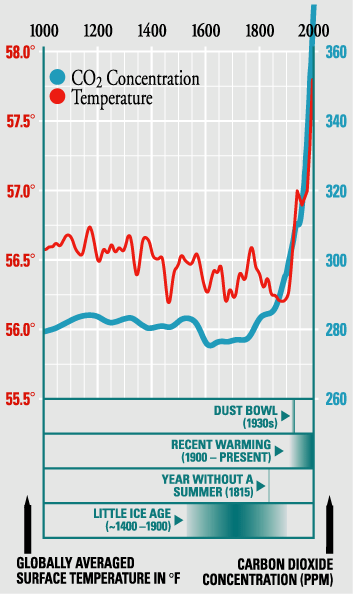
Not 97% but .3% of Climatologists agree.

Quote from futurecurrents:

CO2 is a greenhouse gas. Why is it so hard to make the logical leap that when levels of it rise then so will temperatures? Are you stupid?

The past is mostly irrelevant because we were not releasing 9 billion tons of CO2 per year into the air. The last thousand years are quite adequate to show the effect.

I'll try another chart.

Ammonia is toxic to fish. If I pour a glass in the ocean, do fish die?

My disagreement is not with CO2 being a so-called "greenhouse gas", but on the amounts that it takes to affect heating on a global level.
 
Quote from futurecurrents:

historical03.gif

Now you're expanding the timeline. Good.

Did you know that the average earth's temperature during the dinosaurs was almost 18 degrees hotter than it is today? I didn't know it was that much hotter until I looked it up.

So if the dinosaurs lived 245 million years ago, and the temperature back then was much hotter than it is today, logic would say there were significant heat spikes in earth's 4.25 Billion year lifespan (unless the dinosaurs were driving cars and stuff). So the fact that your chart is indicating a "spike" of two degrees over the last 200 years isn't really indicative of anything. Sure, CO2 is a greenhouse gas (I'll not argue that it isn't). But how do you know that the 2 degree differential is because of CO2? Because you can show a chart showing the correlation of the two data points? I could show a chart showing how radio frequency use over the last 200 years has spiked, too. Does that mean radio frequencies contribute to global warming?

As I said in the beginning, this isn't my topic of expertise, so all I can rely on is logic. But it would seem to me you haven't proven anything other than two data sets matching on a chart that is scaled for both to exist.

 
Quote from gwb-trading:

Over and over again... 9 billion tons, 9 billion tons, 9 billion tons... like a retarded parrot.

The 9 billion tons that man puts into the air is a miniscule percentage of the CO2 that nature puts into the air each year.

This is precisely the point I was arguing with the ammonia example.
 
http://wattsupwiththat.com/2013/12/...-is-just-within-the-natural-range/#more-99108


...
Co-author Dr Ivan Haigh, lecturer in coastal oceanography at the University of Southampton and also based at NOCS, adds: “Historical observations show a rising sea level from about 1800 as sea water warmed up and melt water from glaciers and ice fields flowed into the oceans. Around 2000, sea level was rising by about three mm per year. That may sound slow, but it produces a significant change over time.”

The natural background pattern allowed the team to see whether recent sea-level changes are exceptional or within the normal range, and whether they are faster, equal, or slower than natural changes.

Professor Rohling concludes: “For the first time, we can see that the modern sea-level rise is quite fast by natural standards. Based on our natural background pattern, only about half the observed sea-level rise would be expected.

“Although fast, the observed rise still is (just) within the ‘natural range’. While we are within this range, our current understanding of ice-mass loss is adequate. Continued monitoring of future sea-level rise will show if and when it goes outside the natural range. If that happens, then this means that our current understanding falls short, potentially with severe consequences.”
 
Quote from Tsing Tao:

Now you're expanding the timeline. Good.

Did you know that the average earth's temperature during the dinosaurs was almost 18 degrees hotter than it is today? I didn't know it was that much hotter until I looked it up.

So if the dinosaurs lived 245 million years ago, and the temperature back then was much hotter than it is today, logic would say there were significant heat spikes in earth's 4.25 Billion year lifespan (unless the dinosaurs were driving cars and stuff). So the fact that your chart is indicating a "spike" of two degrees over the last 200 years isn't really indicative of anything. Sure, CO2 is a greenhouse gas (I'll not argue that it isn't). But how do you know that the 2 degree differential is because of CO2? Because you can show a chart showing the correlation of the two data points? I could show a chart showing how radio frequency use over the last 200 years has spiked, too. Does that mean radio frequencies contribute to global warming?

As I said in the beginning, this isn't my topic of expertise, so all I can rely on is logic. But it would seem to me you haven't proven anything other than two data sets matching on a chart that is scaled for both to exist.

So you know CO2 is a greenhouse gas. We know it is responsible for most of the long term greenhouse effect and it's levels are like the setting on the earth's thermostat and the level of CO2 have gone up 40% from man and temps are rapidly rising for no other reason.

What was your question again?

BTW, the dinosaurs died due to climate change.
 
NOAA: Arctic sea-ice melt linked to extreme summer weather
http://www.newsobserver.com/2013/12/12/3455580/noaa-arctic-sea-ice-melt-linked.html

'Scientists are strongly debating those conclusions. But Jeffries, who edited the NOAA Arctic Report Card, said Thursday that they reflected a growing body of evidence.

“We can say the statistical relationships are there,” Jeffries said.

He said more research was needed to understand the process and to get a better sense of the underlying physics."'


What is interesting is that within hours of the release of this NOAA report, scientists world-wide were attacking it as unsupported and incorrect. Looks like we have turned a corner where scientists are no longer willing to accept this nonsense.
 
yes... it does look like we may get back to scientists demanding standards be observed.

Quote from gwb-trading:

NOAA: Arctic sea-ice melt linked to extreme summer weather
http://www.newsobserver.com/2013/12/12/3455580/noaa-arctic-sea-ice-melt-linked.html

'Scientists are strongly debating those conclusions. But Jeffries, who edited the NOAA Arctic Report Card, said Thursday that they reflected a growing body of evidence.

“We can say the statistical relationships are there,” Jeffries said.

He said more research was needed to understand the process and to get a better sense of the underlying physics."'


What is interesting is that within hours of the release of this NOAA report, scientists world-wide were attacking it as unsupported and incorrect. Looks like we have turned a corner where scientists are no longer willing to accept this nonsense.
 
Quote from jem:

snow fell today in cairo for the first time in 100 years.

are things that far from normal telling us something?
this is just a question. I would think some climatologists would have an opinion?


http://www.latimes.com/world/worldn...-egypt-20131213,0,1691393.story#axzz2nMzV6vMp

This is why the alarmists now call it "climate change" instead of "global warming". They want to blame any type of weather event on man-made CO2 - not just 'warm' ones.

In the corporate world we would call this re-branding. Which we know is lingo for putting together a set of marketing bullshiat so you can take in more money.
 
Back
Top