In any event, my takeaway here is that this is definitely not a system where I can simply place my trades and walk away—at least not if I want maximum performance.
A couple of days ago I wrote the Ms. Mae’s Trading Strategy is not a system where I can simply place my trades and walk away if I wish to maximize performance, and today,
which was a losing day, certainly bore that out.
Everything was fine until I retired for the night. The problem was, I assigned preeminence to one set of factors when I
should have assigned it to another. The reading(s) that I thought represented the most dominant aspect of price action was actually subservient to another that I had erroneously assigned less importance. The result was that four positions turned against me
big time as I slept, turning my respectable winning day into an absoute monster of a loser.
When I awoke and saw my folly, I exited the remaining positions I had entered based on the incorrectly assigned priority, and entered new ones in accordance with my fresh insight.
Yesterday’s initial experimentation (which consisted of more than 45 trades) did not lead to the modification of any additional indicators, but
did involve combining those from two separate setups on a single chart such that they complemented one another. I am still in the process of finalizing the corresponding rules, but once complete, the percent of profit trades should theoretically be significantly higher (it was approximately 63% today) and likewise
the ratio of average profit trades to average loss trades, which was an absolute
disaster this round of sessions.
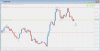
Combining the two setups has resulted in a rather cluttered look , but each line serves a distinct purpose, with which I am very familiar (I’d better be, since I originated the system), so this does not really present much of a problem for me.
Multiple Simple Moving Average Envelope (Ms. Mae) Trading Strategy final setup:
The example pictured above illustrates conditions under which a trader would be wise to
stay out of the market.