I wanted to reconcile the five-minute charts I was using with my one-hour charts, but haven’t had the time.
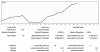
Instead of trying to reconcile the equity-market-version of the five-minute MSMAE chart with the equity-market-version of the
one-hour MSMAE chart, I now wish to compare and contrast it with the
Forex-market-version of the five-minute MSMAE chart, given that it is my hope that the Forex-market version has reached a stage where no substantial modifications are likely to be forthcoming—meaning I’m essentially finished analyzing it.
I originally concluded that my multiple simple moving average envelope system was not applicable to the equity-markets, but have since revised that judgment.
First of all, the zzz-period simple moving average accurately reflects the week-to-week trend in BOTH contexts, and the yyy-period simple moving average does the same with respect to the day-to-day trend.
However, while the xxx-period simple moving average is the principal indicator for interpreting price action on five-minute Forex charts, it lags behind the intraday trend on stock charts, and yet is not a precise enough representation of the day-to-day trend to be used in that manner, rendering it a somewhat purposeless sensor for use in equity charts.
Indeed, the simple moving average that
does do a good job of tracking the intraday trajectory on five-minute
stock charts is the xx-period SMA. On Forex charts however, this moving average serves as an
alarm signal alerting traders as to when the exchange rate is initiating a reversal after having overextended itself in
extreme overbought or oversold territory, with an express warning
NOT to use it for the purpose of trying to identify trends.
What
is used to identify what I call the five-minute trend on Forex charts is the xy-period simple moving average (I call the xxx-period SMA the 15-minute trend). It is comparable to the threefold moving average cluster on stock charts consisting of SMAs (nn), (mm), and (ss), though this threefold cord is probably unnecessary since it is essentially little more than a smoother version of SMA (xx).
What is also probably unnecessary is the stock-chart moving average cluster that begins with SMA (ff) and ends with SMA (gg) since this is simply a faster (more sensitive/responsive) version of SMA (xx).
The set of moving averages that
cannot be overlooked on the stock charts however comprise the triple set of SMAs (bb), (cc), and (dd), which delineate the
short-term intraday trend.
On the Forex charts, this job belongs to SMAs (aa) through (ee), so there is a pretty close match between the two contexts when it comes to representing the short-term trend.
The
big difference is found in the intraday
price range, which is represented by the xx-period simple moving average envelope with a deviation level of ?.00% at the extreme on stock charts—but is represented by the xxx-period simple moving average envelope with a deviation level of 0.??% at the extreme on Forex charts (yet with a more typical “maximum” degree of separation at only 0.!!% deviation).
Based on this information, I would be looking to short most stocks if they don’t gap up on Monday, but NOT until price drops back BELOW the xx-simple moving average, which it crossed ABOVE approximately five hours after the opening bell on Friday.