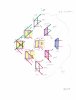
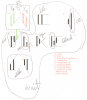
The gaussian sequence is ... B2B 2R 2B. This is a complete gaussian sequence. Once complete, only 2 things can happen with gaussian...
1) cycle indefinitely, as in... 2R 2B 2R 2B etc ... new pt3/new pt2/new pt3/new pt2/etc UNTIL BO of RTL.
2) RTL BO
Cycling is NOT required, but is often the case. Once a gaussian is complete, RTL BO is on the table, cycling or not.
Break down a gaussian sequence B2B 2R 2B ...
B2B... Each "B" is a volume peak, with a, lets call it "unlabeled" trough in-between. In gaussian, the B2 portion of B2B is overlap.... In point terms, pt1(first B of B2B) is located in the "old" trend container, the unlabeled trough (the 2 of B2B) CAN BE in the old trend or the new but still undefined trend container, and pt2(second B of B2B) is located in the new trend container and creates the new LTL (which gives a best-guess-at-this-moment slope for RTL).
2R... pt3
2B... confirmation of pt3, completion of THIS gaussian sequence, begin cycling until or no cycling until RTL BO.
The final 2B in the gaussian is confirmation of a pt3. Another way of thinking about that is things like VE, FBO, fanning, and RTL BO can only occur AFTER a pt3 has been (properly) identified.
All of the above applies to both B2B and R2R gaussian sequences and cycling in the applicable rotation.
I had already understood all the above, and this was VERY VERY VERY nice, important and good from you and for me to have it reminded. It cleans even more things in my mind. That's a kind of "iterative strengthening"
Thanks a LOT @tiddlywinks !