So,
P is assigned or
P1 is assigned ?
Hmmm.. I may be missing something.
View attachment 198492
I see Pt1 of the long channel on a volume peak, then on B2B volume creates a trough as price BO prior RTL after ftt, and when B2B ends to lead to dec 2R, therefore volume creates a peak.
If we say the volume OOE's loop is trough-> inc -> peak -> trough, does this mean we consider the beginning, on this example, of Dom M1 of the long channel, to be when the short channel is BO ?
I thought trends, fractals overlap and each beginning point of any trend is inside the prior one. And that's why (from my understanding) JH explained a trend has two ends and a middle, with that middle being the non-dom part of the segment, and being supported by a DV.
I feel I'm into the deep core now..
The gaussian sequence is ... B2B 2R 2B. This is a complete gaussian sequence. Once complete, only 2 things can happen with gaussian...
1) cycle indefinitely, as in... 2R 2B 2R 2B etc ... new pt3/new pt2/new pt3/new pt2/etc UNTIL BO of RTL.
2) RTL BO
Cycling is NOT required, but is often the case. Once a gaussian is complete, RTL BO is on the table, cycling or not.
Break down a gaussian sequence B2B 2R 2B ...
B2B... Each "B" is a volume peak, with a, lets call it "unlabeled" trough in-between. In gaussian, the B2 portion of B2B is overlap.... In point terms, pt1(first B of B2B) is located in the "old" trend container, the unlabeled trough (the 2 of B2B) CAN BE in the old trend or the new but still undefined trend container, and pt2(second B of B2B) is located in the new trend container and creates the new LTL (which gives a best-guess-at-this-moment slope for RTL).
2R... pt3
2B... confirmation of pt3, completion of THIS gaussian sequence, begin cycling until or no cycling until RTL BO.
The final 2B in the gaussian is
confirmation of a pt3. Another way of thinking about that is things like VE, FBO, fanning, and RTL BO can only occur AFTER a pt3 has been (properly) identified.
All of the above applies to both B2B and R2R gaussian sequences and cycling in the applicable rotation.
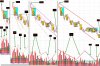
Something else I'll mention... while Jacks "clean" pages for gaussians are nice, they are hand-made. Unfortunately the market does not (usually) work in a "clean" fashion. IMO, Spydertraders journal does a much better job for understanding guassian in real-life market terms. For example I've attached a pic I created from posts in Spyders journal showing different gaussian fractals of the same day, trader's choice as to which is most appropriate trading fractal.
Keep up the good work!