Making JH' SCT and all his material alive

@WchPl Did you do any weekend studying? What did you find if you did?
James, yes I have done some week end studies, but have been unable to post it yet. I mostly focus currently on the resolution of the VTP, reading literature about it and pairing it up with the very last explanations by @Sprout and you, between others. I will post soon.

Thank you for your consideration and effort about the English language with me ! :) by the way, what's your native language ?


@Sprout, as I go deeper in the work IN A PUBLIC THREAD, I get a lot of benefits of it. I hope I'm not the only one in the case. I would like to, then, publicly, give you a huge thank you for your advice. It was a firmly good one. Thank you very much to you, and to all the participants.
 
@Sprout, as I go deeper in the work IN A PUBLIC THREAD, I get a lot of benefits of it. I hope I'm not the only one in the case. I would like to, then, publicly, give you a huge thank you for your advice. It was a firmly good one. Thank you very much to you, and to all the participants.

YVW
 
James, yes I have done some week end studies, but have been unable to post it yet. I mostly focus currently on the resolution of the VTP, reading literature about it and pairing it up with the very last explanations by @Sprout and you, between others. I will post soon.

Thank you for your consideration and effort about the English language with me ! :) by the way, what's your native language ?


@Sprout, as I go deeper in the work IN A PUBLIC THREAD, I get a lot of benefits of it. I hope I'm not the only one in the case. I would like to, then, publicly, give you a huge thank you for your advice. It was a firmly good one. Thank you very much to you, and to all the participants.

Native language is English, I am from the USA.
 
Native language is English, I am from the USA.

What a luck ! :) I'd love to speak english like you, I'd feel better at reading each post and writing mines ^^ Anyway, I feel my english level has increased quite a bit since the beginning ;) hope to be perfectly operationnal soon !
 
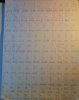
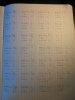
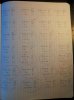
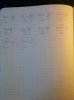
@Sprout, this is the first part of the Matrix of the 9 volume cases X 100 price cases = 900 cases.
You had said some people will do the work, others will think there's an easier path. I feel myself part of the first group ;)

I have found myself down some little issues that I feel I could solve as I build LTM, but I have for now to express them.

First, the main thing I notice doing that drill, is that there are combinations of price cases that make surge, by nature, whatever volume does, a shape. Others will make appear two opposed shapes, and volume will make us decide to include or exclude the third bar.
Some other cases just do not show any tape buildable.
And to go deeper, some cases can be both the two quoted above : I dont know then if the way I see/build the tapes is the easiest and first way my mind decided to create the shapes in order to get uncounsciously what I wanted to see, or if the most obvious, basic option that is precisely the way to see/perceive it.
Anyway, whatever the answer is, it causes me problems as for the resolution of that 900's cases matrix, but not necessarly on live charts. It's like if there are things I do not know how to label on that drill, but that do not cause me problems when they appear on a chart, and this is simply because the main issue I have on that drill is when I need some more context to decide about include/exclude the 3d bar.

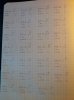
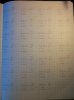
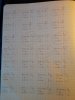
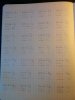
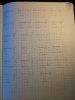
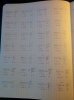
On the pics of the sheets I post, you'll see apear some red circled cases, that are some of the cases in where depending on the prior context AND/OR the way to create the first/second price case (it deals with the length of legs of certain bars into the combo), we can include or exclude the last bar.
And you'll see some *. Here are the explanations for it (not all cases are discussed, but what I explain here covers all the issues I have :

* -> for example here, for any volume case paired up with FTP/FTP, I see a Lateral. So, whichever volume case can appear, I'll always include the 3d bar, and end with seeing a Lat. Is that correct ? It seems too easy to be true to me.
(I suspect my last sentence to be quoted and commented ^^)
So, in terms of the tape including FTP/FTP, I kind of see both a long tape and a "non-sloped" one, the lateral pattern so to speak. I both annotated them for each FTP/FTP.

** -> clear example here, logically, geometrically, a FTP/FBP can only make appear a long tape. I see it kind of an ideal case. This is not a problem, but important enough to be mentioned. The ideal aspect of that case repeats itself a lot. Like if some cases forced us to go the easyness of recognizing very quickly which tape to draw or not. Pleasant.

*3 -> example here where the length of Leg3 of the third price bar will either create a long tape or a kind of "no tape" (for example on AB volume case). In the case of "no tape", I'd say it depends (as always) on the context. Some cases on that drill provide context enough to scan and draw, others don't. It depends on the prior price/volume bar. In order to get a clearer view, I annotated 8 of the 9 paired up volume/price cases with the SR creating a long tape, but I firmly keep in mind that it can be a "non-tape" case, leading us to go back in time to decide if we are to include/exclude the 3d bar of the FTP/FBP case, both with volume case. But it's even harder when I think about the fact that if the 3d leg of the 3d bar is inside the 1st one, cause I'd see a Lat.

*4 -> another problematic case as for taping : in this case I see a Lat in any volume combo underneath FTP/H. But I can also see a long tape. In the AA volume case, I illustrate the Lat I see, and on the AB case : the long tape. And for all the remaining cases, I draw both long and "Lat-tape". No matter what is the volume case, the 3d bar here will always be included.

*5 -> by nature of the geometric pattern of FTP/Lat, I'll always see a Lat...and/or a long tape. Same as *4. But the issue is, what about volume case ? Cause I'm pairing up since the beginning the price cases with 3 volume bars, and I need a 4th one here. Am I to create a matrix for each case showing a Lat with all 4th volume bar combo ?

*6 -> the length of Leg 3 of the 3d bar price creating the XB for example, will make me see both a Lat and a short tape ( if high of Leg 3 of bar 3 is under/equal to high of bar 1) or a "non-tape" case (if high of the 3rd bar's leg3 is higher than high of bar1). On the AA, I created a short tape (but there's at the same time a Lat for me). On the AB case, I created a Leg 3 making new highs. This takes me back to -> what happened before ? We could either be about to include that 3bar into a prior long tape, or exclude it from a prior short one.


That drill, even though I have not finished it yet, is like "making its path" in my mind. Do not know if I am understandable with that last sentence ^^
I feel the importance and understand the goal : be aware and ready at any time to distinguish what can/must/cannot surge just after I've just seen before. Road towards satisfaction, and this time no need to ask it.

The feeling while doing that drill is very pleasant, cause I do feel it's a time-consuming work that leads to a tremendous time-saving in a close future.

I take a break of 1 hour, and will be back to post about the VTP, which is my main goal currently.

 

Attachments

  • matrix 900's cases.jpg
    matrix 900's cases.jpg
    906.5 KB · Views: 50
  • 900's cases 1.jpg
    900's cases 1.jpg
    356.8 KB · Views: 47
  • 900's cases 2.jpg
    900's cases 2.jpg
    686.2 KB · Views: 36
  • 900's cases 3.jpg
    900's cases 3.jpg
    518.8 KB · Views: 33
  • 900's cases 4.jpg
    900's cases 4.jpg
    391.5 KB · Views: 34
  • 900's cases 5.jpg
    900's cases 5.jpg
    343.7 KB · Views: 33
  • 900's cases 6.jpg
    900's cases 6.jpg
    335.7 KB · Views: 34
  • 900's cases 7.jpg
    900's cases 7.jpg
    378.6 KB · Views: 34
  • 900's cases 8.jpg
    900's cases 8.jpg
    663.8 KB · Views: 35
  • 900's cases 9.jpg
    900's cases 9.jpg
    632 KB · Views: 33
It's easier than you think
As very often ^^

You know how to annotate TL's
I do
When a TL established by a T1 is XO'd, you have a BO of the T1

Here begins the issue. What does " A Trendline established by a T1" mean ? More precisely, what does that mean when a TL is established by a T1 ?

Some weeks ago, as you know I was working on the resolution of the VTP.
Your advice was : It’s easier to begin at a definite start of trend which is increasing volume and a XO of the previous trends RTL.

Is that sentence in bold the same as your "When a TL established by a T1 is XO'd, you have a BO of the T1" ?

While waiting your answer, I take my break and will be in 30min or so, trying to understand alone, and to fill a log, with the real time ES chart I'm currently annotating.
 
As very often ^^


I do


Here begins the issue. What does " A Trendline established by a T1" mean ? More precisely, what does that mean when a TL is established by a T1 ?

Some weeks ago, as you know I was working on the resolution of the VTP.
Your advice was : It’s easier to begin at a definite start of trend which is increasing volume and a XO of the previous trends RTL.

Is that sentence in bold the same as your "When a TL established by a T1 is XO'd, you have a BO of the T1" ?

While waiting your answer, I take my break and will be in 30min or so, trying to understand alone, and to fill a log, with the real time ES chart I'm currently annotating.


Your annotations on the extension of the price case drill to three bars are confusing. Jack uses bands designations such as Aa, Ab, Ac, etc. Your duplication of them in a different context other than volume will just add to confusion.


In your matrix, draw 3 TL's when possible. The first to encapsulate the first two bars, the second to encapsulate the 2nd and 3rd bar. The third to encapsulate all three bars as per OOE of price. What this third bar does in it's variation of price form, price sentiment, price geometry and volume profile will make it unique or part of a larger set of similars. It will also either include it in the first two bars or not.

ie. An XB, then an XR.
The XR could close inside the TL established by the XB,
penetrate it and still close within the TL,
penetrate it and close outside the TL,
or penetrate it and penetrate the close outside the BM established at the Low of Bar1 of the XB
or penetrate the BM and close above it in between the BM and the TL.


In some cases the third bar will be a BO of the 2 bar TL or an acceleration of the TL or a fan of the TL. Sometimes BO's and fans occur in both price directions as in the case of SYM.


You need to start thinking. You've posted many a chart with 1,2,3, ftt of price. Each tape, traverse, channel having it's own RTL as well as the one's shared with other bars as the next larger fractal parallel lines - group the oscillating pairs of smaller fractals within it.

When volume comes into the market, it's pace accelerates until it ebbs and flows. As it ebbs and flows, the 1st de-acceleration establishes a T1 in volume. An increasing in volume from this point is price going toward pt2. Therefore r2r and b2b , include a T1 of volume in-between two peaks of volume as price moves from pt1,pt2,pt3 in the first traverse. This Dominant traverse is always a r2r or b2b.

Some times this is easily seen in the gaussian formations. Othertimes, this dynamic is occurring intrabar and one would have to go to a faster timescale to discern it. When people describe 'fractal jumping' it's referring to the phenomenon that gaussians couple to price action aperiodically as the previous example points out.


The questions that came up for you in the drill is a starting point. The market gives the correct answer. Laterals are more of the difficult areas to differentiate due to exactly the points you've made. To get answers directly from the market, frame your questions as IF,...Then,... and test your working hypothesis.

At a beginner level, one is 'squishing' multiple bars within a lateral to form a single bar. This is a useful concept to build upon, but it is like training wheels - useful to a point then outgrown.
 
Last edited:
@Sprout, I took the trouble to proof your EE table and it is very good. Too bad Jack is not here to see the work. This will be a big time saver. May I ask what you are working through since you have such a firm knowledge of the information?


My current work is linking EE's to Turns and Trend Types through the Modrian Table and building displays to support the effort. It's like a drag racing christmas tree, volume goes through a sequence of bands prior to 'lock-in'.

It all starts with a P1.
Is the next bar greater than or less than?
Once a bar is built is shifts from being a 'n' bar to an 'n-1' bar and the trend progresses through the OOE. As each bar is built, it permits and gates what zones are activated and on alert. By building a catalog of EE's, one begins to see the finite possibilities of the path of least resistance.
 

Attachments

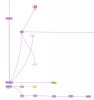
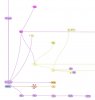
  • Band Aid P1 or T1.jpeg
    Band Aid P1 or T1.jpeg
    77.9 KB · Views: 74
  • Band Aid T1 or P2.jpeg
    Band Aid T1 or P2.jpeg
    97.5 KB · Views: 63
  • Band Aid P2 or T2P.jpeg
    Band Aid P2 or T2P.jpeg
    124.5 KB · Views: 59
  • Band Aid T2P or T2F.jpeg
    Band Aid T2P or T2F.jpeg
    154.1 KB · Views: 64
Last edited:
@Sprout, this is the first part of the Matrix of the 9 volume cases X 100 price cases = 900 cases.
You had said some people will do the work, others will think there's an easier path. I feel myself part of the first group ;)

I have found myself down some little issues that I feel I could solve as I build LTM, but I have for now to express them.

First, the main thing I notice doing that drill, is that there are combinations of price cases that make surge, by nature, whatever volume does, a shape. Others will make appear two opposed shapes, and volume will make us decide to include or exclude the third bar.
Some other cases just do not show any tape buildable.
And to go deeper, some cases can be both the two quoted above : I dont know then if the way I see/build the tapes is the easiest and first way my mind decided to create the shapes in order to get uncounsciously what I wanted to see, or if the most obvious, basic option that is precisely the way to see/perceive it.
Anyway, whatever the answer is, it causes me problems as for the resolution of that 900's cases matrix, but not necessarly on live charts. It's like if there are things I do not know how to label on that drill, but that do not cause me problems when they appear on a chart, and this is simply because the main issue I have on that drill is when I need some more context to decide about include/exclude the 3d bar.

On the pics of the sheets I post, you'll see apear some red circled cases, that are some of the cases in where depending on the prior context AND/OR the way to create the first/second price case (it deals with the length of legs of certain bars into the combo), we can include or exclude the last bar.
And you'll see some *. Here are the explanations for it (not all cases are discussed, but what I explain here covers all the issues I have :

* -> for example here, for any volume case paired up with FTP/FTP, I see a Lateral. So, whichever volume case can appear, I'll always include the 3d bar, and end with seeing a Lat. Is that correct ? It seems too easy to be true to me.
(I suspect my last sentence to be quoted and commented ^^)
So, in terms of the tape including FTP/FTP, I kind of see both a long tape and a "non-sloped" one, the lateral pattern so to speak. I both annotated them for each FTP/FTP.

You've not numbered your questions nor coupled them to the pics.

In general, an FTP followed by an FTP could be one of two cases.
1)The second FTP is within the bounds of the first, thereby forming a Lat3 with a faster fractal within forming a RTL.
2) The second FTP is not within the bounds of the first, in such a case the 2nd price case is not an FTP.


** -> clear example here, logically, geometrically, a FTP/FBP can only make appear a long tape. I see it kind of an ideal case. This is not a problem, but important enough to be mentioned. The ideal aspect of that case repeats itself a lot. Like if some cases forced us to go the easyness of recognizing very quickly which tape to draw or not. Pleasant.

Check again. An FTP/FBP 3 bar combo can and frequently form within laterals. Depending on the volatility of the form and where the bar closed determines if there was a BO of the FTP rtl or fanning the FTP rtl is more appropriate.


*3 -> example here where the length of Leg3 of the third price bar will either create a long tape or a kind of "no tape" (for example on AB volume case). In the case of "no tape", I'd say it depends (as always) on the context. Some cases on that drill provide context enough to scan and draw, others don't. It depends on the prior price/volume bar. In order to get a clearer view, I annotated 8 of the 9 paired up volume/price cases with the SR creating a long tape, but I firmly keep in mind that it can be a "non-tape" case, leading us to go back in time to decide if we are to include/exclude the 3d bar of the FTP/FBP case, both with volume case. But it's even harder when I think about the fact that if the 3d leg of the 3d bar is inside the 1st one, cause I'd see a Lat.

You're using AB labeling in a completely different context than ID'ing EE's. In general, there is no "non-tape" case. All price cases are mathematically derived. When a bar forms it is one of the 10 price cases without exception. In a series of bars, trends interlock, and in so doing there is bar or series of bars where trends also overlap.


*4 -> another problematic case as for taping : in this case I see a Lat in any volume combo underneath FTP/H. But I can also see a long tape. In the AA volume case, I illustrate the Lat I see, and on the AB case : the long tape. And for all the remaining cases, I draw both long and "Lat-tape". No matter what is the volume case, the 3d bar here will always be included.

A FTP coupled with internals is a Lat3. When coupled with StB can be a fanned long or a BO of the rtl, depending on where the bar closed. The close is exact to the tick when degapping.


*5 -> by nature of the geometric pattern of FTP/Lat, I'll always see a Lat...and/or a long tape. Same as *4. But the issue is, what about volume case ? Cause I'm pairing up since the beginning the price cases with 3 volume bars, and I need a 4th one here. Am I to create a matrix for each case showing a Lat with all 4th volume bar combo ?

The volume on bar2 and bar3 of a potential lateral is checked for UL. Internal bars are wait's, thus are not measured unless they activate UL or were assigned a P1 from a prior EE. Even they are waits in terms of volume, they are still annotated to the OOE. In general Laterals are the non-Dominant traverse of a larger trend. This is not always true in that some Laterals contain a Turn by Trend type.


*6 -> the length of Leg 3 of the 3d bar price creating the XB for example, will make me see both a Lat and a short tape ( if high of Leg 3 of bar 3 is under/equal to high of bar 1) or a "non-tape" case (if high of the 3rd bar's leg3 is higher than high of bar1). On the AA, I created a short tape (but there's at the same time a Lat for me). On the AB case, I created a Leg 3 making new highs. This takes me back to -> what happened before ? We could either be about to include that 3bar into a prior long tape, or exclude it from a prior short one.

I'm not gonna comment for your AA and AB labeling is confusing. A band EE's require 4 bars not three. At three bars, the pre-primary band is the only one active.


That drill, even though I have not finished it yet, is like "making its path" in my mind. Do not know if I am understandable with that last sentence ^^
I feel the importance and understand the goal : be aware and ready at any time to distinguish what can/must/cannot surge just after I've just seen before. Road towards satisfaction, and this time no need to ask it.

This is true.
Price movement is finite. The more you can identify what is currently presenting from what just came before within a larger context, the more you'll know that you know WMCN.


The feeling while doing that drill is very pleasant, cause I do feel it's a time-consuming work that leads to a tremendous time-saving in a close future.

I take a break of 1 hour, and will be back to post about the VTP, which is my main goal currently.


Comments with quoted text.
 
Back
Top