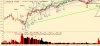
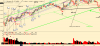
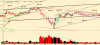
There's a couple of things. First, Jack used the ES to teach this method. The instrument that you are attempting to chart doesn't have the same kind of liquidity that the ES does. Your specific application might not work due to this liquidity issue. It appears as if most of your volume bars are under 1k in transactions. In comparison, on the ES, whenever volume dips below 2.5k, practitioners of this method are sidelined.
I don't have much knowledge on other applicable markets as for my focus is the ES.
Also, RTH is defined for your market. You should be doing MADA just on this segment and not on the extended hours. Although it is a continuous market, the character is different enough between the two to explicitly account for this. Annotate a vertical line for your start and end times.
In your first chart, fbo's on always on the RTL. They come after a pt3 has been established. The first black fbo is not an fbo. It cannot be, it's on the LTL of the short channel and a pt1 of the beginning black channel long. This pt1 is an ve and ftt of bar9. This is an early ID of an ftt, bar10 could also be considered the ftt if it was missed on the prior bar.
Match your channel colors to the OOE colors. The dark blue channel's pt2 is not an blue ftt. The blue ftt would come after a blue pt3.
If appears that you are fanning from pt3's of a channel. Spydertrader does this. Jack fans from pt1. Both can work, but I've found that Jack's way worked better for me. Once understanding the principals, one can apply how they see fit, which is what Spydertrader imho did.
The accelerated tapes look ok. When there is an accelerated tape, that is the Dominant Traverse. Acceleration always denotes Dominance.
With your row of volume annotations, add another row atop that uses this first base layer as the input to determine incr/decr volume. You'll use this upper row to screen for the larger peaks and troughs that occur by looking at bar clusters. Then add another row atop that.
The idea is that tracking bar-by-bar with give you the gaussians for the tapes. The next level up you are tracking the traverses and the next level up you are tracking channels. So at the end of the effort as one goes up in rows, the frequency of incr/decr annotations also decrease. A b2b2r2b channel is composed of three segments - D,nD,D. Each of those segments also have D,nD,D which are traverses. Each of those segments also have D,nD,D which are your tapes.
The logic needs to be a done with soft focus in that sometimes trends are interrupted and the pattern of D,nd,D is cut short with Dominance coming from the opposite sentiment - other times, the pattern is accelerated within a bar or a couple of bars. So if one is always looking with a rigid mindset, it's gonna be frustrating.
Lastly, whatever concept you are working on, keep a log of the questions and answers (with references). Sometimes to work through some of the logic one has to put a concept on a back burner. For example, in the TL thread, Spydertrader says that all sequences must complete. My basic assumption when I heard this was to apply it to a different context than the one that is was specifically expressed for. It tripped me up for months.
HTH