
is trading oil just trading the dollar

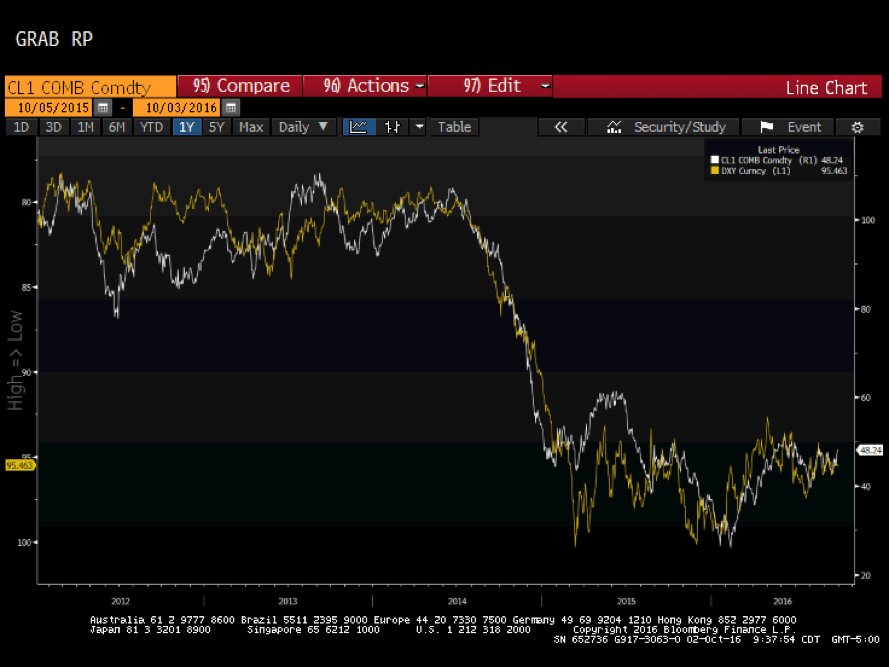
A guy on twitter called Raoul Pal posted this chart to show that oil trades exclusively on the dollar:
Ctxs4aYWIAAOdCt.jpg:large


The implication is that if dollar goes up, oil goes back to $20s. That seems really unlikely based on supply and demand for oil, but what if he's right? Oil is priced in dollars, so if dollar goes up 30% and oil goes down 30%, the net effect to an oil exporter like Nigeria is zero, and hence there's no reason to stop pumping, even if oil is at $30. And the market for the dollar is vastly larger than the market for oil. About $1.6T of oil is produced and sold annually, not a huge amount compared with the massive amounts traded daily in foreign exchange. Does anyone have a good case that oil doesn't trade exclusively on the dollar?

All dollar based commodities are influenced by the US dollar, this should be intuitive to the trader. There are a whole host of other reasons why the oil price moves, of course it is not just because of the dolllar. Trading commodities though you absolutely need to be aware of what the dollar is doing by monitoring dxy futures. A lot of pro energy traders play in the spreads as you are hedging out the effect of the dollar. So if you watching the Jan Mar calendar the prices of each leg are equally influenced by the dollar. You also have unique order flows going through spreads, real paper business getting done which is interesting to trade. GL.
 
First off your chart is wrong based on dollar, surprised no one noticed?
I feel Dollar may have topped and headed down and Currencies have either bottomed or will bottom soon. But regarding Dollar and Oil, they are opposite of each other. Crude Oil making Head & Shoulders pattern on the monthly.

U.S. Dollar
upload_2016-10-5_6-32-26.png


Crude Oil

upload_2016-10-5_6-34-26.png
 
All dollar based commodities are influenced by the US dollar, this should be intuitive to the trader. There are a whole host of other reasons why the oil price moves, of course it is not just because of the dolllar. Trading commodities though you absolutely need to be aware of what the dollar is doing by monitoring dxy futures. A lot of pro energy traders play in the spreads as you are hedging out the effect of the dollar. So if you watching the Jan Mar calendar the prices of each leg are equally influenced by the dollar. You also have unique order flows going through spreads, real paper business getting done which is interesting to trade. GL.

you're not saying anything but "of course not" which is not actually responsive. DOn't barf up a big word salad and then pretend you've answered the question.
 
Does this mean that Canadian oil has a kind of structural advantage vs the US? Canadian oil producers benefit from having essentially a petro currency - as the loonie declines and dollar strengthens, they benefit from selling in dollars while local costs are in loonies. So a Canadian producer in Alberta is much less exposed to the price of oil than a producer across the border in North Dakota. It also means that US producers are the most exposed to oil prices of any producers because US producers are not sheltered in any way from the decline in oil prices.

Tell me what you want to know and I will answer.
 
I did a similar study back in august which showed the correlation going back 5 years. Still pretty strong. I believe FX rates have a big impact on markets. Just look at the weakness of the GBP and it's impact on the FTSE 100 and UK wheat exports which have both risen against consensus. There is a definite effect...I will leave you to think on why though.

View attachment 167011
The thing is, that's not very correlated. If you take out the July-2016 > Dec-2016 period, it doesn't strike as very correlated. IMHO
 
All dollar based commodities are influenced by the US dollar, this should be intuitive to the trader. There are a whole host of other reasons why the oil price moves, of course it is not just because of the dolllar. Trading commodities though you absolutely need to be aware of what the dollar is doing by monitoring dxy futures. A lot of pro energy traders play in the spreads as you are hedging out the effect of the dollar. So if you watching the Jan Mar calendar the prices of each leg are equally influenced by the dollar. You also have unique order flows going through spreads, real paper business getting done which is interesting to trade. GL.

For the 25 years I been trading same Commodity system, I have never checked what the dollar does, I do trade the dollar but has zero influence on how to trade U.S. Commodities. If all comes down to your back testing, if you have found a relationship of dollar and fifty plus markets, use it, but to just fling out there it "absolutely need to be aware" is false. Energy traders I know aren't checking the dollar, more like consumption, weather and seasonal. Like spreading for hurricane season CLZ16-CLZ17 bullish divergence recently and hurricane Matthew for a kick in reduction of deliveries.
 
The thing is, that's not very correlated. If you take out the July-2016 > Dec-2016 period, it doesn't strike as very correlated. IMHO

Isn't that like saying that if you took out the time period between the beginning of 2009 when CL was about ~$47 per barrel, and now when it is ~$49 per barrel in end of 2016, that CL didn't move at all in price? *shrugs*
 
Any commodity that is priced globally will be influenced by currency rates. The currency correlation will be stronger when the volatility of the currency is higher than the volatility of the other price factors (supply/demand/cost of carry) of the commodity.

Since all the factors making up the price of oil have varying volatilities and are bouncing around over time, you actually get a nice cointegration of the dollar with oil.
 
Back
Top