In fact, it is Bush and Cheney that are the founders of ISIS

Fact Check: Did Obama Withdraw From Iraq Too Soon, Allowing ISIS To Grow? 6:30

POLITICS[/paste:font]
Fact Check: Did Obama Withdraw From Iraq Too Soon, Allowing ISIS To Grow?
6:30


  • ALICE FORDHAM

    TwitterInstagram
    ap_817556148506_custom-fe49538445ad4841967fc67405c8298c5910a860-s800-c85.jpg

    In 2014 photo, demonstrators chant pro-ISIS slogans in front of the provincial government headquarters in Mosul, Iraq.

    AP
    Like everyone else, the Republican candidates talk about ISIS a lot. And what they — at least Ben Carson, Carly Fiorina and former Florida Gov. Jeb Bush — charge is that ISIS is President Obama's fault, because he withdrew troops from Iraq in 2011 — when he should have kept them there to keep a lid on the insurgency.

    Let's Break It Down:

    The Claim:

    "Barack Obama became president, and he abandoned Iraq. He left, and when he left al Qaida was done for. ISIS was created because of the void that we left, and that void now exists as a caliphate the size of Indiana." — former Florida Gov. Jeb Bush

    The Big Question:

    OK, maybe it's actually two questions:
    1. Is Obama responsible for the timing of the troop withdrawal from Iraq?
    2. Did that withdrawal cause the rise of ISIS?
    And there are answers for both, though not simple ones.

    The Long Answer:

    First, we have to decide on a starting point.

    Many Democrats, and even a few Republicans, say we should look back to the 2003 U.S.-led invasion of Iraq. That, and the dismantling of the entire security force, created an angry, mainly Sunni demographic, which fueled the insurgency that would later become ISIS.

    Others go back further, pointing out the strong links between Saddam Hussein's brutal Baathist regime, and the structure, methods and, indeed, commanders of ISIS.

    But if we take the invasion as a given, and Saddam Hussein as history, we can begin the answer to the first question —

    Was Obama responsible for the timing of the withdrawal?

    It was President George W. Bush who signed the Status of Forces agreement in 2008, which planned for all American troops to be out of Iraq by the end of 2011.

    "The agreement lays out a framework for the withdrawal of American forces in Iraq — a withdrawal that is possible because of the success of the surge," he said in a joint press conference with Iraqi Prime Minister Nouri al Maliki at the time.

    Moments later, an Iraqi journalist threw his shoes at the president. It is important to remember most Iraqis saw the Americans as occupiers and blame them for civilian deaths.

    YouTube
    Maliki summed up the sentiment at the time, thus:

    "The incomplete sovereignty and the presence of foreign troops are the most dangerous, most complicated and most burdensome legacy we have faced since the time of dictatorship. Iraq should get rid of them to protect its young democratic experiment."

    Thousands of American troops had died, and by the time Obama announced the withdrawal, fully three-quarters of Americans supported the withdrawal (though a majority of Republicans did not).

    Still, many had real concerns al Qaeda wasn't done for. And there were some, including U.S. senators, saying the troops should stay just in case things went downhill. They say Obama should have sold the idea, hard, to Maliki.

    Iraq analyst Kirk Sowell said Obama never really tried.

    "This is one of the criticisms of Obama — that he sort of wanted the negotiations to fail," Sowell said, "and, so, he didn't even talk to Maliki until it was basically all over."

    The State Department's lawyers said troops couldn't stay in Iraq unless the Iraqi parliament authorized them to do so, including granting them immunity from Iraqi law. The Iraqi parliamentarians would never OK such a decision, with Iraqi popular opinion staunchly against U.S. troops staying.

    Sowell saw State's decision as a deliberately insurmountable obstacle.

    "It was a barrier that was very high," he said, "and there was no way it was going to be jumped over."

    But, does Obama bear responsibility for the timing of the troop withdrawal? On balance, no.

    He was following through on an agreement made by Bush and abiding by the will of the Iraqi and American people.

    Alright so, onto the next question —

    Did the withdrawal of troops lead to the rise of ISIS?

    Back then, in 2011, there was no ISIS. The group didn't exist under that name yet. There was just their predecessor, al Qaeda in Iraq, which had been at the forefront of the terrible insurgency in Iraq. But many thought it was licked.

    "All of the intelligence that we had gathered, all of the results of the surge, all of the detainees we had in our detention system, all of the information we had coming to us from people on the ground, from the tribes indicated that al Qaeda in Iraq was defeated," said Ret. Col. Peter Mansoor, who served in Iraq.

    That surge was the influx of American soldiers, and the way the U.S. military organized Sunni tribes to fight against insurgents. The Americans paid them, helped arm them and gave them air cover.

    One of those tribal leaders, Sheikh Hamid Taees, told me: "In May of 2006, I worked closely with the American side to rid Anbar of terrorism and al Qaeda, and actually we killed a large number of al Qaeda fighters."

    But by the time of that comment, early in 2014, al Qaeda was beginning to get a grip on Sunni areas again, including that province of Anbar.

    Many Sunni sheikhs say once the American soldiers left, the minority Sunni population of Iraq suffered under a government dominated by the Shiite majority. That government stopped paying most of them, and even arrested many.

    (As an aside, we should note that there was a political, as well as a military, dimension to American influence in Iraq: Obama continued to support the government even as Sunni fear and anger grew. "We were encouraged," he said in 2013, "by the work that Prime Minister Maliki has done in the past to ensure that all people inside of Iraq — Sunni, Shia and Kurd — feel that they have a voice in their government."

    (But they did not feel that. Sheikh Zeidan al-Jabri led a series of Sunni protests and sit-ins in Anbar, which were eventually violently dispersed by security forces at the end of 2013.

    ("For a year, we did not attack anyone; we were an example of democracy on an international level," he told me from exile in Jordan. "And what did the world do? The world simply turned its face from us and gave Maliki the permission to attack the demonstrations and kill hundreds of innocent demonstrators.")

    So some Sunnis were drawn back to the insurgency. ISIS found supporters and gained ground. And, yes, much of that could have been prevented by a big U.S. troop presence.

    The other thing that happened after the American military left was that the Iraqi army deteriorated dramatically.

    "They really did become relatively complacent, and then flat out just didn't train," said Major-General Paul E. Funk II, speaking after abruptly returning to Iraq on a training mission 2014. "Just didn't spend the money to do it, didn't maintain the systems and therein lies the problem."

    And corruption was running rampant. Supplies were stolen; soldiers were paid, who never reported for duty. And, so, when ISIS came rushing into the city of Mosul last year, the military collapsed.

    I met one of the defeated Iraqi troops, named Bahr Ibrahim, shortly afterward, sitting dejectedly next to an injured friend in a hospital not far from Mosul.

    "We fought," he said. But ISIS had more men and bigger weapons.

    So, yes, the withdrawal of U.S. troops helped ISIS. If they'd stayed, they could have bolstered Iraq's security forces and tamped down Sunni anger.

    But the Republicans' claim that ISIS grew because Obama withdrew troops from Iraq still glosses over many other factors beyond America's control — like the fact that the rift between Sunnis and Shiites in Iraq has been going on for centuries. And that wasn't going to be permanently solved by American troops.

    Another crucial thing is Syria. For reasons completely beyond Obama's control, after 2011, Syria sank into civil war. Suddenly, just over Iraq's borders were vast ungoverned spaces and lots of weapons. It became a safe haven for ISIS to grow in.

    The Republican candidates have the benefit of hindsight now, but they couldn't have predicted all the things that contributed to the growth of ISIS back then. And neither could Obama.

    The Short Answer:

    1. No, Obama shouldn't shoulder the full burden for the timing of the withdrawal of troops;

    2. Yes, a significant American troop presence would have helped slow the growth of ISIS

    But with the significant caveat that there were many other factors that enabled ISIS to become strong — and they weren't all predictable in 2011.

    This story is part of NPR's fact-checking series, "Break It Down," in which we try to cut through the spin and put things in context. Have something you want us to fact check? Put it in the comments section or send us an email at nprpolitics@npr.org.
http://www.npr.org/2015/12/19/45985...draw-from-iraq-too-soon-allowing-isis-to-grow
 
Fact Check: Did Obama Withdraw From Iraq Too Soon, Allowing ISIS To Grow? 6:30

POLITICS[/paste:font]
Fact Check: Did Obama Withdraw From Iraq Too Soon, Allowing ISIS To Grow?
6:30


  • ALICE FORDHAM

    TwitterInstagram
    ap_817556148506_custom-fe49538445ad4841967fc67405c8298c5910a860-s800-c85.jpg

    In 2014 photo, demonstrators chant pro-ISIS slogans in front of the provincial government headquarters in Mosul, Iraq.

    AP
    Like everyone else, the Republican candidates talk about ISIS a lot. And what they — at least Ben Carson, Carly Fiorina and former Florida Gov. Jeb Bush — charge is that ISIS is President Obama's fault, because he withdrew troops from Iraq in 2011 — when he should have kept them there to keep a lid on the insurgency.

    Let's Break It Down:

    The Claim:

    "Barack Obama became president, and he abandoned Iraq. He left, and when he left al Qaida was done for. ISIS was created because of the void that we left, and that void now exists as a caliphate the size of Indiana." — former Florida Gov. Jeb Bush

    The Big Question:

    OK, maybe it's actually two questions:
    1. Is Obama responsible for the timing of the troop withdrawal from Iraq?
    2. Did that withdrawal cause the rise of ISIS?
    And there are answers for both, though not simple ones.

    The Long Answer:

    First, we have to decide on a starting point.

    Many Democrats, and even a few Republicans, say we should look back to the 2003 U.S.-led invasion of Iraq. That, and the dismantling of the entire security force, created an angry, mainly Sunni demographic, which fueled the insurgency that would later become ISIS.

    Others go back further, pointing out the strong links between Saddam Hussein's brutal Baathist regime, and the structure, methods and, indeed, commanders of ISIS.

    But if we take the invasion as a given, and Saddam Hussein as history, we can begin the answer to the first question —

    Was Obama responsible for the timing of the withdrawal?

    It was President George W. Bush who signed the Status of Forces agreement in 2008, which planned for all American troops to be out of Iraq by the end of 2011.

    "The agreement lays out a framework for the withdrawal of American forces in Iraq — a withdrawal that is possible because of the success of the surge," he said in a joint press conference with Iraqi Prime Minister Nouri al Maliki at the time.

    Moments later, an Iraqi journalist threw his shoes at the president. It is important to remember most Iraqis saw the Americans as occupiers and blame them for civilian deaths.

    YouTube
    Maliki summed up the sentiment at the time, thus:

    "The incomplete sovereignty and the presence of foreign troops are the most dangerous, most complicated and most burdensome legacy we have faced since the time of dictatorship. Iraq should get rid of them to protect its young democratic experiment."

    Thousands of American troops had died, and by the time Obama announced the withdrawal, fully three-quarters of Americans supported the withdrawal (though a majority of Republicans did not).

    Still, many had real concerns al Qaeda wasn't done for. And there were some, including U.S. senators, saying the troops should stay just in case things went downhill. They say Obama should have sold the idea, hard, to Maliki.

    Iraq analyst Kirk Sowell said Obama never really tried.

    "This is one of the criticisms of Obama — that he sort of wanted the negotiations to fail," Sowell said, "and, so, he didn't even talk to Maliki until it was basically all over."

    The State Department's lawyers said troops couldn't stay in Iraq unless the Iraqi parliament authorized them to do so, including granting them immunity from Iraqi law. The Iraqi parliamentarians would never OK such a decision, with Iraqi popular opinion staunchly against U.S. troops staying.

    Sowell saw State's decision as a deliberately insurmountable obstacle.

    "It was a barrier that was very high," he said, "and there was no way it was going to be jumped over."

    But, does Obama bear responsibility for the timing of the troop withdrawal? On balance, no.

    He was following through on an agreement made by Bush and abiding by the will of the Iraqi and American people.

    Alright so, onto the next question —

    Did the withdrawal of troops lead to the rise of ISIS?

    Back then, in 2011, there was no ISIS. The group didn't exist under that name yet. There was just their predecessor, al Qaeda in Iraq, which had been at the forefront of the terrible insurgency in Iraq. But many thought it was licked.

    "All of the intelligence that we had gathered, all of the results of the surge, all of the detainees we had in our detention system, all of the information we had coming to us from people on the ground, from the tribes indicated that al Qaeda in Iraq was defeated," said Ret. Col. Peter Mansoor, who served in Iraq.

    That surge was the influx of American soldiers, and the way the U.S. military organized Sunni tribes to fight against insurgents. The Americans paid them, helped arm them and gave them air cover.

    One of those tribal leaders, Sheikh Hamid Taees, told me: "In May of 2006, I worked closely with the American side to rid Anbar of terrorism and al Qaeda, and actually we killed a large number of al Qaeda fighters."

    But by the time of that comment, early in 2014, al Qaeda was beginning to get a grip on Sunni areas again, including that province of Anbar.

    Many Sunni sheikhs say once the American soldiers left, the minority Sunni population of Iraq suffered under a government dominated by the Shiite majority. That government stopped paying most of them, and even arrested many.

    (As an aside, we should note that there was a political, as well as a military, dimension to American influence in Iraq: Obama continued to support the government even as Sunni fear and anger grew. "We were encouraged," he said in 2013, "by the work that Prime Minister Maliki has done in the past to ensure that all people inside of Iraq — Sunni, Shia and Kurd — feel that they have a voice in their government."

    (But they did not feel that. Sheikh Zeidan al-Jabri led a series of Sunni protests and sit-ins in Anbar, which were eventually violently dispersed by security forces at the end of 2013.

    ("For a year, we did not attack anyone; we were an example of democracy on an international level," he told me from exile in Jordan. "And what did the world do? The world simply turned its face from us and gave Maliki the permission to attack the demonstrations and kill hundreds of innocent demonstrators.")

    So some Sunnis were drawn back to the insurgency. ISIS found supporters and gained ground. And, yes, much of that could have been prevented by a big U.S. troop presence.

    The other thing that happened after the American military left was that the Iraqi army deteriorated dramatically.

    "They really did become relatively complacent, and then flat out just didn't train," said Major-General Paul E. Funk II, speaking after abruptly returning to Iraq on a training mission 2014. "Just didn't spend the money to do it, didn't maintain the systems and therein lies the problem."

    And corruption was running rampant. Supplies were stolen; soldiers were paid, who never reported for duty. And, so, when ISIS came rushing into the city of Mosul last year, the military collapsed.

    I met one of the defeated Iraqi troops, named Bahr Ibrahim, shortly afterward, sitting dejectedly next to an injured friend in a hospital not far from Mosul.

    "We fought," he said. But ISIS had more men and bigger weapons.

    So, yes, the withdrawal of U.S. troops helped ISIS. If they'd stayed, they could have bolstered Iraq's security forces and tamped down Sunni anger.

    But the Republicans' claim that ISIS grew because Obama withdrew troops from Iraq still glosses over many other factors beyond America's control — like the fact that the rift between Sunnis and Shiites in Iraq has been going on for centuries. And that wasn't going to be permanently solved by American troops.

    Another crucial thing is Syria. For reasons completely beyond Obama's control, after 2011, Syria sank into civil war. Suddenly, just over Iraq's borders were vast ungoverned spaces and lots of weapons. It became a safe haven for ISIS to grow in.

    The Republican candidates have the benefit of hindsight now, but they couldn't have predicted all the things that contributed to the growth of ISIS back then. And neither could Obama.

    The Short Answer:

    1. No, Obama shouldn't shoulder the full burden for the timing of the withdrawal of troops;

    2. Yes, a significant American troop presence would have helped slow the growth of ISIS

    But with the significant caveat that there were many other factors that enabled ISIS to become strong — and they weren't all predictable in 2011.

    This story is part of NPR's fact-checking series, "Break It Down," in which we try to cut through the spin and put things in context. Have something you want us to fact check? Put it in the comments section or send us an email at nprpolitics@npr.org.
http://www.npr.org/2015/12/19/45985...draw-from-iraq-too-soon-allowing-isis-to-grow
I cannot believe I just read that article. Pulling the troops out of Iraq was one of the primary campaign promises of Obama in 2008.

 
Last edited:
Hezbollah Accuses Obama of Creating IS, Using Trump’s Words

  • Says suggestion Obama founded jihadist group based on facts
  • Running mate says Trump not joking about failed Obama policy
Share on FacebookShare on Twitter

The leader of Lebanon’s Hezbollah group has accused the U.S. and President Barack Obama of creating Islamic State, using the words of presidential hopeful Donald Trump as proof.

Quoting the Republican candidate, Sayyed Hassan Nasrallah also accused Trump’s Democratic Party competitor Hillary Clinton of helping create the militant group.

“This American candidate, who speaks in the name of the American Republican party, has facts” that can support this claim, Nasrallah said in a speech on Saturday, according to a transcript published by Al Manar TV.


The Hezbollah comments are the latest instance of rogue foreign leaders or groups making comments complimentary or supportive of Trump. In December, Russian President Vladimir Putin termed the Republican “the absolute leader of the presidential race.” An official mouthpiece of North Korea’s government lauded Trump in June as “a wise politician.”

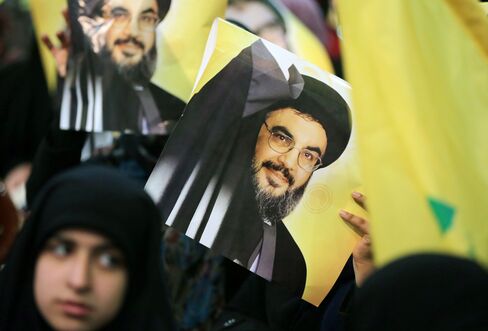
488x-1.jpg

A Shiite supporter holds a poster showing Sayyed Hassan Nasrallah.

Photographer: Joseph Eid/AFP via Getty Images

Trump called Obama and Clinton, who served as secretary of state from 2009 to 2013, “co-founders” of Islamic State during a campaign rally on Aug. 10. He has since downplayed the comments as having been meant as sarcasm, echoing his response to the outcry over earlier comments in which he exhorted Russia to hack Clinton’s e-mails. A White House spokesman declined to comment on the most recent remarks.

Republican vice presidential candidate Mike Pence, in an interview taped on Aug. 12 and broadcast Sunday on Fox News, said Trump hadn’t been joking.

‘Failed Policies’

...

http://www.bloomberg.com/politics/a...-trump-right-to-say-u-s-created-islamic-state
 
Whereas Trump said on TV in 2007 that the US should have withdrawn out of Iraq completely and immediately, then and there, in 2007.
He said the same in 2011. Had Drumpf been president (and holding all other things constant, LOL), ISIS would have grown just the same.
 
the truth is killing the left. Hillary's makes the wrong choices with the wrong policies all the time.


wait til I post this next...

Hillary;s emails confirm Soros gives her marching orders.
Our work here is done.
 
President Obama pummels ISIS and frees 2000 hostages; Donald Trump goes completely silent

President Obama’s international coalition has taken the city of Manbij from ISIS in Syria, pummeling the terrorist group and taking away yet another one of its bases and forcibly freeing more than two thousands hostages in the process. This comes just days after the Obama coalition killed the leader of ISIS in Afghanistan, knocking the group further back on its heels. This must all come as a surprise to Donald Trump, who spent the week claiming that Obama was the “Founder of ISIS.” It may explain why Trump has now gone completely silent.

Just one day after Donald Trump’s rally was supervised by RNC Chair Reince Priebus in a rather transparent effort at keeping the erratic Republican nominee from doing any further damage to himself and the party, it now appears that Trump has gone off the social media grid altogether. His Twitter account hasn’t been active in seventeen hours, and if you rule out the generic promotional tweets which were obviously made by his staff, Trump himself hasn’t touched Twitter in more than a day and a half. It may be that the ISIS controversy has indeed pushed him over the edge into stunned silence.

When Trump absurdly claimed that President Obama was the founder of ISIS and that Hillary Clinton was the co-founder of ISIS, it prompted the major media outlets to push back definitely with the truth, seemingly no longer willing to hold back and play its usual false-equivalence games. But now that Trump’s bizarre lie about Obama and ISIS has been immediately followed by news of one major victory for the Obama coalition over ISIS after another, it’s made him look more foolish than ever
 
You have to go back a whole lot further than Dubya to find the roots of modern day terrorism. Could be a couple centuries of you really want to find the root of the root, but for modern day teorrism I'd say in really grew some horns at the end of the Reagan administration. Some would say it was Carter, but that was different. Under the Reagan administration a big hole was left when we successfully financed the Afgans in their war against the Soviets. "And then we fucked up the end game." Charlie Wilson.
We're great a breaking shit over in that hell hole part of the world.
 
Back
Top